
Published 13 January 2026 | Updated 13 January 2026
Technology
How Automation Accelerates SME Growth: Business Automation Guide for Small and Mid-Sized Businesses
Small and mid-sized enterprises (SMEs) are the backbone of economies around the world — from India and the USA to Germany, Australia, Singapore, Canada, Dubai, and Qatar. These businesses generate jobs, encourage innovation, and promote inclusive growth. But in today’s fast-changing market, they face intense competition and operational challenges. That’s where business automation comes in — helping SMEs drive efficiency, reduce costs, increase productivity, and scale rapidly without proportional increases in overhead.
“Automation doesn’t replace people—it empowers SMEs to work smarter, grow faster, and compete globally.”
This guide from PerfectionGeeks Technologies explores how automation accelerates SME growth, practical strategies for implementation, high-impact use cases, tools, and a projected SME growth outlook through 2030.
What Is Business Automation for SMEs?
Business automation refers to using technology to automatically perform repetitive tasks or workflows that were previously done manually. Instead of spending hours on tasks such as data entry, invoicing, lead follow-ups, and reporting, automation enables these processes to run independently using software, AI tools, and intelligent workflows. Automating these tasks empowers SMEs to focus on strategy, innovation, and customer engagement — the things that truly grow a business.
In today’s digital era, automation is no longer optional — it’s a necessity for SMEs that want to stay competitive and grow sustainably.
Why Automation Matters for SME Growth
1. Efficiency and Productivity Boost
In many SMEs, a significant portion of staff time is wasted on manual, repetitive tasks. Automation slashes this time dramatically. For example, tools that automate invoicing, customer follow-ups, and data analysis can increase productivity by up to 30%, reduce errors by 25%, and free employees to work on strategy and innovation.
Instead of spending hours inputting data into spreadsheets, employees can focus on creative problem-solving, improving customer experiences, and expanding market reach.
2. Cost Reduction and Better Resource Allocation
Manual processes are costly — not just in wages, but in mistakes, delays, and lost opportunities. Automation cuts operational costs by minimizing redundant tasks and reducing human error. Research suggests that SMEs using automation can see cost reductions of 25-40% across finance, HR, and operations.
These savings can be reinvested in growth areas like marketing, product development, and customer retention.
3. Enhanced Customer Experience
Customers today expect fast, accurate, and consistent communication. Automation tools such as AI chatbots, automated email responders, and CRM systems ensure that inquiries are answered immediately, orders are processed quickly, and updates are communicated on time — 24/7.
Better customer experience typically leads to higher retention rates, more referrals, and a stronger brand reputation.
4. Scalability and Competitive Edge
One of the most compelling benefits of automation is scalability. Automated processes operate consistently even when business volume increases — unlike manual systems, which require more staff and introduce more complexity as you grow.
Automation enables SMEs to respond quickly to market trends, launch new products faster, and enter new markets — whether that’s expanding from India to Singapore or from Canada to the Gulf region.
5. Better Data-Driven Decisions
Automation systems collect and analyze business data in real time. Dashboards and reporting tools provide critical insights into sales performance, customer behavior, and financial metrics. With these insights, SME leaders can make informed decisions quicker and more confidently.
Real-time analytics becomes an asset for strategic planning, risk management, and long-term growth.
Business Automation Trends for SMEs in 2026
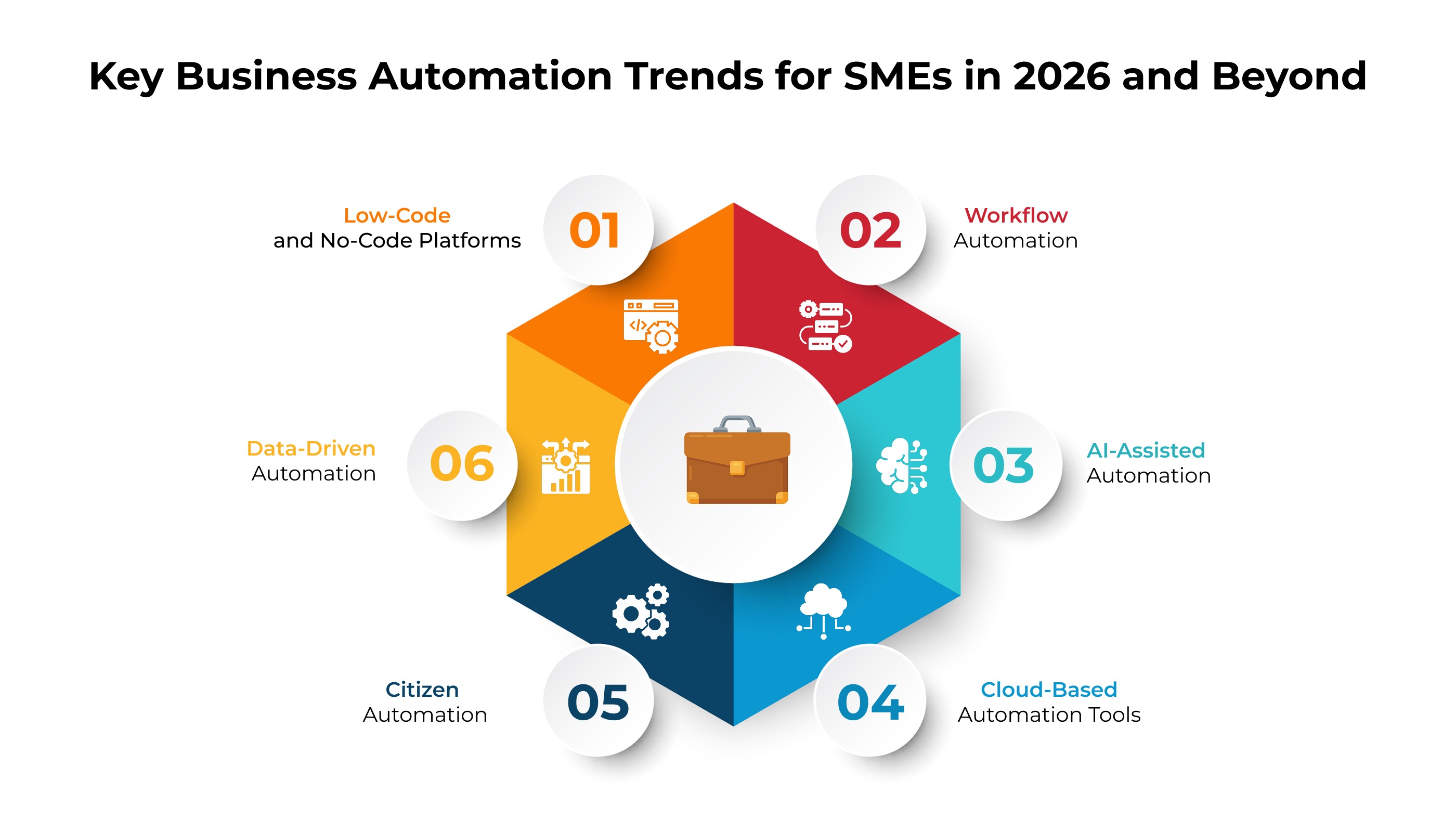
Here are major automation trends shaping how SMEs operate and grow:
1. Low-Code and No-Code Platforms
Low-code and no-code automation platforms allow business users to create workflows without needing deep technical skills. This democratizes automation and accelerates digital transformation — particularly for SMEs with limited IT resources.
2. Workflow Automation
Rather than automating individual tasks, SMEs are now automating entire workflows — from lead capture to invoice generation. Workflow automation ensures seamless handoffs and consistent execution.
3. AI-Assisted Automation
AI is the next big leap in automation. It powers intelligent decision-making, predictive insights, and natural language processing — enabling SMEs to automate complex tasks like customer segmentation, content generation, and real-time forecasting.
4. Cloud-Based Automation Tools
Cloud automation tools are affordable, flexible, and scalable. They allow SMEs to launch automation with minimal upfront investment and scale as the business grows.
5. Citizen Automation
Citizen automation enables non-technical employees to build and manage automated workflows with proper guardrails — reducing dependency on IT and speeding up rollout.
Core Areas Where SMEs Should Automate First
The following areas offer high impact and quick returns when SMEs implement automation:
| Business Function | Examples of Automation |
|---|---|
| Finance & Billing | Automated invoicing, payment reminders, reconciliation |
| Sales & CRM | Lead scoring, follow-up reminders, CRM updates |
| Marketing | Email campaigns, social automation, analytics |
| Customer Support | AI chatbots, automated ticket routing |
| HR & Payroll | Onboarding workflows, payroll processing |
| Inventory & Procurement | Stock alerts, automatic reorders |
| Reporting & BI | Scheduled dashboards, KPI tracking |
| Compliance & Documentation | Automated routing, retention policies |
This table outlines areas where automation generates meaningful efficiency and cost savings.
SME Growth Projections Through 2030 (With Automation)
Here’s a projected growth outlook for SMEs in key global markets — thanks to automation adoption, digital transformation, and strong policy environments supportive of tech innovation:
| Region / Country | SME Growth Outlook by 2030 | Key Automation Drivers |
|---|---|---|
| India | +35% SME growth | Digital adoption, CRM automation |
| USA | +28% SME expansion | AI workflows, cloud automation |
| Singapore | +30% innovation growth | Government tech support, automation tools |
| Canada | +25% SME growth | Data analytics & workflow automation |
| Germany | +22% manufacturing SME growth | RPA, ERP automation |
| Australia | +27% service SME growth | Cloud & AI adoption |
| Dubai (UAE) | +32% SME expansion | Business-friendly policies, automation platforms |
| Qatar | +29% SME diversification | Digital trade services and automation |
Note: These figures are illustrative projections highlighting the positive impact of automation on SME expansion and competitiveness globally.
Case Study: SME Growth Through Automation
The following table shows real results from SMEs that implemented automation solutions — illustrating efficiency gains, revenue growth, and operational improvements:
| SME Type | Automation Used | Impact After 12 Months |
|---|---|---|
| Retail Store | Inventory & POS Automation | 40% faster fulfillment, 30% fewer stock errors |
| Manufacturing Firm | RPA Production Scheduling | 20% production increase, 25% labor cost reduction |
| Financial Services | Client Onboarding Automation | 50% faster onboarding, higher retention |
| Digital Agency | Marketing Automation | 35% more leads, 60% reduction in manual effort |
| Tech Startup | AI-Driven Sales Automation | 4X increase in revenue growth (smaller firms) |
These case outcomes demonstrate how automation becomes a growth multiplier for SMEs, enhancing productivity and contributing to revenue expansion.
Best Practices for Implementing Automation in SMEs
Implementing automation successfully requires strategy and patience. Here are some best practices:
1. Start Small and Prioritize
Begin with processes that are repetitive, high volume, and time-consuming — such as invoicing, CRM updates, email marketing, or customer service queries. These quick wins demonstrate value and build confidence.
2. Choose Tools That Fit Your Business
There’s no one-size-fits-all tool. Evaluate tools based on your industry, team size, and operational needs — whether it’s cloud apps, AI automation platforms, low-code options, or CRM automation suites.
3. Train Your Teams
Automation changes how work gets done. Invest in training your employees to use tools effectively, interpret dashboards, and manage exceptions.
4. Monitor & Optimize
Automation isn’t “set and forget.” Review performance data, update workflows, and introduce incremental improvements regularly.
5. Maintain a Balance
While automation reduces manual work, human oversight remains essential — especially for customer relationships, critical decision-making, and creative problem-solving.
Future Outlook: SME Automation in 2030 and Beyond
By 2030, automation will be deeply integrated into SME operations globally. Technologies like AI, machine learning, robotic process automation (RPA), and advanced analytics will enhance not just efficiency, but also innovation, customer personalization, and strategic growth.
Leading SMEs in India, USA, Singapore, Germany, Canada, Australia, Dubai, and Qatar will continue to adopt automation as a core capability — not just a tool — driving productivity, competitiveness, and global expansion.
Frequently Asked Questions
Quick answers related to this article from PerfectionGeeks.
1. How can automation help my small or mid-sized business grow faster?
2. Is business automation expensive for SMEs?
3. Which business processes should I automate first?
4. Can automation work for SMEs across different countries?
5. Do I need technical knowledge to use automation tools?
6. How long does it take to see results after automation implementation?
7. How do I get started with business automation for my SME?
Conclusion
Automation is more than a technology — it’s a growth engine for small and mid-sized businesses. From reducing operational costs and boosting productivity to enhancing customer experience and enabling strategic decision-making, automation empowers SMEs to compete with larger enterprises and SCALE with confidence.
At PerfectionGeeks Technologies, we help SMEs implement tailored automation solutions that align with their business goals — ensuring a smooth digital transformation journey and measurable ROI.
Whether your business is in India, USA, Singapore, Canada, Germany, Australia, Dubai, or Qatar — automation isn’t just the future. It’s the competitive advantage your business needs today.

Shrey Bhardwaj is the Director & Founder of PerfectionGeeks Technologies, bringing extensive experience in software development and digital innovation. His expertise spans mobile app development, custom software solutions, UI/UX design, and emerging technologies such as Artificial Intelligence and Blockchain. Known for delivering scalable, secure, and high-performance digital products, Shrey helps startups and enterprises achieve sustainable growth. His strategic leadership and client-centric approach empower businesses to streamline operations, enhance user experience, and maximize long-term ROI through technology-driven solutions.