
Published 22 January 2026 | Updated 18 May 2026
Technology
How Enterprise Mobile App Development Drives Business Growth in New York
In New York’s competitive business environment, enterprise mobile app development is a game-changer. These apps serve as strategic assets that streamline operations, increase productivity, and enhance customer experiences across industries. For business leaders seeking growth, understanding how enterprise mobile apps work and their benefits in New York is essential. This blog explores what enterprise mobile apps are, why they matter locally, and how they can accelerate your business success in today’s fast-paced market.
1 app development company
2. web development
What Is Enterprise Mobile App Development?
Enterprise mobile app development is the process of developing mobile applications that are specifically meant to be used by big businesses to manage their complicated processes, make their internal workflows more efficient, and do better in customer engagement. Enterprise mobile software is different from consumer apps, which are mainly for general use, in that it addresses the specific business needs of data management, communication, inventory control, and sales enablement.
These mobile enterprise apps are usually customized to integrate seamlessly with existing enterprise systems like CRM, ERP, and HR platforms. They provide real-time access to critical data, allowing employees, managers, and partners to work efficiently on the go.
In short, the development of enterprise mobile applications is the creation of mobile solutions that are large, secure, and durable enough to match the company's goals and operations.
Why New York Businesses Are Investing in Enterprise Mobile Apps
New York is one of the most vibrant commercial hubs in the world. With its diverse industries ranging from finance and healthcare to retail and technology, companies here face unique challenges fast-paced markets, demanding clients, and complex regulatory environments.
Here’s why businesses in New York are increasingly turning to enterprise mobile app development companies to develop custom mobile apps:
- Competitive Edge: In a city where every second counts, having mobile tools that accelerate decision-making and customer service gives a clear advantage.
- Remote and Hybrid Work: Post-pandemic, many companies have adopted hybrid work models. Mobile apps ensure employees stay connected and productive, regardless of location.
- Customer Expectations: New Yorkers expect quick, efficient, and personalized services. Enterprise apps help businesses meet these expectations by offering seamless user experiences.
- Data-Driven Decisions: Mobile enterprise applications enable real-time data collection and analytics, empowering businesses to make smarter decisions swiftly.
How Enterprise Mobile Apps Improve Operational Efficiency
One of the primary advantages of enterprise app development services is operational efficiency boost. Having appropriate mobile tools available to the employees means that they can do their work faster and with fewer mistakes.
Here’s the way:
Automated Workflows: Enterprise apps streamline tedious tasks like inventory counting, order processing, and reporting by automating them, thus lessening the manual input.
Instant Communication: Mobile applications allow fast communication between teams, suppliers, and customers, thus fluidizing communication.
Total Access: Workers in the field are able to access important information and also to feed data from their mobile devices with no need to go back to the office.
Linked Up Systems: Enterprise mobile apps that sync with ERP or CRM systems create a scenario where data duplication and inconsistencies are non-existing.
Together all of these upgrades contribute to smoother operations and hence lower costs.
Role of Enterprise Mobile Apps in Business Scalability
Growth is a key focus for any New York business, but scaling operations efficiently is challenging. Enterprise mobile app development platforms offer flexible solutions that grow with your business.
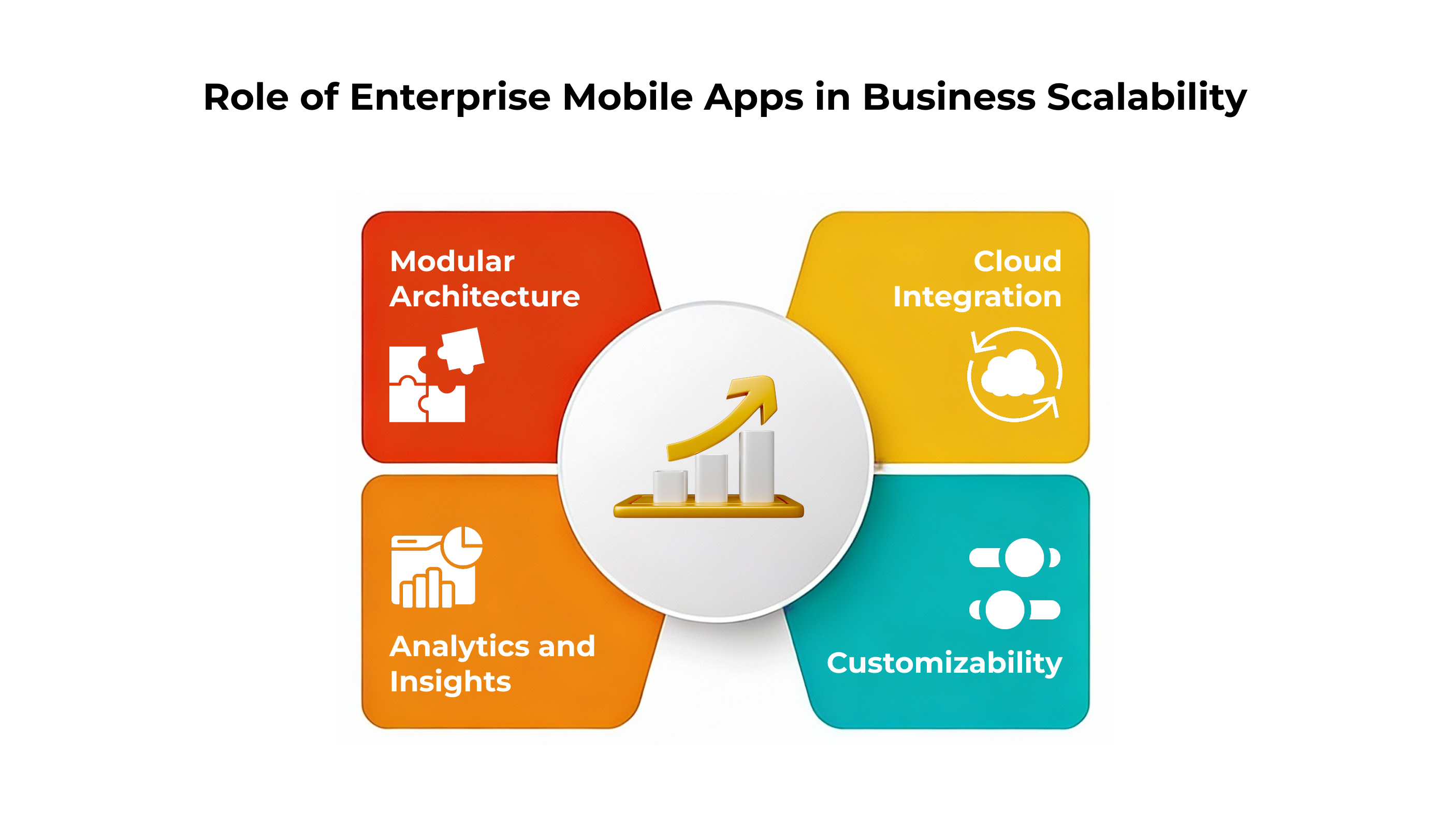
- Modular Architecture: Enterprise apps can be built with modules that add new features as needed without disrupting existing workflows.
- Cloud Integration: Apps connected to cloud infrastructure can handle increasing users and data effortlessly.
- Customizability: As market demands evolve, enterprise mobile applications can be tailored to support new products, services, or geographic expansion.
- Analytics and Insights: Scalability requires data-driven strategy, and enterprise apps provide in-depth analytics to guide decision-making.
With the right enterprise app development company by your side, scaling becomes more manageable and less risky.
How Enterprise Mobile App Development Enhances Customer Experience
Customer experience is at the heart of business growth. New York customers, accustomed to fast-paced lifestyles, appreciate businesses that offer convenience and responsiveness.
Enterprise mobile apps contribute significantly to customer satisfaction by:
Personalized Engagement: Apps can deliver personalized offers, updates, and communication based on customer data.
Self-Service Features: Customers can access account information, make orders, track deliveries, or resolve issues without needing support calls.
Multichannel Support: Integration with chat, social media, and email ensures customers receive help wherever they prefer.
Faster Response Time: Mobile apps empower sales and support teams to respond instantly, improving loyalty and retention.
When customers feel valued and supported, your business builds trust and long-term relationships.
Impact of Enterprise Mobile Apps on Employee Productivity
Employees are the backbone of any business. Empowering them with efficient mobile tools improves motivation, engagement, and output.
Here’s how enterprise mobile apps boost employee productivity:
Simplified Access to Information: Employees can retrieve work instructions, schedules, and customer data in seconds.
Task Management: Mobile apps provide clear task lists, reminders, and progress tracking.
Collaboration Tools: Real-time chat, video calls, and document sharing foster teamwork.
Performance Analytics: Managers can monitor productivity and identify areas for improvement.
The result is a workforce that works smarter, not harder.
Security, Compliance, and Data Protection for Enterprise Mobile Apps
Security is paramount in enterprise mobile app development. New York businesses, especially in finance, healthcare, and legal sectors, must comply with strict regulations like HIPAA, GDPR, and CCPA.
An experienced enterprise mobile app development company ensures:
Data Encryption
Data encryption protects sensitive information by converting it into a secure format that can only be read by authorized parties. Encryption is applied both when data is being transmitted over networks and when it is stored on devices or servers, preventing unauthorized access or interception.
User Authentication
Robust user authentication mechanisms like multi-factor authentication (MFA) and biometric verification (fingerprints, facial recognition) add extra layers of security. These methods ensure that only verified users can access the app, reducing the risk of unauthorized entry.
Access Controls
Role-based access controls restrict users’ permissions based on their roles within the organization. This means employees can only access the data and features necessary for their job, minimizing the risk of internal data leaks or misuse.
Regular Audits
Conducting regular security audits involves continuous monitoring of the app for vulnerabilities, testing for weaknesses, and promptly addressing any security flaws. This proactive approach helps maintain a strong security posture over time.
Compliance with Legal Standards
Enterprise apps must comply with industry regulations such as HIPAA for healthcare, GDPR for data privacy in Europe, and CCPA for California residents. Compliance ensures that the app meets legal requirements, avoiding fines and protecting the company’s reputation.
Prioritizing security protects your business from breaches, legal issues, and loss of customer trust.
Common Challenges in Enterprise Mobile App Development and How to Overcome Them
Developing enterprise apps is complex, and companies often face challenges such as:
| Challenge | Solution |
| Integrating with legacy systems | Use APIs and middleware to ensure smooth integration without disrupting current operations |
| Ensuring cross-platform compatibility | Employ hybrid or cross-platform development frameworks to support iOS, Android, and web |
| Managing app scalability | Adopt cloud-based infrastructure that scales dynamically with user demand |
| Balancing user experience with security | Implement intuitive UI with robust security protocols |
| Keeping up with changing business requirements | Use agile development methodologies to adapt quickly |
Partnering with a skilled enterprise app development company in New York can help navigate these challenges smoothly.
Case Study: How a New York Retail Giant Boosted Efficiency with Enterprise Mobile App Development
Let’s look at a real example to understand the impact.
Company: A leading retail chain in New York with over 100 stores.
Challenge: Managing inventory and communication between stores and warehouses was slow and error-prone, leading to stockouts and lost sales.
Solution: They partnered with an enterprise mobile app development company to build a custom mobile app that allowed store managers to scan inventory, place orders, and communicate with warehouses in real time.
Result:
- Inventory management errors reduced by 40%
- Order processing time cut in half
- Store managers reported a 30% increase in productivity
- Customer satisfaction improved due to better product availability
This case highlights how enterprise mobile app development platforms can deliver measurable business growth.
The Enterprise Mobile App Development Process: Step by Step
Understanding the development process helps set realistic expectations and ensures project success. Here’s a simple breakdown of the enterprise mobile app development process followed by top enterprise mobile app development companies:
1. Requirement Analysis
This initial phase involves gathering comprehensive information about the business’s unique needs and challenges. It includes identifying the target users, understanding their pain points, and clearly defining the app’s primary objectives. A detailed analysis ensures that the development team aligns the app’s features with the strategic goals of the enterprise.
2. Planning and Strategy
During planning, the project scope is finalized by deciding which features will be included and determining the platforms (iOS, Android, or both) the app will support. Choosing the right technology stack is crucial for scalability and security. A realistic timeline and budget are also established to guide the entire development process smoothly.
3. Design
The design phase focuses on creating wireframes and prototypes that outline the app’s structure and flow. UI/UX designers work to ensure the interface is intuitive, user-friendly, and consistent with the enterprise’s brand identity. The goal is to provide a seamless experience that encourages user engagement and satisfaction.
4. Development
In this stage, developers start coding the app, paying close attention to implementing secure and efficient architecture. Integration with existing enterprise systems such as CRM, ERP, or cloud services is prioritized. Performance optimization and adherence to coding best practices ensure the app is reliable and scalable.
5. Testing
Rigorous testing is conducted to identify and fix bugs or vulnerabilities. This includes functional testing to verify features work correctly, security testing to protect sensitive data, and usability testing to ensure the app meets user expectations. Testing helps guarantee the app’s stability and readiness for launch.
6. Deployment
Once testing is complete, the app is prepared for release. For public apps, this means submitting to app stores like Apple’s App Store or Google Play. For enterprise apps, deployment may involve distribution through private enterprise platforms or Mobile Device Management (MDM) solutions to control access securely.
7. Maintenance and Updates
Post-launch, continuous support is critical to address any issues and keep the app up-to-date with evolving business needs. Regular updates introduce new features, improve performance, and maintain security compliance. Ongoing collaboration between developers and stakeholders ensures the app remains aligned with enterprise goals.
Each step requires collaboration between business stakeholders and enterprise app developers to ensure the solution fits perfectly.
How PerfectionGeeks Helps New York Enterprises Drive Business Growth
At PerfectionGeeks, we specialize in enterprise app development services tailored to New York businesses. Our team of experienced enterprise app developers focuses on understanding your unique challenges and delivering solutions that drive growth.
We offer:
- Custom enterprise mobile application development aligned with your goals
- Connecting with your current enterprise systems
- Scalable and secure apps using the latest technologies
- An agile development process wherein you get both flexibility and quick time to market
- Continuous support and maintenance that will ensure your app is always up to date
By partnering with PerfectionGeeks, you are not only choosing a trustworthy mobile app development company in New York but also one that is committed to enabling you to tap the whole power of enterprise mobile apps.
Benefits of Enterprise Mobile App Development
Before wrapping up, let’s quickly recap the key benefits that enterprise mobile app development brings to New York businesses:
- Improved operational efficiency and cost savings
- Enhanced employee productivity and collaboration
- Better customer engagement and satisfaction
- Scalable solutions to support business growth
- Robust security and compliance adherence
- Real-time data access for informed decision-making
Frequently Asked Questions
Quick answers related to this article from PerfectionGeeks.
1. What is the difference between enterprise mobile apps and regular mobile apps?
2. How long does it take to develop an enterprise mobile app?
3. Can enterprise mobile apps work on multiple platforms?
4. How do enterprise mobile apps improve employee productivity?
Conclusion
In New York's dynamic business environment, enterprise mobile app development is no longer just a tech upgrade — it's a strategic necessity. From improving operational workflows to enhancing customer experiences and enabling scalable growth, these apps provide tangible benefits that fuel long-term success. If your business is ready to embrace the power of enterprise mobile applications, collaborating with a trusted enterprise mobile app development company like PerfectionGeeks can make all the difference. Together, we can build solutions that transform your business and keep you ahead in the competitive New York market.

Shrey Bhardwaj is the Director & Founder of PerfectionGeeks Technologies, bringing extensive experience in software development and digital innovation. His expertise spans mobile app development, custom software solutions, UI/UX design, and emerging technologies such as Artificial Intelligence and Blockchain. Known for delivering scalable, secure, and high-performance digital products, Shrey helps startups and enterprises achieve sustainable growth. His strategic leadership and client-centric approach empower businesses to streamline operations, enhance user experience, and maximize long-term ROI through technology-driven solutions.