
Published 17 September 2026 | Updated 17 September 2026
cybersecurity
Cyber Security Solutions: A Complete Guide for Businesses in 2026
The digital world has reached a major turning point where old-fashioned network boundaries no longer exist, forcing companies to adopt comprehensive, modern cyber security solutions to survive. With digital crime costing companies millions of dollars globally, setting up reliable cybersecurity solutions for businesses is no longer just an extra chore for your tech team—it is a critical requirement to keep your doors open. Today, organizations face AI-powered scams, cloud storage hacks, and sneaky digital supply chain threats. This complete guide will show you exactly how to protect your team, your data, and your bottom line using smart tools, regular testing, and non-stop monitoring.
Transform Your Digital Experience
In 2026, old-school security tactics like basic antivirus software and standard firewalls are no longer enough to protect your business. Modern hackers use advanced Artificial Intelligence (AI) to launch highly sophisticated phishing scams and bypass corporate defenses. To keep your company safe, you need an all-in-one approach to cyber security solutions that includes Zero Trust architectures (verifying every single user), regular safety checkups (VAPT services), and round-the-clock monitoring (Managed SOC services).
- Trust Nobody Automatically: Shift to a model where every device and user must prove their identity before accessing company data.
- Test Before Hackers Do: Use continuous vulnerability testing to find and patch security holes before criminals exploit them.
- 24/7 Eyes on the Screen: Cybercriminals don't work 9-to-5; your security monitoring must run non-stop, every single day.
- Compliance ≠ Safety: Passing a basic government or industry audit means you are meeting minimum rules, not that you are fully safe from a breach.
Cybersecurity Threats Businesses Face in 2026
The days of protecting your company by simply securing the office router are long gone. With remote work, cloud apps, and smart devices everywhere, your business data is scattered all over the place. Because of this, hackers have evolved their tactics:
- AI-Powered Attacks: Hackers now use smart software tools that scan your company’s code at lightning speed to find hidden glitches before software companies can fix them.
- Hyper-Realistic Scams (Deepfakes): Phishing emails aren't full of obvious spelling mistakes anymore. Scammers use AI tools to generate fake audio clips or highly realistic emails that mimic your executive team or clients, tricking employees into transferring funds.
- Sneaky Ransomware: Modern ransomware won't just lock up your desktop screens. It quietly slips into your systems, turns off your antivirus software, steals your customer records, and then demands a massive payment.
The Core Pillars of Modern Business Security
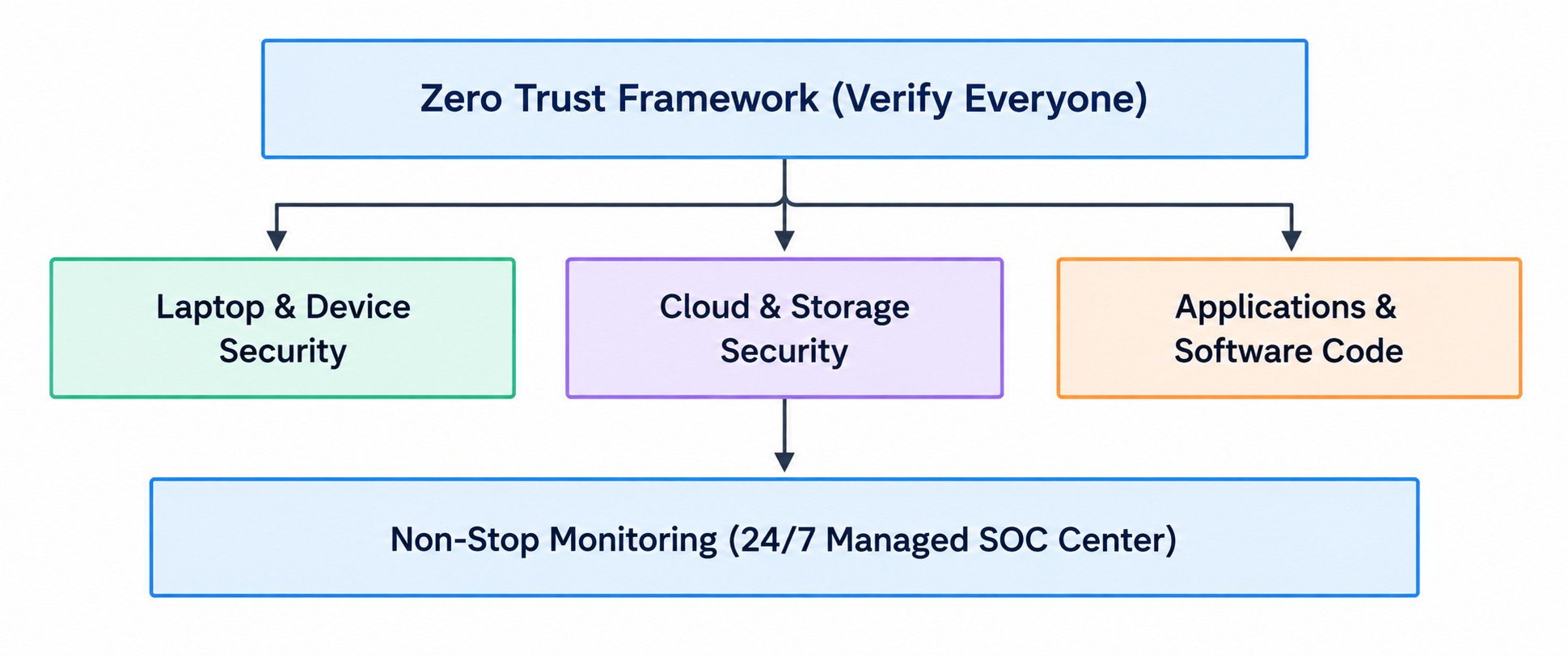
To build a strong defense system, your company needs to use a few essential layers that work together smoothly.
A. Zero Trust Network Access (ZTNA)
The gold standard for safety today is simple: Never trust, always verify. With a Zero Trust setup, your network treats an employee sitting in the main office the exact same way it treats a stranger logging in from a public coffee shop. Everyone must prove who they are, and they only get access to the specific files they need to do their job.
B. Smart Endpoint Security (EDR & XDR)
Because your team works from home, hotels, and airports, their devices are the frontline of defense. Modern cyber security solutions use Endpoint Detection and Response (EDR) software. Think of EDR as a smart digital guard living on every employee laptop, phone, and server. It instantly spots strange behavior, like a weird script running in the background, and freezes the device before a problem can spread to the rest of the company.
C. Securing Apps and Infrastructure
If your business runs web apps or connects systems together using APIs, you have exposed windows that hackers look for. You need active firewalls, strong data encryption (so stolen files look like gibberish to thieves), and a secure way to build and update your software.
VAPT Services: Finding the Cracks First
You cannot fix a leak if you don’t know where the pipe is broken. Waiting for a hacker to find a flaw in your network is a recipe for disaster. That is why proactive businesses use professional VAPT services (Vulnerability Assessment and Penetration Testing).
[ Step 1: Scan for Weaknesses ] ──> [ Step 2: Simulate Real Attacks ] ──> [ Step 3: Fix the Flaws ]
Vulnerability Assessment: This is like a automated digital home inspection. Special software checks your networks, cloud databases, and apps to build a clean list of outdated software or messy settings that need updating.
Penetration Testing: This is where the real value lies. Ethical, friendly hackers try to break into your systems on purpose. They think exactly like real criminals to show you exactly how an attacker could bypass your defenses and steal your data.
Managed SOC Services: 24/7 Threat Protection
Many business owners think they are safe because they have a firewall installed. But a firewall is just a lock on the door. What happens when someone tries to pick that lock at 2:00 AM on a Sunday?
Cybercriminals specifically wait for holidays, weekends, and late nights to attack because they know your regular IT staff is asleep. Managed SOC services solve this problem by giving you a round-the-clock Security Operations Center.
| What the SOC Team Does | How It Works | Why It Saves Your Business |
| Monitors Everything | Collects security data from all your laptops, cloud accounts, and routers. | Ensures you have zero digital blind spots. |
| Filters the Noise | Uses smart filters to separate real threats from harmless IT glitches. | Saves your team from chasing false alarms. |
| Stops Attacks Instantly | Shuts down suspicious user accounts and blocks rogue IP addresses immediately. | Keeps a tiny digital slip-up from turning into a business disaster. |
Compliance vs. True Security: What is the Difference?
Do not make the common mistake of assuming that passing a business audit means your data is fully secure.
- Compliance (GDPR, ISO 27001, HIPAA): This means you have met the minimum legal guidelines required by your industry. It is like having a valid driver's license—it proves you know the rules, but it doesn't guarantee you won't get into an accident.
- True Security Resilience: This is practical, real-world preparation. It means your company is set up to handle a live attack, limit the damage, keep your website or apps online, and stop hackers from stealing your client records even if they manage to get past your front door.
Simple Checklist to Stay Safe
Protecting your business doesn't have to be overwhelming. You can make massive improvements by focusing on these four basic habits:
- Use Multi-Factor Authentication (MFA): Make it mandatory for every single app, email login, and cloud system. A simple text confirmation or authenticator app code stops the vast majority of basic hacks.
- Turn On Auto-Updates: Make sure all your employee computers, web browsers, and company tools update automatically to patch software bugs instantly.
- Keep Separate Backups: Save copies of your business data in a secure, completely isolated cloud location. If ransomware ever strikes, you can simply wipe your systems clean and restore your files without paying a penny to criminals.
- Run Basic Training: Teach your team how to spot fake emails and suspicious links. A quick, regular reminder keeps security top of mind for everyone.
Prepare Your Business for a Cybersecurity Incident
Most businesses skip this until it's too late: a written plan for what happens the moment you discover a breach. When ransomware hits at 2 AM, that's not the time to figure out who calls whom. A basic incident response plan should answer, in advance:
- Who gets called first — your IT lead, a security partner, your legal team.
- What gets disconnected immediately, and who has the authority to decide that.
- Who talks to customers and regulators, so nobody's improvising a statement mid-crisis.
- Where your clean backups are, and who knows how to restore from them.
This doesn't need to be a fifty-page document. A one-page checklist everyone has actually seen beats a detailed plan sitting unread in a shared drive.
One related point: if you carry cyber insurance, read the fine print. Insurers can — and do — deny claims when a business hasn't actually implemented the controls the policy assumed were in place. A policy isn't a substitute for doing the work.
Common Cybersecurity Mistakes Businesses Should Avoid
- Trusting "security included" from an IT provider that can't name a specific monitoring service or show a real test report.
- Buying cyber insurance without doing the underlying work — a policy that gets denied when a claim comes in isn't worth much.
- Running one phishing test and stopping there. A 30% click rate the first time is useless data unless you retrain and retest.
- Having no incident response plan on paper. Figuring it out mid-breach is the worst time to figure it out.
Why Partner with PerfectionGeeks for Your Cybersecurity?
Managing complex network security on your own can be stressful. At PerfectionGeeks Technologies, we build straightforward, highly effective cyber security solutions designed around the actual needs of your business.
Whether you need to check your software for bugs using our professional VAPT services, upgrade your setup to a modern Zero Trust security architecture, or get full peace of mind with 24/7 monitoring from our Managed SOC services, our expert team is here to protect your digital assets.
Frequently Asked Questions
Quick answers related to this article from PerfectionGeeks.
1. What is the difference between a Vulnerability Assessment and a Penetration Test (VAPT)?
2. How does a Managed SOC protect my business after hours?
3. What industries do PerfectionGeeks Technologies specialize in protecting?
4. How long does it take PerfectionGeeks to secure our business network?
5. What's the difference between cyber security solutions and cyber security services?
6. Do small businesses actually need managed detection and response (MDR), or is that overkill?
Conclusion
As digital systems become faster and more connected, corporate security requires professional, specialized management. True business safety means moving away from old, reactive habits and embracing a dynamic system that watches over your team, checks for flaws, and monitors traffic every single minute of the day. By building a complete defense plan today, you protect your company from expensive downtime, legal fines, and damaged client trust.
Contact our Cybersecurity Experts today for a straightforward checkup of your company's systems.

Avantika creates SEO-driven technology content focused on AI, app development, and digital innovation. She combines strategic storytelling with search optimization to produce engaging, research-backed content that improves brand visibility, audience engagement, and organic growth across competitive digital markets.