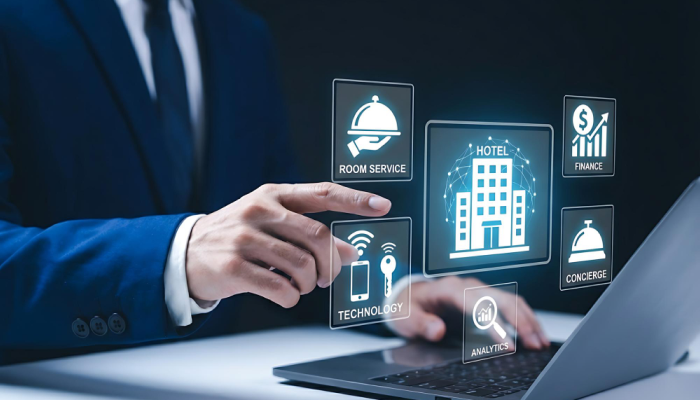
Published 31 August 2026 | Updated 16 September 2026
ai
AI Agents for Hospitality: Automate Hotel Operations and Guest Services
Hospitality businesses are using AI to automate repetitive workflows, respond to guests faster, and make better use of operational data. But the highest-value applications go beyond a traditional hotel chatbot.
AI agents for hospitality are software systems that can understand requests, retrieve information, use connected business tools, execute defined actions, and escalate complex situations to staff. In a hotel environment, an agent can support reservations, guest communication, concierge services, housekeeping coordination, front-desk workflows, and internal operations.
PerfectionGeeks Technologies builds custom AI agents for hospitality businesses that can integrate with existing applications, APIs, databases, and hotel-management platforms. The objective is to automate the right workflows while keeping humans in control of decisions that require judgment, empathy, or authorization.
Need an AI agent for your hotel or hospitality platform? Talk to our AI development team about your workflow.
Transform Your Digital Experience
AI agents for hospitality are intelligent software systems that automate hotel and hospitality workflows by understanding natural-language requests, retrieving relevant information, using connected business tools, and completing authorized actions. They can support hotel bookings, guest communication, AI concierge services, front-desk assistance, housekeeping, maintenance, customer support, and internal hotel operations.
Unlike traditional hotel chatbots that mainly answer predefined questions, AI agents can connect with systems such as property management systems (PMS), booking engines, CRM platforms, housekeeping software, and other business applications. This enables them to perform multi-step workflows while applying permissions, validation rules, monitoring, and human escalation.
For hospitality businesses in the USA and UK, AI agents can help create more responsive guest experiences while reducing repetitive administrative work. The most effective implementations start with specific, high-volume workflows and expand gradually based on measurable business outcomes.
In simple terms: AI agents turn hospitality AI from a system that only answers questions into a system that can understand, retrieve, act, coordinate, and escalate.
- AI agents for hospitality go beyond traditional chatbots by combining conversational AI with business data, APIs, tools, and workflow automation.
- Hotels can use AI agents across the guest journey, including reservations, pre-arrival communication, concierge services, check-in support, room-service requests, and post-stay communication.
- Internal hotel operations can also benefit, with AI supporting front-desk employees, housekeeping coordination, maintenance requests, reporting, and information retrieval.
- PMS, CRM, booking-engine, and other system integrations are critical when an AI agent needs to access real business information or execute actions.
- Human oversight remains important for refunds, disputes, sensitive complaints, safety issues, exceptional compensation, and other high-risk decisions.
- Security should be designed into the architecture, including authentication, authorization, data minimization, encryption, audit logging, monitoring, and appropriate access controls.
- RAG can help ground AI responses in hotel-specific policies, property information, service details, and internal knowledge.
- The best starting point is usually one high-value workflow, rather than attempting to automate every hotel process simultaneously.
- AI agent development costs vary significantly depending on integrations, workflow complexity, interfaces, data architecture, security requirements, and deployment scale.
- A successful hospitality AI implementation should be measured using business outcomes, such as resolution rate, escalation rate, response accuracy, booking conversion, handling time, guest satisfaction, and staff adoption.
The central lesson
The goal of hospitality AI should not be to automate everything. The goal is to automate the right workflows, give AI controlled access to the right systems, and keep people involved where human judgment matters most.
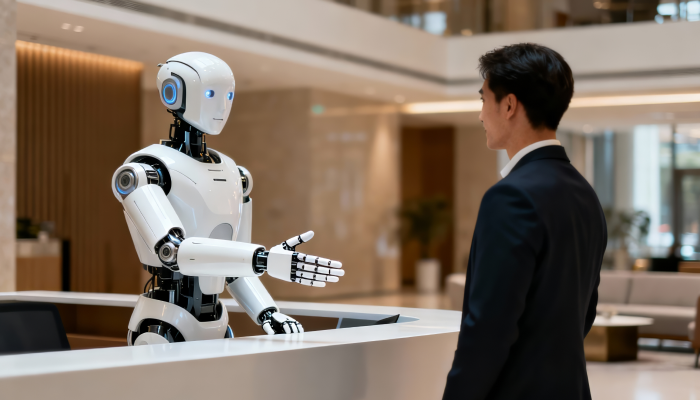
What Are AI Agents for Hospitality?
AI agents for hospitality are intelligent software systems designed to perform defined hotel or hospitality workflows using AI, business data, APIs, and connected applications.
Unlike a basic FAQ chatbot, an AI agent can be designed to move beyond answering questions. Depending on its permissions and integrations, it can retrieve booking information, create or update requests, coordinate workflows, recommend actions, and hand off conversations to employees when required.
For example:
Guest request → AI understands intent → checks authorized hotel data → performs an approved action → confirms the result → escalates if necessary
This makes AI agents useful for both customer-facing and internal hospitality workflows.
How AI Agents Work in Hotels
A production hospitality AI agent generally combines several components rather than relying on a single AI model.
1. Natural language understanding
The agent interprets requests made through chat, web, mobile apps, messaging platforms, voice interfaces, or other supported channels.
A guest might ask:
"Can I check in early tomorrow?"
The agent identifies the intent and determines what information or system action is required.
2. Knowledge and data retrieval
The agent can retrieve relevant information from approved sources such as:
- Hotel policies
- Room information
- Property FAQs
- Restaurant menus
- Guest-service information
- Local recommendations
- Booking records
- Internal knowledge bases
RAG can be used when an organization needs responses grounded in its own documents or operational data.
3. Tool and API integration
An agent becomes significantly more useful when it can interact with business systems.
Potential integrations include:
- Property Management Systems
- Booking engines
- CRM platforms
- Channel managers
- Payment systems
- Housekeeping platforms
- Restaurant systems
- Customer-support platforms
- ERP systems
- Analytics platforms
4. Workflow orchestration
The agent determines which tool or workflow should be used for a particular request.
For example:
Guest asks for extra towels → agent identifies request → creates housekeeping task → confirms request to guest
5. Guardrails and permissions
Not every action should be autonomous.
A production system should define:
- Which data the agent can access
- Which actions it can execute
- Which actions require approval
- Which information must not be exposed
- When conversations must be escalated
- How actions are logged
6. Human escalation
AI should complement hotel staff rather than blindly replace them.
When an issue is sensitive, unusual, financially significant, or outside the agent's authority, the system can route it to the appropriate employee.
AI Agents for Hotels: Key Use Cases
The most valuable hospitality AI applications are connected to real workflows.
AI Booking Agent
An AI booking agent can help potential guests find suitable rooms, answer property questions, explain policies, and guide them through reservations.
With appropriate integrations, it can also retrieve availability and initiate approved booking workflows.
AI Concierge
An AI concierge can provide guests with information about:
- Hotel facilities
- Restaurants
- Spa services
- Activities
- Transportation
- Local attractions
- Events
- Dining recommendations
The agent can also assist with selected reservations or service requests when connected to the relevant systems.
Guest Communication Agent
Hospitality businesses receive repetitive questions before, during, and after a guest's stay.
An AI communication agent can support requests involving:
- Check-in information
- Check-out procedures
- Amenities
- Room services
- Hotel policies
- Directions
- Wi-Fi information
- Service requests
Multilingual capabilities can also support international guests when properly designed and evaluated.
Front Desk Assistant
An internal AI agent can help front-desk employees retrieve information and complete routine workflows.
For example:
Employee question → agent retrieves hotel policy or guest information → agent suggests next action → employee approves or completes action
This can reduce the time staff spend searching across different systems.
Housekeeping Agent
AI can help coordinate housekeeping workflows by receiving requests, routing tasks, checking task status, and notifying relevant teams.
Potential workflows include:
- Room-cleaning requests
- Maintenance notifications
- Linen requests
- Amenity replenishment
- Priority-room notifications
Maintenance Agent
A maintenance-focused agent can receive reported issues, classify requests, create work orders, and route them to the appropriate team.
For example:
Guest reports air-conditioning problem → AI identifies maintenance issue → creates ticket → assigns priority → notifies staff
Revenue and Operations Assistant
AI agents can also support internal analysis by retrieving operational data and producing structured insights.
Potential use cases include:
- Occupancy analysis
- Booking trends
- Guest feedback analysis
- Demand signals
- Operational reporting
- Performance summaries
These systems should support management decisions rather than make uncontrolled pricing or business decisions without appropriate validation.
AI Hospitality Solutions by Business Function
| Hospitality Function | AI Agent Application | Potential Outcome |
| Reservations | Booking agent | Faster responses and booking assistance |
| Guest services | Concierge agent | More responsive guest support |
| Front desk | Employee copilot | Faster information retrieval |
| Housekeeping | Task agent | Better request routing |
| Maintenance | Maintenance agent | Faster issue assignment |
| Customer support | Conversational agent | Automated routine communication |
| Operations | Operations assistant | Better workflow coordination |
| Analytics | Data agent | Faster access to operational insights |
| Marketing | Personalization agent | More relevant guest communication |
The exact automation level depends on the hotel's systems, policies, data architecture, and risk requirements.
AI Automation for Hotels: What Should Be Automated?
A useful rule is:
Automate repetitive, rules-based, high-volume workflows first.
Good candidates include:
- Frequently asked questions
- Booking information requests
- Routine service requests
- Internal information retrieval
- Task creation
- Status notifications
- Basic reporting
- Guest-message classification
- Request routing
Workflows requiring significant judgment should generally include human review.
Examples include:
- Refund decisions
- Sensitive complaints
- Security incidents
- Exceptional compensation
- High-value commercial decisions
- Disputes
- Safety-related situations
The goal of AI hotel automation should not be maximum autonomy. It should be useful and controlled automation.
Core Features of Hospitality AI Agents
A custom hospitality AI solution can include:
Conversational AI
Natural-language interaction through websites, mobile applications, messaging platforms, or internal interfaces.
Multi-language Support
AI-powered communication can support multiple languages where the selected models, knowledge sources, and evaluation process provide sufficient accuracy.
PMS Integration
Connect AI workflows with approved property-management data and processes.
Booking Integration
Allow agents to retrieve or initiate reservation workflows through authorized APIs.
CRM Integration
Use relevant guest information to support personalized interactions while respecting access controls and privacy requirements.
RAG Knowledge Base
Ground responses in hotel-specific documents, policies, service information, and operational knowledge.
Tool Calling
Allow the agent to interact with approved APIs, databases, search tools, calculators, workflow systems, and other business tools.
Role-Based Access
Restrict actions and data according to user roles and business permissions.
Human-in-the-Loop
Route selected actions or conversations to employees for review and approval.
Monitoring and Analytics
Track agent activity, response quality, failures, escalations, latency, and business KPIs.
Audit Logs
Record important actions and system events to support troubleshooting, governance, and accountability.
AI Agents vs Hotel Chatbots
AI agents and chatbots are related, but they are not the same.
| Capability | Traditional Hotel Chatbot | AI Agent |
| Answer FAQs | Yes | Yes |
| Natural-language interaction | Limited to strong | Strong |
| Retrieve business data | Sometimes | Yes, when integrated |
| Execute workflows | Limited | Yes, with permissions |
| Use multiple tools | Limited | Yes |
| Coordinate multi-step tasks | Limited | Yes |
| Human escalation | Yes | Yes |
| Personalized workflows | Limited | More flexible |
| Autonomous action | Usually low | Configurable |
| PMS/CRM integration | Possible | Core implementation consideration |
A chatbot may be sufficient for answering frequently asked questions. An AI agent is more appropriate when the business wants the system to reason across a workflow and take authorized actions.
How to Build AI Agents for Hospitality
Successful implementation starts with the business workflow, not the AI model.
Step 1: Identify the business problem
Define the workflow that needs improvement.
Examples:
- Too many repetitive booking questions
- Slow guest-request processing
- Manual housekeeping coordination
- High support volume
- Employees searching across multiple systems
Step 2: Select the right agent use case
Prioritize workflows according to:
- Business value
- Volume
- Complexity
- Data availability
- Automation feasibility
- Risk
- Integration requirements
Step 3: Map the existing workflow
Document:
Input → Decision → Data → Action → Approval → Outcome
This makes it easier to determine where an AI agent should act and where humans should remain involved.
Step 4: Design the architecture
A typical architecture may include:
Guest/Employee Interface → AI Agent → Orchestration Layer → LLM → Knowledge/RAG Layer → APIs & Hotel Systems → Monitoring & Security
Step 5: Integrate hotel systems
The agent may need controlled access to:
- PMS
- CRM
- Booking engine
- Payment systems
- Housekeeping software
- Internal databases
- Knowledge bases
Integration requirements should be defined before development begins.
Step 6: Add guardrails
Define:
- Permissions
- Data-access rules
- Approved actions
- Escalation conditions
- Validation requirements
- Audit requirements
Step 7: Test with realistic scenarios
Testing should cover both successful and unsuccessful interactions.
Examples:
- Ambiguous guest request
- Incorrect information
- API failure
- Missing booking
- Duplicate request
- Unauthorized action
- Sensitive complaint
- Human escalation
Step 8: Deploy, monitor and improve
After launch, evaluate the agent using measurable indicators such as:
- Resolution rate
- Escalation rate
- Booking conversion
- Response accuracy
- Average handling time
- Failed-action rate
- Guest satisfaction
- Staff adoption
Hospitality AI Technology Stack
The technology stack should be selected according to the workflow rather than simply choosing the newest model.
| Layer | Possible Technologies | Purpose |
| AI/LLM | OpenAI, Claude, Gemini, Llama | Language understanding and reasoning |
| Agent orchestration | Custom orchestration / agent frameworks | Workflow execution |
| RAG | Vector database + retrieval layer | Grounded responses |
| Backend | Python, Node.js, Go and other suitable technologies | Business logic and integrations |
| APIs | REST, GraphQL, webhooks | System connectivity |
| Cloud | AWS, Azure, GCP | Deployment and infrastructure |
| Data | SQL/NoSQL databases | Operational data |
| Analytics | BI/observability platforms | Monitoring and reporting |
| Security | IAM, encryption, RBAC, audit logging | Access and governance |
PerfectionGeeks' broader AI development offering includes LLM applications, AI agents, RAG pipelines, chatbots/copilots and enterprise integrations.
Integrating AI Agents With Hotel Management Systems
AI delivers greater operational value when it can work with the systems already used by the hospitality business.
PerfectionGeeks' hotel-management software offering covers PMS, reservation and booking software, hotel ERP, CRM, hotel automation and multi-property management solutions.
Potential integration architecture:
AI Agent ↔ API Layer ↔ PMS / Booking Engine / CRM / Housekeeping / Payment / Analytics
The integration should enforce explicit permissions rather than giving the AI unrestricted access to operational systems.
Security and Privacy for Hospitality AI
Hospitality systems can process personal information such as guest names, contact details, reservation data, preferences, communication history, and payment-related information.
Security should therefore be part of the architecture from the beginning.
Important controls can include:
- Data minimization
- Encryption
- Role-based access control
- Authentication
- API security
- Tenant isolation for multi-property platforms
- Audit logging
- Secret management
- Data-retention policies
- Human approval for sensitive actions
- Prompt and output monitoring
- Model and vendor risk assessment
For US deployments, organizations can use the NIST AI Risk Management Framework as a voluntary framework for incorporating trustworthiness considerations into AI design, development, deployment, and evaluation. NIST's Generative AI Profile provides additional guidance for generative-AI risks.
For UK deployments, AI systems that process personal data should be assessed against applicable data-protection requirements. The UK's Information Commissioner's Office provides guidance covering areas including lawfulness, transparency, fairness, security, data minimization, and individual rights in AI systems.
Compliance requirements depend on the implementation, data processed, vendors involved, and jurisdiction. They should be assessed during solution design rather than treated as a final-stage checklist.
AI Agents for Hospitality in the USA and UK
Hospitality businesses in the USA and UK can have different operational, contractual, privacy, and technology requirements.
For US hospitality businesses
Key implementation considerations may include:
- Integration with existing hotel technology
- Data governance
- Cloud architecture
- Multi-property scalability
- Guest communication
- Role-based access
- Vendor management
- Operational analytics
- AI risk management
For UK hospitality businesses
Additional considerations can include:
- UK data-protection requirements
- Data minimization
- Transparency
- Privacy governance
- International data transfers where applicable
- Integration with existing hospitality platforms
- Human oversight
For both markets, the best approach is to start with a clearly defined workflow and then design the AI architecture around the hotel's systems and operational requirements.
How Much Does AI Agent Development for Hospitality Cost?
There is no single fixed price because hospitality AI projects vary considerably in scope.
The main cost factors are:
| Cost Factor | Impact |
| Number of AI agents | More agents increase architecture and testing requirements |
| Workflow complexity | Multi-step workflows require more orchestration |
| PMS/CRM integrations | More integrations increase engineering effort |
| AI model requirements | Model selection and usage affect cost |
| RAG/knowledge systems | Data preparation and retrieval add complexity |
| Security | Enterprise security controls increase engineering effort |
| User interfaces | Web, mobile, voice and messaging interfaces affect scope |
| Multi-property support | Multi-tenant architecture increases complexity |
| Monitoring | Production observability adds implementation and operating costs |
| Ongoing optimization | AI systems require evaluation and maintenance |
PerfectionGeeks' published AI-agent pricing guidance currently places basic agents around $15,000–$50,000, semi-autonomous systems around $50,000–$150,000, and advanced enterprise implementations around $250,000–$500,000+. These are general budgeting ranges rather than a quotation for a hospitality project.
A hospitality project should be estimated after reviewing the required workflows, integrations, data sources, security requirements, deployment environment, and expected scale.
How Long Does It Take to Build a Hospitality AI Agent?
The timeline depends primarily on scope and integration complexity.
| Project Stage | Typical Activities |
| Discovery | Business requirements and workflow analysis |
| Architecture | Agent, data and integration architecture |
| Prototype | Initial workflow and AI validation |
| Development | Agent logic, interfaces and integrations |
| Testing | Functional, security and AI evaluation |
| Deployment | Production infrastructure and monitoring |
| Optimization | Performance and workflow improvements |
A simple customer-facing agent can require considerably less engineering than a production system connected to PMS, CRM, booking, payment and housekeeping systems.
For that reason, a reliable timeline should be provided after technical discovery rather than using a universal number of weeks.
Why Choose PerfectionGeeks for Hospitality AI Agent Development?
PerfectionGeeks approaches hospitality AI as a software-engineering and integration problem, not simply as a chatbot implementation.
Hospitality-focused workflows
The solution can be designed around hotel reservations, guest communication, concierge, housekeeping, maintenance and internal operations.
AI engineering capability
PerfectionGeeks provides AI development services covering AI agents, LLM applications, RAG pipelines, conversational AI and enterprise AI solutions.
Integration-first architecture
AI agents can be designed to work with existing applications, APIs, databases and business workflows.
Security-conscious implementation
Access controls, data handling, auditability, human approval and monitoring can be incorporated into the architecture.
Scalable software engineering
Hospitality platforms often need to support multiple properties, users, workflows and integrations. Architecture should therefore account for future growth.
End-to-end delivery
The engagement can span discovery, architecture, development, integration, deployment and post-launch optimization.
PerfectionGeeks states that it works with startups, scale-ups and enterprises across multiple international markets, including the UK and the US.
A Practical Framework for Choosing an AI Agent Development Company
Before selecting an AI development partner, ask:
- Can they demonstrate real AI engineering capability?
- Can they integrate with existing hotel systems?
- Do they understand APIs, databases and enterprise architecture?
- How will the AI agent be evaluated?
- What actions can the agent execute?
- Where is human approval required?
- How is guest data protected?
- How are failures and hallucinations handled?
- What monitoring will be available after launch?
- Can the solution scale across multiple properties?
- What happens when an external API or AI model fails?
- What ongoing support and optimization is included?
A good hospitality AI partner should be able to discuss these questions in technical and business terms.
Frequently Asked Questions
Quick answers related to this article from PerfectionGeeks.
1. What are AI agents in hospitality?
2. What can AI agents do for hotels?
3. What is the difference between an AI agent and a hotel chatbot?
4. Can AI agents integrate with hotel PMS software?
5. Can an AI agent handle hotel bookings?
6. Can AI agents replace hotel staff?
7. How much does it cost to build an AI agent for a hotel?
8. How long does hospitality AI development take?
9. Is hospitality AI secure?
10. Should hotels start with one AI agent or multiple agents?
Conclusion
AI agents are changing how hotels and hospitality businesses approach guest service and operational automation. Their value comes from combining conversational intelligence with access to business systems, allowing an agent to do more than provide information.
A well-designed hospitality AI agent can help answer guest questions, assist with reservations, provide concierge support, coordinate housekeeping and maintenance requests, support front-desk teams, retrieve operational information, and automate other repetitive workflows.
However, successful implementation requires more than selecting an AI model. Hotels need a clear workflow strategy, reliable integrations, secure data access, appropriate guardrails, evaluation processes, monitoring, and human escalation. The right architecture should also account for the hotel's existing PMS, CRM, booking infrastructure, operational software, and future scalability requirements.
For hospitality businesses in the USA and UK, the strongest approach is to begin with a measurable business problem, build a focused AI agent around that workflow, validate its performance, and then expand to additional use cases.
PerfectionGeeks Technologies helps businesses design and develop custom AI agents that connect AI capabilities with real business workflows. From AI strategy and agent architecture to integrations, deployment, security, and ongoing optimization, our team can help turn a hospitality automation idea into a practical software solution.
Have a hotel workflow you want to automate? Contact PerfectionGeeks to discuss your AI agent development requirements.

Avantika creates SEO-driven technology content focused on AI, app development, and digital innovation. She combines strategic storytelling with search optimization to produce engaging, research-backed content that improves brand visibility, audience engagement, and organic growth across competitive digital markets.