Published 31 August 2026 | Updated 26 September 2026
Technology
AI in the Oil and Gas Industry: 12 Powerful Use Cases, Benefits, Challenges & Future Trends (2026 Guide)
The oil and gas industry has always operated in a high-risk, data-intensive, and capital-heavy environment. Companies constantly face challenges such as fluctuating oil prices, aging infrastructure, equipment failures, environmental regulations, workforce shortages, and increasing operational costs. In this competitive landscape, traditional methods are no longer sufficient to maximize efficiency and profitability.
Artificial Intelligence (AI) is transforming how oil and gas companies explore reserves, optimize drilling operations, monitor pipelines, improve refinery performance, and predict equipment failures. By combining AI with machine learning, computer vision, IoT sensors, digital twins, and advanced analytics, organizations can automate critical processes, improve safety, reduce downtime, and make faster, data-driven decisions. Research and industry analyses consistently identify AI as a major driver of operational efficiency, safety, and value creation across upstream, midstream, and downstream operations.
Transform Your Digital Experience
What is AI in the Oil and Gas Industry?
Artificial Intelligence (AI) in the oil and gas industry refers to the use of machine learning, deep learning, computer vision, predictive analytics, Generative AI, and automation technologies to improve exploration, production, maintenance, safety, and operational efficiency.
AI-powered solutions analyze large volumes of data generated from drilling equipment, sensors, pipelines, refineries, and industrial systems to identify patterns, predict failures, optimize processes, and support faster decision-making.
Oil and gas companies are using AI for predictive maintenance, drilling optimization, reservoir analysis, pipeline monitoring, digital twins, worker safety, production forecasting, and intelligent automation.
By combining AI with IoT, cloud computing, and real-time analytics, energy companies can reduce operational costs, improve asset performance, increase safety, and achieve greater sustainability.
- Artificial Intelligence is transforming the oil and gas industry by improving exploration, drilling, production, refining, and asset management through data-driven automation.
- Predictive maintenance delivers one of the highest returns on investment, helping companies reduce unplanned downtime, extend equipment life, and lower maintenance costs.
- AI-powered drilling optimization and reservoir analysis enable faster decision-making, improve well placement, and maximize hydrocarbon recovery while reducing operational expense.
- Computer vision, drones, and autonomous inspection systems improve worker safety by detecting hazards, monitoring PPE compliance, and identifying equipment defects in real time.
- Digital Twins provide real-time virtual models of physical assets, allowing operators to simulate performance, predict failures, and optimize maintenance strategies before problems occur.
- Generative AI and AI Agents are streamlining technical documentation, automating repetitive workflows, assisting engineers, and enabling faster access to operational knowledge across the enterprise.
- AI supports ESG and sustainability initiatives by improving emissions monitoring, methane leak detection, environmental reporting, and regulatory compliance through intelligent analytics.
- Successful AI implementation depends on high-quality data, seamless integration with legacy systems, strong cybersecurity, and employee adoption, not just advanced algorithms.
- The greatest business value comes from deploying AI across the entire oil and gas value chain—from upstream exploration and drilling to midstream pipeline management and downstream refining and distribution.
- Partnering with an experienced AI development company like PerfectionGeeks enables energy businesses to build secure, scalable, and customized AI solutions that accelerate digital transformation, improve operational efficiency, reduce costs, and drive long-term growth.

Today's leading energy companies are investing heavily in AI-powered solutions to enhance productivity while meeting sustainability and compliance goals. Recent examples include automated drilling systems, AI-assisted reservoir management, and autonomous production optimization.
Whether you're an upstream exploration company, pipeline operator, refinery, or energy technology provider, AI offers measurable improvements across every stage of the oil and gas value chain.
AI in Oil and Gas Industry Statistics
The adoption of Artificial Intelligence in the oil and gas sector is accelerating as companies look for ways to improve productivity, reduce operational risks, and optimize complex industrial processes.
Key industry trends include:
- AI-powered predictive maintenance is helping companies monitor asset health, identify equipment failures earlier, and reduce unexpected downtime.
- Digital Twin technology is becoming increasingly important for real-time asset monitoring, simulation, and operational optimization.
- Generative AI and AI Agents are emerging as powerful tools for automating technical documentation, knowledge management, and field operations.
- Machine learning models are improving production forecasting, drilling optimization, and decision-making across upstream, midstream, and downstream operations.
Modern oil and gas companies are moving from traditional reactive operations toward intelligent, AI-driven systems that enable predictive and autonomous decision-making.
Why the Oil and Gas Industry Needs Artificial Intelligence
Energy companies generate enormous volumes of structured and unstructured data every day. Information flows continuously from drilling equipment, pressure sensors, pipelines, offshore platforms, SCADA systems, inspection drones, refinery control rooms, and enterprise software.
Without AI, much of this valuable information remains underutilized.
Artificial Intelligence transforms raw operational data into actionable business intelligence that helps organizations:
- Reduce operational costs
- Improve drilling accuracy
- Predict equipment failures
- Increase production efficiency
- Enhance worker safety
- Monitor environmental compliance
- Optimize fuel consumption
- Improve supply chain planning
- Reduce downtime
- Accelerate decision-making
AI also enables organizations to shift from reactive maintenance to predictive and prescriptive maintenance, reducing costly disruptions while maximizing asset utilization.
Benefits of AI in the Oil and Gas Industry
| Benefit | Business Value |
|---|---|
| Predictive Maintenance | Minimize equipment failures and reduce maintenance costs |
| Production Optimization | Increase oil and gas output through intelligent automation |
| Worker Safety | Detect hazards before accidents occur |
| Pipeline Monitoring | Identify leaks and corrosion in real time |
| Drilling Optimization | Reduce drilling time and operational costs |
| Reservoir Analysis | Improve exploration success rates |
| Supply Chain Intelligence | Optimize inventory and logistics |
| Digital Twins | Simulate assets for better planning and maintenance |
| AI Analytics | Enable faster, data-driven decisions |
| ESG Monitoring | Improve environmental compliance and sustainability reporting |
How AI is Transforming the Oil and Gas Value Chain
Artificial Intelligence supports every stage of oil and gas operations.
Upstream
- Exploration
- Seismic interpretation
- Reservoir modeling
- Drilling optimization
- Well planning
Midstream
- Pipeline monitoring
- Leak detection
- Transportation optimization
- Storage management
- Asset integrity
Downstream
- Refinery optimization
- Quality control
- Supply chain planning
- Inventory forecasting
- Customer demand prediction
1. Predictive Maintenance with AI
Predictive maintenance is one of the most valuable applications of Artificial Intelligence in the oil and gas industry.
Traditional maintenance follows either fixed schedules or reactive repairs after equipment failures occur. Both approaches increase maintenance costs and result in unnecessary downtime.
AI changes this approach completely.
By analyzing data from sensors installed on pumps, compressors, turbines, pipelines, drilling rigs, and production equipment, machine learning algorithms continuously monitor asset health and identify early warning signs of failure.
How Predictive Maintenance Works
AI systems collect information from:
- Temperature sensors
- Pressure gauges
- Vibration monitors
- Acoustic sensors
- Oil quality sensors
- Historical maintenance records
- SCADA systems
- IoT devices
Machine learning models identify abnormal operating conditions and predict failures before they happen.
Business Benefits
- Reduce unexpected equipment failures
- Extend equipment lifespan
- Lower maintenance costs
- Increase production uptime
- Improve worker safety
- Optimize spare parts inventory
Example
An offshore platform uses AI-powered predictive maintenance to monitor rotating equipment. Instead of waiting for a compressor to fail, the AI model detects unusual vibration patterns several weeks in advance. Engineers schedule maintenance during planned downtime, preventing costly production interruptions and avoiding emergency repairs.
2. AI-Powered Drilling Optimization
Drilling operations account for a significant portion of exploration and production costs.
Artificial Intelligence improves drilling efficiency by analyzing real-time drilling parameters and historical performance data to recommend optimal drilling strategies.
AI algorithms monitor:
- Drill bit performance
- Torque
- Mud pressure
- Penetration rate
- Well trajectory
- Formation characteristics
The system continuously adjusts drilling parameters to improve speed, reduce equipment wear, and minimize non-productive time.
Advantages
- Faster drilling operations
- Lower fuel consumption
- Improved drilling accuracy
- Reduced operational costs
- Fewer equipment failures
- Better well placement
Recent deployments of automated drilling technologies demonstrate how AI and robotics are improving both safety and productivity in large-scale oil operations.
3. Reservoir Modeling and Exploration
Finding economically viable hydrocarbon reserves has become increasingly complex.
Oil companies must analyze massive datasets from:
- Seismic surveys
- Satellite imagery
- Geological maps
- Well logs
- Production history
- Reservoir pressure data
Artificial Intelligence accelerates this process by identifying hidden geological patterns, estimating reservoir characteristics, and improving exploration accuracy.
Machine learning models help engineers:
- Predict reservoir quality
- Estimate recoverable reserves
- Optimize well placement
- Improve production forecasting
- Reduce exploration risks
Generative AI is also beginning to assist geoscientists by synthesizing large volumes of subsurface information into usable insights, significantly reducing analysis time.
4. AI for Pipeline Monitoring and Leak Detection
Oil and gas pipelines span thousands of miles across challenging environments, making manual inspection time-consuming, expensive, and prone to delays. Even a minor leak can lead to production losses, environmental damage, regulatory penalties, and safety risks.
Artificial Intelligence enables continuous pipeline monitoring by analyzing data from IoT sensors, drones, satellites, thermal cameras, and SCADA systems. AI algorithms can detect pressure anomalies, corrosion patterns, vibration changes, and unusual flow behavior in real time, allowing operators to respond before a small issue becomes a major incident.
How AI Detects Pipeline Leaks
AI systems continuously collect data from:
- Pressure sensors
- Flow meters
- Acoustic sensors
- Thermal imaging cameras
- Drone inspections
- Satellite imagery
- SCADA systems
- IoT-enabled monitoring devices
Machine learning models compare real-time operational data with historical performance to identify abnormalities and trigger alerts automatically.
Benefits
- Detect leaks faster
- Reduce environmental risks
- Prevent costly shutdowns
- Lower inspection costs
- Improve regulatory compliance
- Extend pipeline lifespan
Real-World Example
A pipeline operator uses AI-powered drones equipped with computer vision and thermal imaging to inspect remote pipeline sections. The AI system detects a temperature anomaly indicating a small leak. Maintenance teams receive an automated alert and repair the issue before it escalates into a major failure.
5. Computer Vision for Worker Safety and Hazard Detection
Worker safety is a top priority in the oil and gas industry, where employees operate in hazardous environments involving heavy machinery, high-pressure equipment, and flammable materials.
AI-powered computer vision enhances workplace safety by monitoring live video feeds from CCTV cameras, drones, and wearable devices. These systems automatically detect unsafe conditions and notify supervisors in real time.
Common Computer Vision Applications
- PPE (Personal Protective Equipment) detection
- Helmet and safety vest compliance
- Unauthorized area monitoring
- Fire and smoke detection
- Gas leak identification
- Worker fall detection
- Vehicle movement monitoring
- Restricted zone access control
Instead of relying solely on manual supervision, AI continuously monitors operations 24/7, helping reduce workplace incidents and improve compliance with safety regulations.
Business Benefits
- Reduce workplace accidents
- Improve employee safety
- Faster emergency response
- Automated compliance monitoring
- Lower insurance costs
- Increased operational efficiency
6. Digital Twins for Intelligent Asset Management
Digital Twins are becoming one of the most valuable AI technologies in the energy sector.
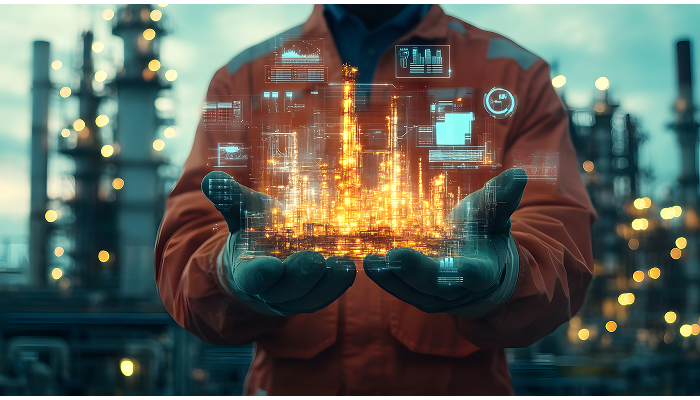
A Digital Twin is a virtual replica of a physical asset, such as a drilling rig, refinery, compressor, pipeline, or offshore platform. By combining AI, IoT sensors, and real-time operational data, companies can monitor, simulate, and optimize asset performance without interrupting production.
How Digital Twins Work
The digital model receives continuous updates from connected equipment, allowing engineers to:
- Monitor equipment health
- Simulate different operating conditions
- Predict failures
- Test maintenance strategies
- Optimize production
- Improve energy efficiency
Key Advantages
- Real-time visibility
- Predictive maintenance
- Reduced downtime
- Better asset utilization
- Lower operational costs
- Improved decision-making
Digital Twins are particularly valuable for complex industrial facilities where equipment failures can result in significant financial losses.
7. AI for Refinery Process Optimization
Refineries process millions of barrels of crude oil every day. Optimizing production while reducing energy consumption is critical for profitability.
Artificial Intelligence continuously analyzes refinery operations and identifies opportunities to improve efficiency.
AI helps optimize:
- Crude oil processing
- Distillation units
- Catalytic cracking
- Heat exchanger performance
- Energy consumption
- Chemical usage
- Product quality
Instead of relying on static operating parameters, AI dynamically adjusts refinery settings based on changing production conditions.
Business Benefits
- Increase production efficiency
- Lower energy costs
- Improve product quality
- Reduce operational waste
- Optimize fuel consumption
- Improve plant reliability
8. AI for Supply Chain and Inventory Optimization
Managing the oil and gas supply chain involves coordinating equipment, spare parts, transportation, logistics, storage facilities, and global suppliers.
Artificial Intelligence helps organizations make smarter decisions by predicting demand, optimizing inventory, and reducing supply chain disruptions.
AI Applications
- Inventory forecasting
- Procurement optimization
- Fleet management
- Route optimization
- Warehouse automation
- Fuel demand forecasting
- Spare parts management
Machine learning models analyze historical purchasing data, seasonal demand, weather conditions, and market trends to recommend optimal inventory levels.
Benefits
- Lower inventory costs
- Faster deliveries
- Improved procurement planning
- Reduced stock shortages
- Better supplier management
- Increased operational efficiency
9. AI Agents and Generative AI for Industrial Operations
Generative AI and AI Agents are redefining how oil and gas companies manage knowledge, automate workflows, and support field engineers.
Unlike traditional automation, AI Agents can understand natural language, access enterprise knowledge bases, analyze documents, and perform complex tasks with minimal human intervention.
Common AI Agent Applications
- Maintenance assistants
- Technical documentation search
- Equipment troubleshooting
- SOP guidance
- Shift handover automation
- Incident reporting
- Compliance documentation
- Procurement assistance
- Knowledge management
Field engineers can ask questions such as:
- "Show the maintenance history of Compressor 12."
- "What caused the last pipeline shutdown?"
- "Generate today's inspection report."
- "Recommend maintenance actions for abnormal vibration."
The AI Agent retrieves relevant information instantly, saving valuable time and improving decision-making.
Benefits
- Faster access to information
- Improved workforce productivity
- Reduced manual documentation
- Better knowledge retention
- Automated reporting
- Enhanced operational efficiency
10. AI for ESG Monitoring and Environmental Compliance
Environmental regulations are becoming increasingly stringent, requiring energy companies to monitor emissions, reduce waste, and improve sustainability.
Artificial Intelligence enables continuous environmental monitoring by analyzing sensor data, satellite imagery, and operational metrics.
AI Supports
- Methane leak detection
- Carbon emissions monitoring
- Water usage optimization
- Waste management
- Environmental reporting
- Regulatory compliance
- Sustainability dashboards
AI also automates compliance reporting, reducing administrative workload while improving reporting accuracy.
Business Benefits
- Lower environmental risks
- Better ESG performance
- Reduced regulatory penalties
- Improved sustainability reporting
- Increased operational transparency
11. AI for Production Forecasting and Demand Prediction
Accurate forecasting is essential for maximizing production efficiency and planning future investments.
AI models analyze multiple data sources, including:
- Historical production
- Market demand
- Weather conditions
- Equipment performance
- Reservoir pressure
- Economic indicators
These insights help companies forecast production levels, optimize resource allocation, and make informed investment decisions.
Advantages
- Better production planning
- Reduced operational uncertainty
- Improved financial forecasting
- Smarter resource allocation
- Increased profitability
12. Autonomous Inspection Using AI, Drones, and Robotics
Inspecting offshore platforms, refineries, pipelines, and storage facilities often exposes workers to hazardous environments.
Autonomous drones and robotic systems powered by AI can safely inspect assets while collecting high-resolution images, videos, and sensor data.
Computer vision algorithms automatically detect:
- Corrosion
- Structural cracks
- Equipment damage
- Rust
- Thermal anomalies
- Oil leaks
- Surface defects
Maintenance teams receive detailed reports along with prioritized repair recommendations.
Benefits
- Reduce inspection time
- Improve worker safety
- Lower inspection costs
- Increase inspection accuracy
- Minimize operational disruptions
Traditional Operations vs AI-Powered Oil & Gas Operations
| Traditional Operations | AI-Powered Operations |
|---|---|
| Reactive maintenance | Predictive maintenance |
| Manual inspections | Autonomous drone inspections |
| Static reporting | Real-time analytics |
| Scheduled servicing | Condition-based maintenance |
| Manual safety checks | AI-powered computer vision |
| Historical analysis | Predictive forecasting |
| Human decision-making | Intelligent AI recommendations |
| Delayed issue detection | Real-time anomaly detection |
| Paper-based documentation | AI-generated reports |
| Manual workflows | AI Agents and automation |
Why AI Adoption is Accelerating Across the Energy Sector
Several industry trends are driving AI adoption:
- Rising operational costs
- Aging infrastructure
- Skilled workforce shortages
- Increasing environmental regulations
- Demand for predictive maintenance
- Industrial IoT expansion
- Cloud computing adoption
- Advances in Generative AI
- AI-powered automation
- Need for real-time operational intelligence
Organizations that invest in AI today are better positioned to improve operational resilience, reduce costs, and remain competitive in an increasingly data-driven energy landscape.
Challenges of Implementing AI in the Oil and Gas Industry
While Artificial Intelligence offers tremendous benefits, implementing AI successfully requires careful planning, high-quality data, and the right technology partner. Many organizations still rely on legacy infrastructure, disconnected systems, and manual processes that make AI adoption more complex.
Understanding these challenges early helps businesses build a scalable and sustainable AI strategy.
1. Legacy Systems and Infrastructure
Many oil and gas companies operate on legacy SCADA systems, ERP platforms, and industrial control systems that were never designed for AI integration.
Modern AI solutions must integrate seamlessly with existing infrastructure without disrupting ongoing operations.
2. Poor Data Quality
AI models are only as good as the data they receive.
Incomplete maintenance records, inconsistent sensor data, and fragmented databases can reduce model accuracy and affect business outcomes.
A successful AI implementation starts with data cleansing, normalization, and governance.
3. Cybersecurity Risks
Industrial facilities handle sensitive operational data and critical infrastructure.
AI solutions should include:
- End-to-end encryption
- Secure cloud architecture
- Identity and access management
- Zero Trust security
- Continuous monitoring
- Regulatory compliance
4. Workforce Adoption
AI should empower employees rather than replace them.
Providing training, user-friendly dashboards, and AI-powered assistants encourages adoption while improving productivity.
5. Regulatory Compliance
Energy companies must comply with environmental, safety, and operational regulations across different regions.
AI systems should support:
- Automated compliance reporting
- Audit trails
- ESG monitoring
- Environmental impact analysis
- Risk management
Core AI Technologies Used in the Oil & Gas Industry
Modern AI platforms combine multiple technologies to solve complex industrial challenges.
| Technology | Business Application |
|---|---|
| Machine Learning | Predictive maintenance and forecasting |
| Deep Learning | Seismic interpretation and image analysis |
| Computer Vision | Safety monitoring and equipment inspection |
| Natural Language Processing | Intelligent document search and reporting |
| Generative AI | Knowledge assistants and report generation |
| AI Agents | Workflow automation and operational support |
| Digital Twins | Asset simulation and predictive optimization |
| IoT Integration | Real-time equipment monitoring |
| Predictive Analytics | Risk assessment and production planning |
| Robotics | Autonomous inspection and maintenance |
| Cloud AI | Enterprise-scale AI deployment |
| Edge AI | Real-time processing in remote environments |
How PerfectionGeeks Builds AI Solutions for the Oil & Gas Industry
At PerfectionGeeks, we help energy companies accelerate their digital transformation through secure, scalable, and intelligent AI solutions tailored to their operational goals.
Our multidisciplinary team of AI engineers, data scientists, software developers, and cloud specialists works closely with clients to develop enterprise-grade AI platforms that deliver measurable business value.
Whether you're modernizing upstream exploration, optimizing refinery operations, or deploying AI-powered industrial automation, we provide end-to-end development services.
Our AI Development Services
AI Consulting
We assess your existing infrastructure, identify automation opportunities, define AI roadmaps, and recommend the right technology stack for your business.
Custom AI Software Development
We develop tailored AI applications that integrate seamlessly with your existing systems and operational workflows.
Predictive Maintenance Solutions
Our machine learning models analyze equipment performance to predict failures, reduce downtime, and improve asset reliability.
Computer Vision Solutions
We build AI-powered visual inspection systems capable of detecting defects, monitoring worker safety, recognizing PPE compliance, and inspecting industrial assets.
Generative AI Development
We develop enterprise-grade Generative AI solutions for:
- Technical documentation
- Maintenance recommendations
- Automated reporting
- Knowledge management
- Engineering assistants
AI Agent Development
Our intelligent AI Agents automate repetitive business processes, support maintenance teams, answer technical questions, and improve operational efficiency.
Digital Twin Development
We create digital replicas of industrial assets that enable real-time monitoring, predictive maintenance, and operational optimization.
IoT & AI Integration
We integrate industrial IoT devices with AI platforms to enable real-time analytics, remote monitoring, and intelligent automation.
Our AI Development Process
Every AI project follows a structured development methodology to ensure scalability, accuracy, and long-term success.
Step 1 – Business Discovery
We understand your operational challenges, business objectives, and technical requirements.
Step 2 – Data Assessment
Our experts evaluate available operational data, sensor information, historical records, and infrastructure readiness.
Step 3 – Solution Design
We define the AI architecture, technology stack, cloud environment, APIs, security framework, and deployment strategy.
Step 4 – AI Model Development
Our data scientists build, train, validate, and optimize machine learning and deep learning models.
Step 5 – System Integration
We integrate AI with ERP systems, SCADA platforms, IoT devices, cloud services, and enterprise software.
Step 6 – Testing & Deployment
Comprehensive testing ensures reliability, security, and performance before deployment into production.
Step 7 – Continuous Optimization
AI models continuously learn from new operational data to improve accuracy and deliver long-term business value.
Why Choose PerfectionGeeks for AI Development in Oil and Gas?
Implementing AI successfully requires more than technology. Businesses need a reliable AI development partner that understands data, software architecture, security, and industry-specific challenges.
PerfectionGeeks helps oil and gas companies build customized AI solutions designed for real-world operational needs.
Our AI capabilities include:
- AI Consulting
- Custom AI Software Development
- Machine Learning Solutions
- Predictive Maintenance Platforms
- Computer Vision Systems
- Generative AI Applications
- AI Agent Development
- Digital Twin Solutions
- IoT and AI Integration
- Enterprise Automation
Whether you want to optimize production, improve safety, automate workflows, or modernize industrial operations, our AI experts can help transform your business with scalable and secure solutions.
Traditional Oil & Gas Operations vs AI-Powered Operations
| Traditional Approach | AI-Powered Approach |
|---|---|
| Reactive maintenance | Predictive maintenance |
| Manual inspections | AI-powered monitoring |
| Delayed decision-making | Real-time analytics |
| Human-only analysis | Machine learning insights |
| Paper-based reporting | Automated AI reporting |
| Fixed processes | Intelligent automation |
Ready to Transform Your Oil & Gas Operations with AI?
Artificial Intelligence is no longer a future technology—it's a competitive advantage.
Whether you want to automate inspections, predict equipment failures, improve worker safety, optimize drilling, or build enterprise AI Agents, the right AI strategy can significantly improve operational efficiency while reducing costs.
At PerfectionGeeks, we build intelligent AI solutions that help energy companies unlock the full potential of their operational data.
Let's Build Smarter Energy Solutions Together
Our experts are ready to help you:
- Develop custom AI software
- Build Generative AI applications
- Implement AI-powered predictive maintenance
- Create Digital Twin platforms
- Deploy Computer Vision solutions
- Integrate Industrial IoT
Automate business operations with AI Agents
Contact PerfectionGeeks today for a free consultation and discover how Artificial Intelligence can transform your oil and gas business.
Frequently Asked Questions
Quick answers related to this article from PerfectionGeeks.
1. What is AI in the oil and gas industry?
2. How is AI used in oil exploration?
3. What are the benefits of AI for oil and gas companies?
4. What is predictive maintenance in the oil and gas industry?
5. How does computer vision improve industrial safety?
6. What is a Digital Twin?
7. Can Generative AI improve oil and gas operations?
8. What are AI Agents?
9. Is AI suitable for small and mid-sized energy companies?
10. How long does it take to develop an AI solution?
11. What technologies are commonly used in AI development?
12. Why choose PerfectionGeeks for AI development?
Conclusion
Artificial Intelligence is redefining the future of the oil and gas industry by enabling smarter exploration, safer operations, predictive maintenance, intelligent automation, and data-driven decision-making. From upstream drilling to downstream refining, AI empowers organizations to reduce costs, improve productivity, strengthen compliance, and accelerate innovation.
Businesses that embrace AI today will be better equipped to navigate evolving market demands, sustainability goals, and operational challenges. Whether you're looking to modernize legacy systems, implement predictive analytics, deploy AI Agents, or build Digital Twin solutions, partnering with an experienced AI development company is the key to long-term success.
PerfectionGeeks combines deep technical expertise with industry-focused innovation to deliver AI solutions that drive measurable business outcomes. If you're ready to transform your oil and gas operations with intelligent technology, our team is here to help you build the future of energy.

Written By Kunal Sain
Author
Our authors and technology contributors bring valuable industry insights, practical expertise, and research-driven perspectives across emerging technologies, software development, artificial intelligence, mobile applications, and digital transformation. Through thoughtful analysis and experience-backed content, they aim to help businesses, startups, and technology enthusiasts make informed decisions, discover innovative solutions, and stay ahead in an evolving digital landscape.