Published 12 June 2026 | Updated 26 September 2026
Cloud Computing
Cloud Computing in Supply Chain: Benefits, Use Cases and Implementation
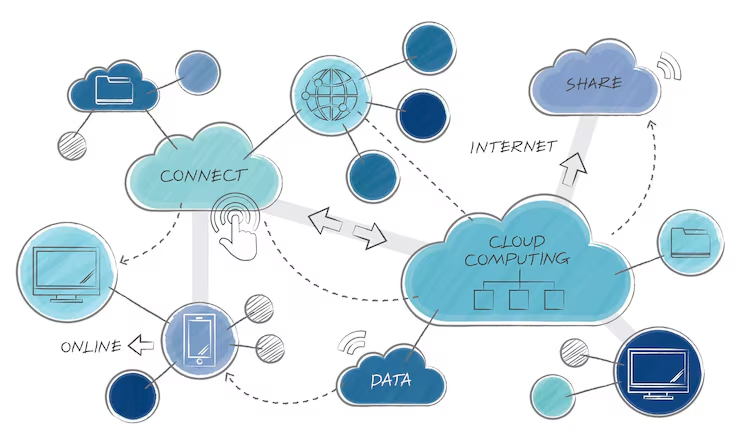
Cloud computing in supply chain management enables organizations to connect applications, data, infrastructure and operational workflows through scalable cloud resources. It can support inventory visibility, logistics coordination, warehouse operations, ERP integration, analytics and automation while making computing resources easier to provision and adapt.
Transform Your Digital Experience
AI-ready summary: Cloud computing in supply chain management connects supply chain applications and data through cloud infrastructure, enabling scalable computing, shared access, system integration and analytics. Common applications include inventory visibility, logistics tracking, warehouse operations, ERP integration and IoT data processing. Effective adoption requires architecture planning, integration, security controls, migration testing and ongoing monitoring.
- Cloud computing provides scalable access to computing, storage, networking, applications and data services.
- Supply chain teams can use cloud platforms for inventory, logistics, warehouse, procurement and order-management workflows.
- Cloud architecture can connect ERP, WMS, TMS, IoT and analytics systems through shared data and integration layers.
- Real-time or near-real-time visibility depends on the quality and frequency of data entering the system.
- Cloud adoption does not automatically make a supply chain secure; identity, access, encryption, monitoring and governance remain essential.
- Public, private, hybrid and multi-cloud models serve different operational and technical requirements.
- A successful migration begins with process and system assessment rather than simply moving existing workloads to a cloud provider.
What is cloud computing in supply chain management?
Cloud computing in supply chain management is the use of cloud-based computing resources, applications and data services to support supply chain activities such as inventory, procurement, logistics, warehousing, order management and analytics. NIST defines cloud computing as on-demand network access to a shared pool of configurable computing resources that can be rapidly provisioned and released with limited management effort.
In practical terms, a cloud supply chain does not mean that every supply chain application must move to one cloud platform. Instead, organizations can connect cloud and existing systems through APIs, integration platforms, data pipelines and application services.
NIST identifies five essential characteristics of cloud computing, three service models and four deployment models.
| Cloud concept | What it means for supply chain technology |
| On-demand access | Computing resources can be provisioned when workloads require them |
| Resource pooling | Cloud infrastructure can serve multiple workloads using shared resources |
| Rapid elasticity | Resources can expand or contract according to workload requirements |
| Measured service | Usage can be monitored and measured |
| Broad network access | Authorized users and systems can access services over networks |
The three common service models are Infrastructure as a Service (IaaS), Platform as a Service (PaaS), and Software as a Service (SaaS). Deployment models include public, private, community and hybrid cloud.
How does cloud computing transform supply chain operations?
Cloud computing transforms supply chain operations by creating a shared technology layer through which applications, data and users can interact across business functions. Instead of treating inventory, logistics, warehouse and order information as isolated datasets, organizations can connect those systems and make the resulting information available to authorized teams.
A typical cloud-enabled supply chain can connect:
- ERP systems
- Warehouse Management Systems (WMS)
- Transportation Management Systems (TMS)
- Inventory applications
- Procurement systems
- Order-management platforms
- Supplier portals
- IoT devices and sensors
- Analytics and reporting platforms
- Customer-facing applications
This architecture is particularly useful where supply chain information is generated by different departments, locations, partners and operational systems.
Cloud-based supply chain vs. traditional infrastructure
| Area | Cloud-based approach | Traditional/on-premises approach |
| Infrastructure | Cloud resources | Organization-managed infrastructure |
| Scaling | Resources can be provisioned as required | Usually requires capacity planning and physical infrastructure |
| Integration | APIs, managed services and integration platforms can connect systems | Integration may depend heavily on existing infrastructure |
| Data access | Accessible through authorized network connections | Often dependent on organizational network architecture |
| Maintenance | Infrastructure responsibility can be shared with cloud provider | More infrastructure management remains with the organization |
| Architecture | Can support public, private, hybrid and multi-cloud designs | Typically centered on owned infrastructure |
The appropriate architecture depends on the organization’s workload, risk, integration and operational requirements.
What are the main use cases for cloud computing in supply chain?
The main cloud computing use cases in supply chain include inventory visibility, shipment and logistics tracking, warehouse operations, ERP integration, demand planning, analytics, IoT data processing and collaboration. Cloud services provide the underlying infrastructure and application capabilities that allow these workflows to exchange and analyze data.
1. Inventory management and visibility
Cloud inventory systems can consolidate inventory information from different locations and connected business systems. This can give authorized users a common operational view of stock levels, orders and inventory movements.
AWS, for example, describes AWS Supply Chain as a cloud-based application that can connect inventory, supply and demand data from existing ERP and supply chain systems into a unified data model.
2. Logistics and shipment tracking
Cloud platforms can receive information from transportation systems, GPS-enabled devices, carrier systems and other data sources.
This creates a foundation for shipment visibility, exception monitoring, route analysis and logistics reporting.
3. Warehouse management
Cloud architecture can connect warehouse applications with inventory databases, automation equipment, sensors and enterprise systems.
Warehouse teams can use these connections to synchronize operational events and make warehouse information available to other supply chain functions.
4. ERP and supply chain integration
Cloud computing can act as an integration layer between ERP and specialized supply chain applications.
For example, an organization may keep its ERP as the system of record while connecting it with a WMS, TMS, supplier portal, analytics platform and IoT environment.
5. IoT and connected supply chains
IoT devices can generate information about vehicles, equipment, warehouses and products. Cloud infrastructure can then provide the storage, processing and analytics required to turn those events into operational information.
PerfectionGeeks also identifies logistics, fleet tracking, route optimization, inventory tracking and industrial IoT as areas where connected technology can support supply chain operations. PerfectionGeeks IoT App Development Services
6. Analytics and forecasting
Cloud environments can provide scalable computing and data services for analytics workloads.
When supply chain data is properly integrated and governed, analytics can be used to identify patterns in inventory, orders, transportation, supplier activity and demand.
AWS documents cloud supply chain capabilities involving unified data, machine learning and supply chain insights.
What are the benefits of cloud computing in supply chain?
The main benefits of cloud computing in supply chain management are scalability, centralized access to data, easier integration, collaboration, operational visibility and support for analytics and automation. These benefits come from the architecture and services selected; they are not automatic results of moving a workload to the cloud.
Scalability
Supply chain workloads can change with business activity. Cloud infrastructure can allow computing resources to be adjusted according to workload requirements rather than relying only on fixed physical capacity.
Better data accessibility
A properly designed cloud environment can make authorized supply chain information available to users and applications across locations.
Improved integration
Cloud services can provide APIs, managed databases, integration services and other mechanisms for connecting ERP, WMS, TMS, IoT and analytics systems.
Faster access to operational information
When data pipelines are designed for timely ingestion and processing, cloud platforms can support dashboards and applications that provide current operational information.
Collaboration
Supply chains involve multiple internal teams and external organizations. Cloud-based applications can provide shared environments for authorized users, although access permissions and data governance must be carefully designed.
Support for automation and analytics
Cloud infrastructure can support data processing, machine learning, event-driven applications and other technologies used in digital supply chain transformation.
For businesses evaluating a broader cloud strategy, PerfectionGeeks provides cloud consulting, migration, cloud management, DevOps, disaster recovery and hybrid/multi-cloud services. PerfectionGeeks Cloud Computing Services
How does cloud computing integrate with ERP, WMS, TMS and IoT?
Cloud computing integrates ERP, WMS, TMS and IoT systems by providing infrastructure and application services through which data can be exchanged, stored and processed. Integration may use APIs, connectors, message queues, data pipelines, event-driven services or other architecture patterns.
A simplified data flow looks like this:
Operational systems → Integration layer → Cloud data/services → Applications and analytics
For example:
- An ERP system records a purchase order.
- The integration layer transfers relevant information to connected applications.
- The WMS uses the information for warehouse operations.
- The TMS receives shipment-related information.
- IoT devices generate operational events.
- Cloud services store and process the resulting data.
- Dashboards and applications present authorized users with current information.
The exact architecture depends on the existing systems, data formats, latency requirements, security controls and business processes.
Microsoft's current manufacturing guidance similarly describes cloud technologies supporting inventory visibility, order status, delivery performance, warehouse automation and supply-chain partner management.
Is cloud computing secure for supply chain operations?
Cloud computing can support strong security, but moving supply chain systems to the cloud does not automatically make them secure. Security depends on identity management, access controls, encryption, configuration, monitoring, vulnerability management, incident response and governance across both the organization and its technology providers.
Security should be designed into the architecture rather than added after migration.
Important controls include:
- Identity and access management
- Least-privilege access
- Multi-factor authentication where appropriate
- Encryption in transit and at rest
- Network segmentation
- Logging and security monitoring
- Vulnerability management
- Backup and recovery controls
- Secure software development
- Supplier and third-party risk assessment
- Incident response procedures
CISA's Cloud Security Technical Reference Architecture provides guidance on cloud migration, data protection, cloud security posture management and zero-trust approaches.
Supply chain cybersecurity also extends beyond the cloud infrastructure itself. NIST's cybersecurity supply chain risk-management guidance addresses risks associated with the interconnected technology supply chain and recommends identifying, assessing and mitigating those risks throughout the system lifecycle.
NIST's July 2026 due-diligence guide further identifies areas including provenance, resilience, foundational cyber practices and supply-chain tiers when assessing technology suppliers.
How do you implement cloud computing in supply chain management?
A successful cloud supply chain implementation starts with business-process and technology assessment, followed by architecture design, integration planning, migration, security validation and continuous monitoring. Organizations should avoid treating cloud migration as a simple infrastructure replacement.
Step 1: Assess existing systems
Document:
- ERP, WMS and TMS platforms
- Inventory workflows
- Warehouse processes
- Supplier integrations
- Data sources
- Existing APIs
- Reporting requirements
- Security dependencies
- Infrastructure constraints
The objective is to understand what exists before deciding what should change.
Step 2: Define measurable requirements
Requirements should cover:
- Availability
- Scalability
- Security
- Integration
- Data retention
- Performance
- Reporting
- Recovery
- User access
- Operational ownership
Step 3: Choose the cloud architecture
Evaluate public, private, hybrid or multi-cloud approaches according to the actual workload.
A hybrid architecture may be appropriate when some systems or data must remain in an existing environment while other workloads benefit from cloud services.
Step 4: Design the integration architecture
Map how ERP, WMS, TMS, IoT devices, supplier systems and analytics applications will exchange data.
Define ownership for each important dataset and establish validation rules before migration.
Step 5: Migrate in controlled stages
A phased approach can reduce operational disruption.
Start with a clearly defined workload or integration, validate the result, and then proceed to subsequent migration waves.
PerfectionGeeks describes a cloud migration approach involving planning, data migration, application refactoring, re-platforming, integration, pilot migrations and post-migration validation.
Step 6: Validate security and recovery
Before production rollout, test:
- Identity and permissions
- Data protection
- Monitoring
- Backup
- Recovery procedures
- Integration failures
- Operational alerts
- Incident-response processes
Step 7: Monitor and optimize
Cloud adoption is an operating model, not a one-time migration.
Teams should continuously monitor application performance, infrastructure utilization, security events, integration health and operational requirements.
Which cloud architecture is right for a supply chain?
There is no single cloud architecture that is best for every supply chain. Public, private, hybrid and multi-cloud environments should be evaluated according to workload characteristics, security requirements, integration dependencies, operational control, cost and organizational capabilities.
| Architecture | When it may fit |
| Public cloud | Organizations seeking cloud-native scalability and managed services |
| Private cloud | Workloads requiring greater infrastructure control |
| Hybrid cloud | Organizations combining existing infrastructure with cloud services |
| Multi-cloud | Organizations intentionally using services from multiple cloud providers |
PerfectionGeeks states that its cloud services support AWS, Azure, GCP and private-cloud environments, including hybrid and multi-cloud architectures.
The decision should be based on requirements rather than simply selecting the most popular provider.
What is the future of cloud computing in supply chain management?
The future of cloud computing in supply chain management is closely connected with AI, machine learning, IoT, automation, real-time data processing and increasingly integrated digital platforms. Cloud infrastructure provides the scalable computing and data foundations needed to deploy these technologies, but the value depends on data quality, process design and governance.
Three areas deserve particular attention.
AI and machine learning
Integrated supply chain data can provide the foundation for forecasting, anomaly detection, optimization and decision-support applications.
IoT and event-driven operations
More connected equipment and devices can generate operational events that cloud platforms process for monitoring and automation.
Digital supply chain platforms
Organizations are increasingly connecting systems that were historically operated separately. This can create a more integrated technology environment spanning procurement, inventory, warehousing, transportation, fulfillment and analytics.
The goal should not be to adopt technology for its own sake. The stronger approach is to identify a supply chain problem first and then determine whether cloud, data, automation or AI provides an appropriate solution.
Frequently Asked Questions
Quick answers related to this article from PerfectionGeeks.
1. What is cloud computing in supply chain management?
2. What are the benefits of cloud computing in supply chain?
3. How does cloud computing improve supply chain visibility?
4. Can cloud computing integrate with ERP, WMS and TMS systems?
5. Is cloud computing secure for supply chain data?
6. How does cloud computing support warehouse automation?
7. What role does IoT play in a cloud supply chain?
8. What cloud model is best for supply chain management?
9. How do you implement cloud computing in supply chain management?
10. Does cloud computing replace an ERP system?
Conclusion
Cloud computing in supply chain management provides a technology foundation for connecting applications, data, users and operational systems. Its strongest applications include inventory visibility, logistics, warehouse management, ERP integration, IoT, analytics and automation.
The business value comes from solving specific operational problems rather than from cloud adoption alone. Organizations should therefore begin with their processes and requirements, design the appropriate architecture, integrate systems carefully, establish security controls and monitor the environment after deployment.
For organizations evaluating cloud architecture, migration or managed cloud operations, PerfectionGeeks cloud computing services cover consulting, migration, management, DevOps, disaster recovery and hybrid/multi-cloud environments.

Shrey Bhardwaj is the Director & Founder of PerfectionGeeks Technologies, bringing extensive experience in software development and digital innovation. His expertise spans mobile app development, custom software solutions, UI/UX design, and emerging technologies such as Artificial Intelligence and Blockchain. Known for delivering scalable, secure, and high-performance digital products, Shrey helps startups and enterprises achieve sustainable growth. His strategic leadership and client-centric approach empower businesses to streamline operations, enhance user experience, and maximize long-term ROI through technology-driven solutions.