Published 15 May 2026 | Updated 15 May 2026
technology
ERP for Logistics: How 3PLs Are Replacing Spreadsheets with Custom Software
The logistics industry is growing fast, and managing operations with spreadsheets and manual processes is no longer enough. As shipment volumes increase and customer expectations rise, logistics companies and 3PL providers need smarter ways to manage warehouses, fleets, orders, billing, and real-time tracking. This is where ERP for logistics becomes essential. A custom logistics ERP system helps businesses automate operations, reduce errors, improve visibility, and scale efficiently. In this blog, we will explore how 3PL companies are replacing spreadsheets with custom software and why ERP solutions are transforming modern logistics management.
- Spreadsheets were once the go-to tool for managing logistics operations — but they are no longer enough for growing 3PL businesses.
- ERP software for logistics brings all your operations — orders, inventory, warehousing, fleet, billing — into one connected system.
- There are different types of ERP systems built specifically for the logistics industry, each solving unique business challenges.
- Custom logistics software development allows 3PLs to build solutions tailored exactly to how their business works.
- The benefits of adopting a logistics ERP system go far beyond saving time — they directly impact profitability, customer satisfaction, and growth.
- Choosing the right ERP for logistics requires understanding your business size, operations, and long-term goals.
- PerfectionGeeks specializes in custom ERP development services and logistics software development for 3PL businesses worldwide.
The Problem With Spreadsheets in Logistics
Running a logistics business is not simple. You are tracking shipments, managing warehouse stock, coordinating drivers, handling client billing, and making sure everything arrives on time. For years, logistics companies — especially third-party logistics providers (3PLs) — relied on spreadsheets to manage all of this. But as business grew, the cracks started to show. One missed update in a cell and an entire shipment goes to the wrong location. Two team members editing the same file at the same time and the data becomes unreliable. Your operations manager spending three hours every Monday pulling together a report that should take fifteen minutes. This is exactly why thousands of logistics businesses are making the switch from spreadsheets to proper ERP software for logistics. Not because it is trendy, but because it works — and because it helps them compete, scale, and serve their customers better.
What Is ERP for Logistics?
ERP for logistics stands for Enterprise Resource Planning for the logistics industry. It is a software system that connects all the moving parts of your business into one unified platform.
Instead of having separate tools for warehouse management, fleet tracking, order processing, invoicing, and reporting — a logistics ERP system brings all of these together. Every team member sees the same data in real time. Every process is connected. Every decision is backed by accurate, up-to-date information.
Think of it as the central nervous system of your logistics business. When one part moves, every other part knows about it instantly.
ERP software for logistics companies is used by freight forwarders, courier companies, 3PL providers, supply chain managers, last-mile delivery businesses, and large-scale distributors. Whether you are moving ten shipments a day or ten thousand, the right logistics management software keeps everything under control.
Why 3PLs Specifically Need a Logistics ERP System
Third-party logistics providers operate one of the most complex business models in the supply chain world. They are not just moving goods — they are managing multiple clients, multiple carriers, multiple warehouses, and multiple service types all at once.
Here is what a typical 3PL juggles every single day:
- Receiving and processing orders from multiple clients
- Allocating warehouse space and managing inventory for each client separately
- Coordinating pick, pack, and ship operations
- Tracking fleet movements and driver schedules
- Generating client-specific billing and invoicing
- Handling returns and reverse logistics
- Producing reports for every client on their individual performance
Doing all of this with spreadsheets is not just inefficient — it is risky. One error can cost you a major client relationship.
3PL software solutions built on a proper ERP for logistics framework eliminate these risks by automating workflows, reducing manual data entry, and giving your team a single source of truth for all operations.
Key Features of ERP Software for Logistics
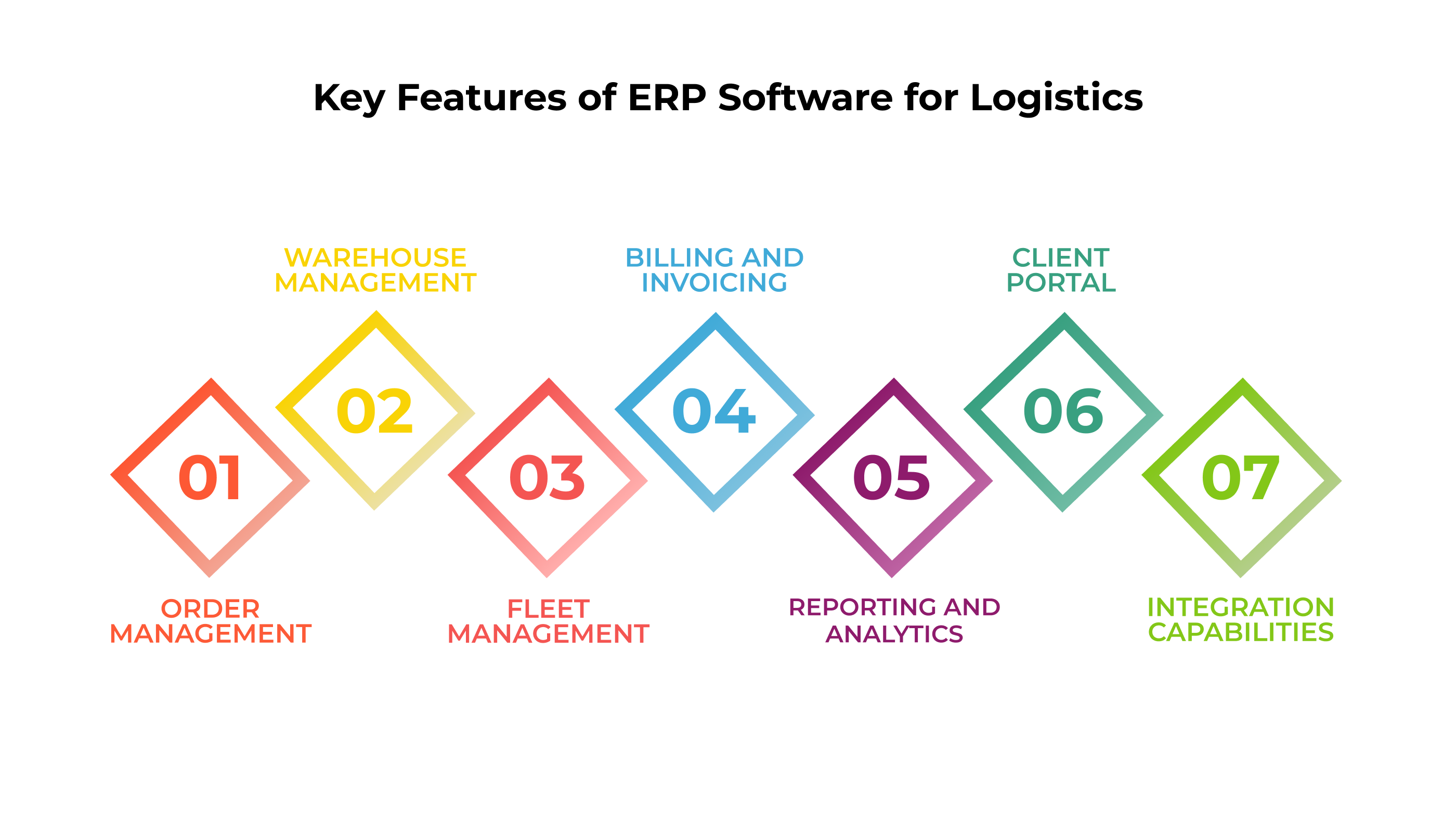
Not all ERP systems are created equal. Here are the core features that make a logistics ERP software genuinely powerful for 3PLs and logistics businesses:
1. Order Management
Capture, process, and track orders from multiple channels and clients in one place. No more switching between tabs or reconciling data from different files.
2. Warehouse Management
A 3PL warehouse management system helps you manage stock locations, picking routes, receiving, and dispatch. Real-time inventory visibility means you always know what is where.
3. Fleet Management
Fleet management software integrated into your ERP tracks vehicle locations, driver performance, fuel usage, maintenance schedules, and delivery status in real time.
4. Billing and Invoicing
Automate client billing based on shipment data, storage duration, value-added services, and custom pricing models. Eliminate billing errors and speed up cash flow.
5. Reporting and Analytics
Get instant reports on shipment volumes, on-time delivery rates, warehouse utilization, cost per shipment, and more — without spending hours pulling data manually.
6. Client Portal
Give your clients a login to track their own shipments, view their inventory, and download reports. This builds trust and reduces support calls.
7. Integration Capabilities
The best ERP systems for logistics connect with your existing tools — eCommerce platforms, carrier APIs, accounting software, and government customs portals.
Types of ERP Solutions for the Logistics Industry
Understanding the types of software outsourcing for ERP helps you make the right choice. Here is how logistics ERP solutions are generally categorized:
Off-the-Shelf ERP
Pre-built software that you buy and configure. Examples include SAP, Oracle, and Microsoft Dynamics. These are powerful but expensive, and often require significant customization to fit a specific 3PL's workflow.
Industry-Specific Logistics ERP
Software built specifically for the logistics industry. These are closer to what most 3PLs need out of the box, but may still require adjustments to match your exact processes.
Custom Logistics Software Development
You work with a logistics software development company to build an ERP system from scratch — or to heavily customize an existing one — so it fits your business perfectly. This is the option that gives you the most control, the best fit, and the greatest long-term value.
Custom ERP development services are particularly popular among mid-size and growing 3PLs who have outgrown generic software but do not want to pay for the complexity of SAP or Oracle.
Spreadsheets vs. Logistics ERP — A Direct Comparison
| Feature | Spreadsheets | Logistics ERP Software |
|---|---|---|
| Real-Time Data | No — manually updated | Yes — auto-updated across all users |
| Multi-User Access | Risky — version conflicts | Yes — role-based access for all teams |
| Order Tracking | Manual entry | Automated end-to-end tracking |
| Warehouse Management | Not possible | Built-in WMS module |
| Fleet Tracking | Not possible | GPS and real-time fleet visibility |
| Client Billing | Manual and error-prone | Automated based on actual data |
| Reporting | Hours of manual work | One-click real-time reports |
| Scalability | Falls apart as volume grows | Scales with your business |
| Integration | None | Connects with carriers, eCommerce, accounting |
| Error Rate | High | Significantly reduced |
The numbers speak for themselves. A logistics ERP system is not just a software upgrade — it is a business upgrade.
Benefits of ERP Software for Logistics
Here is why so many logistics businesses are investing in ERP for the logistics industry:
Operational Efficiency
When your teams are not chasing down data across different files and tools, they get more done. Automation handles the repetitive tasks — so your people can focus on work that actually requires human judgment.
Fewer Errors, Fewer Losses
Manual data entry is the number one source of errors in logistics. A wrong address, a missed quantity update, an unchecked billing line — each of these can cost money and damage client relationships. ERP software for logistics reduces human error dramatically.
Faster Delivery Cycles
With automated order processing, optimized picking routes, and real-time fleet tracking, your deliveries go out faster. Faster delivery means happier clients and more repeat business.
Complete Visibility
From the moment an order is placed to the moment it is delivered, you can see exactly what is happening, where everything is, and what the status of every shipment is. This level of visibility is simply not possible with spreadsheets.
Better Client Relationships
Clients want transparency. When you can give them a live portal to track their inventory and shipments, they trust you more. And when billing is accurate and on time, they stay longer.
Scalability
As your business grows — more clients, more warehouses, more vehicles, more volume — your logistics ERP software grows with you. You do not need to rebuild your processes every time you scale up.
Data-Driven Decisions
With proper reporting and analytics built into your ERP system for logistics, you can spot trends, identify bottlenecks, and make smarter business decisions. Instead of guessing, you are deciding based on real data.
Cost Reduction
Yes, there is an upfront investment in ERP implementation for logistics. But the cost savings from reduced errors, faster processing, less manual labor, and better resource utilization more than make up for it over time.
Benefits of Logistics ERP — At a Glance
| Benefit | Business Impact |
|---|---|
| Operational Efficiency | More output with fewer resources |
| Error Reduction | Lower costs, happier clients |
| Faster Deliveries | Competitive advantage |
| Full Visibility | Better control and decision-making |
| Client Transparency | Stronger relationships and retention |
| Scalability | Growth without growing pains |
| Analytics | Smarter, faster business decisions |
| Cost Savings | Long-term ROI on your ERP investment |
Custom Logistics Software Development — Is It Right for You?
Off-the-shelf ERP systems are built for the average business. But logistics — especially 3PL operations — is rarely average. Your pricing models, your warehouse layouts, your carrier integrations, your client reporting requirements — all of these are specific to your business.
Custom logistics software development means you get a system built around how you actually work — not the other way around.
Here is when custom ERP development makes the most sense:
- Your business has unique workflows that generic software cannot handle
- You manage multiple warehouses or locations with different processes
- You have complex client billing structures that standard software cannot automate
- You are integrating with a large number of carriers or eCommerce platforms
- You want to own your software and not be locked into a vendor's pricing model
PerfectionGeeks offers end-to-end custom ERP development services for logistics companies. Our team has built 3PL software solutions, 3PL warehouse management systems, and full-scale logistics ERP systems for businesses across the globe. We understand the complexity of third-party logistics and we build software that handles it.
How to Choose the Best ERP for Logistics
With so many options available, picking the best ERP for logistics can feel overwhelming. Here is a simple framework to guide your decision:
Step 1 — Map Your Current Pain Points
What is breaking down in your current process? Where are errors happening most? What tasks are taking too long? Start with the problems you need to solve.
Step 2 — Define Your Must-Have Features
Based on your pain points, list the features you absolutely need — warehouse management, fleet tracking, client portal, billing automation, or all of the above.
Step 3 — Decide: Off-the-Shelf vs. Custom
If a standard product covers 90% of your needs, it might be the right starting point. But if your operations are complex or highly specific, custom logistics software development will deliver far better results.
Step 4 — Evaluate Vendors and Partners
Look for a logistics software development company with proven experience in the logistics space. Ask for case studies, references, and a clear development process. Check how they handle post-launch support.
Step 5 — Plan Your ERP Implementation
ERP implementation for logistics requires careful planning. Map out your data migration, staff training, go-live timeline, and rollback plan in case of issues. A phased rollout often works better than switching everything at once.
Step 6 — Measure Results
After go-live, track key metrics — order processing time, delivery accuracy, billing error rate, warehouse utilization. Use these to validate the ROI of your investment and identify areas for further improvement.
How PerfectionGeeks Helps Logistics Businesses
PerfectionGeeks is a trusted logistics software development company with deep expertise in building custom solutions for 3PLs, freight forwarders, courier companies, and supply chain businesses.
- Deep understanding of third-party logistics software requirements
- Proven track record delivering 3PL warehouse management systems and full logistics ERP software
- Custom development — no cookie-cutter solutions
- Agile process with regular client updates and complete transparency
- Scalable architecture that grows with your business
- Integration expertise — carriers, eCommerce, accounting, customs portals
- Post-launch support and continuous improvement
Whether you need a full logistics ERP system built from scratch or want to upgrade your current outsourcing software tools, our team is ready to help.
Common Mistakes to Avoid During Logistics ERP Implementation
Even the best software can fail if the implementation is handled poorly. Here are mistakes to avoid:
- Skipping the discovery phase — jumping into development without fully mapping your requirements leads to a system that does not fit your workflow
- Underestimating data migration — moving data from spreadsheets to a new ERP requires careful planning and cleaning
- Neglecting staff training — even the best software is only as good as the people using it
- Going live all at once — a phased rollout reduces risk and gives your team time to adapt
- Ignoring integration needs — make sure your ERP connects with all the tools your clients and carriers already use
- Choosing on price alone — the cheapest development partner often costs more in fixes and delays later
Frequently Asked Questions
Quick answers related to this article from PerfectionGeeks.
1. What is ERP software for logistics?
2. What is the best ERP for logistics companies?
3. What is a 3PL warehouse management system?
4. How long does ERP implementation for logistics take?
5. Why should I choose PerfectionGeeks for logistics software development?
Conclusion
Spreadsheets had their moment. They helped logistics businesses get off the ground and manage early-stage operations. But as your business grows, the limitations become impossible to ignore missed updates, version conflicts, billing errors, lack of real-time visibility, and hours wasted on manual reporting.
ERP software for logistics solves all of this. It brings your entire operation orders, warehousing, fleet, billing, reporting, and client communication — into one connected, automated system. For 3PLs managing multiple clients and complex workflows, the impact is even greater. Whether you choose an off-the-shelf logistics ERP software or invest in custom logistics software development, the direction is clear: manual processes cannot support long-term growth. The businesses winning in logistics right now are the ones that have replaced spreadsheets with smart, scalable systems.
PerfectionGeeks is here to help you make that transition — with the right technology, the right process, and a team that genuinely understands the logistics industry.

Shrey Bhardwaj is the Director & Founder of PerfectionGeeks Technologies, bringing extensive experience in software development and digital innovation. His expertise spans mobile app development, custom software solutions, UI/UX design, and emerging technologies such as Artificial Intelligence and Blockchain. Known for delivering scalable, secure, and high-performance digital products, Shrey helps startups and enterprises achieve sustainable growth. His strategic leadership and client-centric approach empower businesses to streamline operations, enhance user experience, and maximize long-term ROI through technology-driven solutions.