Published 12 January 2026 | Updated 13 January 2026
App
How AI Is Helping Retail Companies in Egypt Cut Costs and Improve Efficiency
“In retail, every decision matters — from what to stock to how customers are served. Artificial Intelligence is helping retailers make those decisions smarter, faster, and more profitable.”
Artificial Intelligence (AI) is no longer just a buzzword in global business discussions. In Egypt, it is quickly becoming a practical solution for retail companies looking to reduce costs, improve efficiency, and meet rising customer expectations. What once required large teams, guesswork, and manual effort can now be handled with intelligent systems that learn, adapt, and improve over time.
At PerfectionGeeks Technologies, we see AI as a powerful business enabler rather than a complex technology. Retailers across Egypt — from supermarkets and fashion stores to electronics and eCommerce brands — are using AI to streamline operations, optimize inventory, personalize customer experiences, and make better business decisions.
This blog explores how AI is transforming retail in Egypt, where it is delivering the most value, and how real companies are already benefiting from it.
Why AI Is Gaining Momentum in Egypt’s Retail Sector
Egypt’s retail industry is evolving rapidly. Digital payments, online shopping, mobile apps, and social commerce are becoming common. At the same time, retailers face growing challenges such as:
- Rising Operational and Labor Costs
AI helps automate routine tasks, reducing dependence on manual labor and lowering operational expenses. - Inventory Mismanagement and Wastage
AI-driven demand forecasting minimizes overstocking and stock shortages, reducing waste and storage costs. - Intense Competition from Regional and Global Brands
AI enables local retailers to compete by offering personalized experiences and data-driven pricing strategies. - Changing Customer Buying Behavior
AI analyzes customer preferences and shopping patterns, helping retailers adapt quickly to market trends. - Growing Adoption of Digital and Online Shopping
AI supports seamless omnichannel experiences across online and offline retail platforms. - Need for Faster Decision-Making
AI processes large volumes of data in real time, allowing retailers to make quicker and smarter business decisions. - Focus on Cost Optimization and Profitability
AI identifies inefficiencies across operations, helping retailers improve margins and overall profitability.
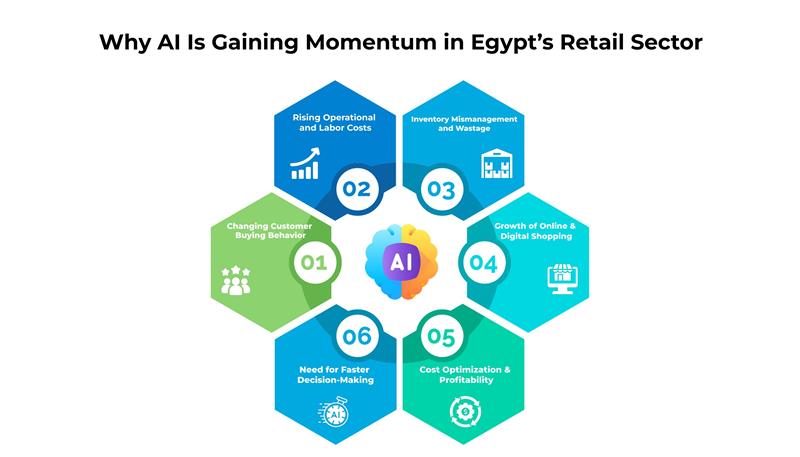
AI helps retailers tackle these challenges by automating processes, analyzing large volumes of data, and providing insights that humans alone cannot easily detect.
Instead of reacting to problems after they happen, AI allows retailers to predict, plan, and prevent inefficiencies.
AI’s Economic Impact Across Industries
Artificial Intelligence is expected to add massive value to the Middle East economy by 2030. While several industries benefit from AI adoption, retail stands out because of its direct connection to consumers and data-driven decision-making.
Expected AI Contribution by Industry (2030)
| Industry | 2030 Contribution (US$ Billion) | Share of ME GDP |
|---|---|---|
| Construction & Manufacturing | 99 | 12.4% |
| Energy, Utilities & Resources | 78 | 6.3% |
| Public Sector (Health & Education) | 59 | 18.6% |
| Financial, Professional & Admin Services | 38 | 13.6% |
| Retail, Wholesale & Consumer Goods | 23 | 19% |
| Transport & Logistics | 12 | 15.2% |
| Technology, Media & Telecom | 10 | 14% |
Although retail does not have the highest dollar contribution, it has one of the largest GDP shares, showing how deeply AI can influence consumer-driven sectors.
1. AI Is Transforming Customer Experience
Customer experience is one of the first areas where retailers see clear benefits from AI.
How AI Enhances the Shopping Experience
Retailers in Egypt are using AI to:
- Recommend products based on customer preferences
- Power chatbots that answer questions 24/7
- Enable visual search using product images
- Deliver personalized offers and promotions
These tools reduce customer wait times, increase engagement, and boost sales — all while lowering customer service costs.
Real Example: AI-Powered Marketing Results
A major electronics retailer in Cairo adopted AI-based advertising optimization tools. By using machine learning to analyze customer data and ad performance, the retailer achieved:
- Better ad targeting
- Lower marketing spend
- Nearly 50% increase in sales
Similarly, a startup in Alexandria used AI-driven customer insights and automated campaigns to double its market share within a short time.
2. Smarter Inventory and Demand Forecasting
Inventory mismanagement is one of the biggest cost drivers in retail. Overstocking leads to storage costs and wastage, while stock shortages result in lost sales and unhappy customers.
AI solves this problem by analyzing:
- Past sales data
- Seasonal demand trends
- Customer buying behavior
- External factors like promotions and holidays
Benefits of AI-Based Inventory Management
Accurate demand forecasting
- Reduced overstock and stockouts
- Lower holding and warehousing costs
- Improved product availability
Case Study: Grocery Retail Efficiency
A well-known grocery chain in Egypt implemented AI-powered demand forecasting and replenishment systems. The outcome was:
- Fresher products on shelves
- Reduced food waste
- Improved inventory turnover
This not only lowered costs but also improved customer trust and satisfaction.
3. Cutting Costs with Back-Office Automation
Many retail expenses come from internal operations that customers never see. AI helps automate these back-office tasks efficiently.
AI Can Automate:
- Invoice and billing processes
- Order and supplier management
- Workforce scheduling
- Reporting and data entry
Retailers using AI-driven automation have reported up to 80% reduction in manual work, allowing teams to focus on strategy, sales, and customer engagement instead of repetitive tasks.
4. Supply Chain and Logistics Optimization
Supply chain inefficiencies can significantly increase costs. AI helps retailers improve logistics by offering real-time insights and predictive planning.
How AI Improves Logistics
- Optimizes delivery routes to save fuel
- Predicts delays and supply disruptions
- Improves warehouse operations
- Enhances coordination with suppliers
With AI-powered logistics, retailers can deliver faster, reduce transportation costs, and maintain better inventory flow.
5. Data-Driven Decisions with AI Analytics
Retailers generate massive amounts of data daily — from sales transactions to customer interactions. AI turns this data into actionable insights.
With AI analytics, retailers can:
- Identify best-performing products
- Optimize pricing strategies
- Understand customer preferences
- Plan new store locations effectively
This shift from intuition-based decisions to data-driven strategies leads to better outcomes and higher profitability.
6. Egypt’s Growing AI Ecosystem
Egypt is steadily building a strong AI ecosystem. Local startups, developers, and analytics firms are creating AI solutions tailored to regional retail needs. Government initiatives supporting digital transformation are also accelerating adoption.
This environment makes AI more accessible and affordable, enabling retailers of all sizes to benefit from intelligent technologies.
Challenges Retailers Must Address
Despite its advantages, AI adoption comes with challenges that retailers must manage carefully.
Common Challenges
- Data privacy and security concerns
- Resistance from employees due to fear of automation
- Poor-quality or fragmented data
With proper planning, employee training, and the right technology partners, these challenges can be effectively addressed.
How Retailers in Egypt Can Start Using AI
Retailers do not need to adopt AI all at once. A gradual approach works best.
Practical Steps to Begin
- Identify a specific problem (inventory, marketing, support)
- Start with a pilot AI project
- Measure results and optimize
- Train staff to work alongside AI tools
- Partner with experienced AI experts
The Future of AI in Egyptian Retail
The future of retail in Egypt will be increasingly intelligent. AI will play a larger role in:
- Dynamic pricing strategies
- Smart checkout systems
- Visual merchandising
- Predictive supply chain planning
- Retailers that invest early will gain a strong competitive advantage.
Case Study: AI-Driven Retail Growth in Egypt
Client Overview: A mid-sized Egyptian retail chain with 20+ stores struggled with inventory inefficiencies and inconsistent customer engagement.
Key Challenge: Frequent stockouts, excess wastage, and lack of personalized shopping experiences.
AI Solution Implemented: The retailer adopted AI-powered demand forecasting, inventory management systems, and customer behavior analytics.
Implementation Process: Machine learning models analyzed historical sales, seasonal trends, and real-time data to automate restocking and personalize offers.
Results Achieved:
- 30% reduction in inventory wastage
- 25% improvement in stock availability
- 20% increase in customer retention
Key Takeaway: AI enabled smarter decisions, operational efficiency, and enhanced customer satisfaction in Egypt’s competitive retail market.
Frequently Asked Questions
Quick answers related to this article from PerfectionGeeks.
1. How is AI helping retail companies in Egypt?
2. Is AI affordable for small and mid-sized retailers in Egypt?
3. Which retail areas benefit the most from AI?
4. Does AI replace human jobs in retail?
5. How can a retail business start using AI?
Conclusion
Artificial Intelligence is reshaping the retail industry in Egypt by helping businesses cut costs, improve efficiency, and enhance customer experiences. From smarter inventory management to automated operations and personalized marketing, AI delivers real, measurable benefits.
At PerfectionGeeks Technologies, we help retail businesses adopt AI solutions that align with their goals and growth plans. If you are ready to modernize your retail operations and stay ahead in a competitive market, contact us today and begin your AI transformation journey.

Shrey Bhardwaj is the Director & Founder of PerfectionGeeks Technologies, bringing extensive experience in software development and digital innovation. His expertise spans mobile app development, custom software solutions, UI/UX design, and emerging technologies such as Artificial Intelligence and Blockchain. Known for delivering scalable, secure, and high-performance digital products, Shrey helps startups and enterprises achieve sustainable growth. His strategic leadership and client-centric approach empower businesses to streamline operations, enhance user experience, and maximize long-term ROI through technology-driven solutions.