
Published 10 February 2026 | Updated 10 February 2026
Technology
How to Build an EdTech App in Australia: Features, Cost, and Development Process
Building an EdTech app in Australia is a smart decision as digital learning continues to grow across schools, universities, startups, and corporate training. Online education platforms are now essential, not optional. This blog covers everything needed to understand EdTech app development in Australia, including the market overview, types of apps, essential features, development process, cost, technology stack, compliance requirements, and key challenges.
Overview of the EdTech Market in Australia
Australia has one of the most advanced education systems in the world, and digital learning has become a core part of it. Online education is no longer optional it’s expected.
Here’s what’s driving the growth of the EdTech app in Australia:
- Strong demand for remote and hybrid learning
- Growing international student population
- Government support for digital education
- High smartphone and internet usage
- Rising need for skill-based and vocational training
Because of this, institutions and startups are actively working with an edtech app development company or an education app development company to build scalable learning platforms.The focus is no longer just on content delivery. Today, successful elearning app development is about personalization, engagement, analytics, and performance tracking.
Types of EdTech Apps You Can Build in Australia
Different education goals require different elearning app development solutions, features, and technology approaches.
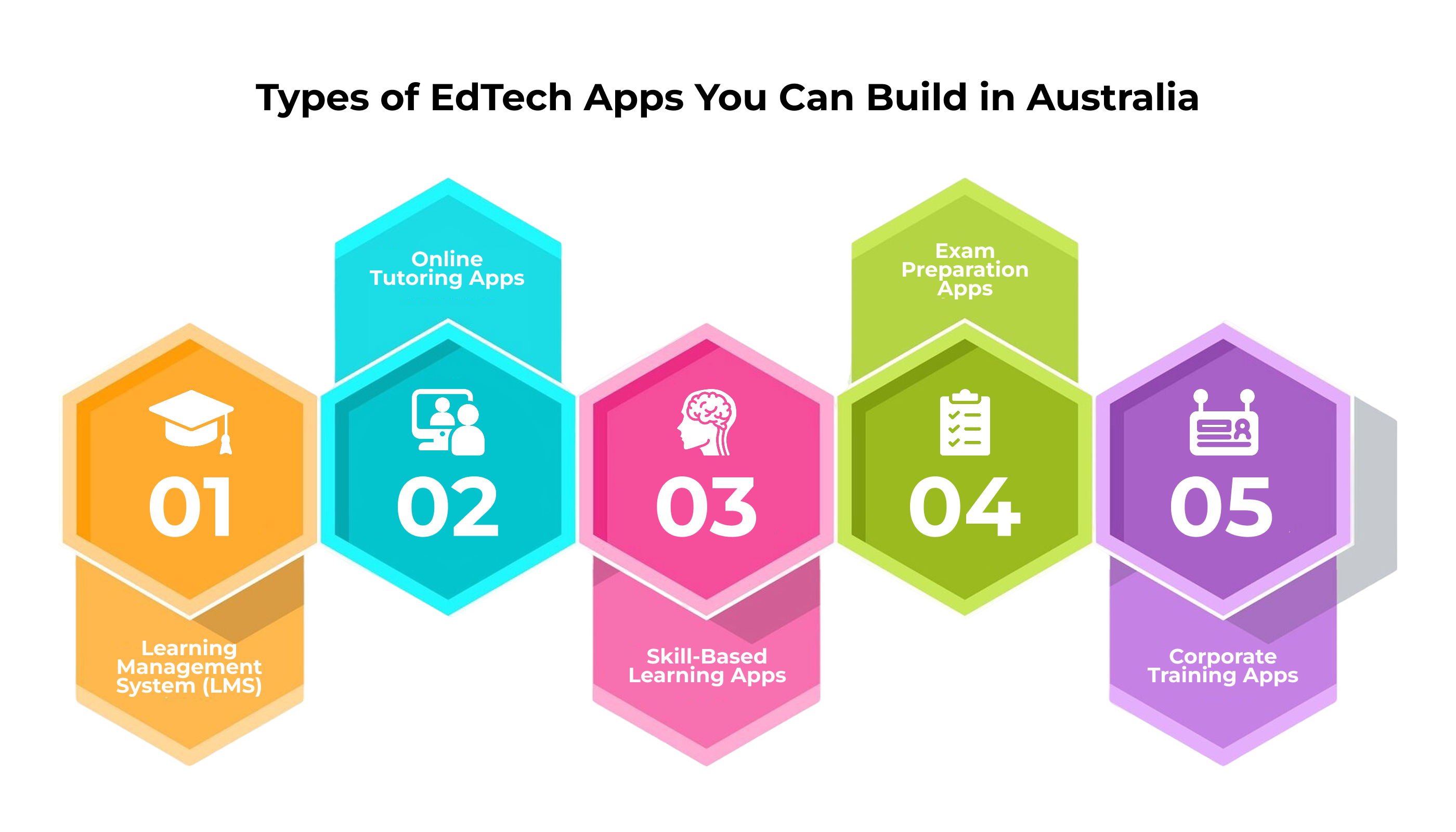
Learning Management System (LMS)
An LMS is used by schools, universities, and enterprises to manage digital learning in one place. It allows administrators to create courses, enroll students, assign teachers, and conduct assessments. LMS platforms are widely used across Australia for academic and professional learning.
Online Tutoring Apps
Online tutoring apps enable one-to-one or group learning through live video sessions. They include features like scheduling, chat, and virtual classrooms. These apps are ideal for personalized learning and remote education.
Skill-Based Learning Apps
These apps focus on practical skills such as coding, design, languages, business, or career development. Content is usually structured into short lessons with quizzes and projects. Skill-based apps are popular among professionals and students looking to upskill.
Exam Preparation Apps
Exam preparation apps are designed to help students prepare for academic, entrance, and competitive exams. They include mock tests, practice questions, progress tracking, and performance analysis. These apps help learners improve accuracy and confidence.
Corporate Training Apps
Corporate training apps are used by organizations to train employees, manage onboarding, and ensure compliance. They offer structured courses, assessments, and progress reports. Such apps help companies improve productivity and standardize learning.
Essential EdTech App Features for the Australian Market
Choosing the right EdTech app features is critical for building a successful learning platform. Based on real user expectations and education standards in Australia, these features are considered essential.
User Registration and Roles
This feature allows different users—students, teachers, and administrators—to log in with role-based access. Each user gets a separate dashboard with relevant permissions and tools. It helps manage data securely and keeps the learning system well organized.
Course and Content Management
This feature supports multiple content formats such as videos, PDFs, quizzes, and assignments. Educators can easily upload, organize, and update courses. Learners get a structured learning path that improves understanding and engagement.
Live Classes and Video Streaming
Live class functionality enables real-time learning through secure video sessions. Features like chat, screen sharing, and session recording enhance interaction. This is especially important for remote and hybrid learning in Australia.
Assessments and Exams
This feature allows institutions to conduct quizzes, tests, and assignments digitally. Automated grading reduces manual effort and saves time for educators. Students receive instant feedback, helping them improve faster.
Progress Tracking and Analytics
Progress tracking shows students how they are performing over time. Teachers and institutions can access analytics to measure engagement, completion rates, and learning outcomes. This data helps improve course quality and teaching methods.
Payment and Subscription Management
This feature enables secure payments for courses and subscriptions. It supports invoices, recurring billing, and multiple payment options. A smooth payment system improves user trust and revenue flow.
Notifications and Alerts
Notifications keep users informed about class schedules, deadlines, and important updates. Timely alerts improve attendance and course completion rates. This feature ensures learners stay engaged and organized.
Offline Access
Offline access allows users to download lessons and study without an internet connection. This is useful for learners in areas with limited connectivity. It ensures uninterrupted learning anytime, anywhere.
Step-by-Step EdTech App Development Process
Let me explain how EdTech app development usually works, from the initial idea to a successful app launch.
Step 1: Idea Validation and Market Research
At this stage, we study your idea to check if it solves a real education problem. We analyze the target audience, competitors, and trends in the edtech app in Australia. This helps ensure the app has strong market demand before development begins.
Step 2: Requirement Gathering
Here, we define all technical and business requirements clearly. This includes selecting features, user roles, platforms (Android, iOS, web), and future scalability needs. A detailed plan helps avoid confusion and extra costs later.
Step 3: UI/UX Design
Design focuses on creating a simple, clean, and user-friendly interface. The goal is to make learning easy and engaging for students of all age groups. Good UI/UX improves user retention and overall learning experience.
Step 4: App Development
This is where actual EdTech mobile app development begins. Developers build the frontend and backend using secure and scalable technologies. The app structure is designed to support future growth and feature expansion.
Step 5: Content Integration
Educational content such as courses, videos, quizzes, and assignments is added to the app. Content is organized in a structured way to make learning smooth and interactive. Quality content plays a key role in app success.
Step 6: Testing and Quality Assurance
The app is tested for performance, security, and usability issues. This ensures the app runs smoothly across devices and platforms. Bugs and errors are fixed before the final launch to avoid user issues.
Step 7: Deployment and Launch
Once testing is complete, the app is deployed on app stores or private servers. This step includes final configurations, server setup, and store approvals. The app is now ready for users.
Step 8: Maintenance and Updates
After launch, regular updates are required to improve performance and add new features. Ongoing technical support ensures the app remains secure and up to date. Continuous improvement helps retain users long-term.
A professional edtech app development company manages this entire process efficiently, ensuring transparency, quality, and timely delivery.
EdTech App Development Cost in Australia
Now let’s talk about one of the most important questions EdTech app development cost.
Average EdTech App Development Cost in Australia
| App Complexity | Features Included | Estimated Cost (AUD) |
| Basic EdTech App | User login, course listing, content viewing | 25,000 – 40,000 |
| Mid-Level App | LMS, payments, quizzes, notifications | 40,000 – 70,000 |
| Advanced App | Live classes, analytics, AI personalization | 70,000 – 120,000+ |
Factors Affecting Cost
- Number of features
- App complexity
- Platform (Android, iOS, Web)
- UI/UX design quality
- Third-party integrations
- Security and compliance requirements
An experienced edtech app development services provider helps you optimize cost without sacrificing quality.
Technology Stack for EdTech App Development
Choosing the right technology is crucial for performance and scalability in mobile app development education.
Frontend Technologies
- React Native
- Flutter
- Swift (iOS)
- Kotlin (Android)
Backend Technologies
- Node.js
- Laravel
- Django
Database
- PostgreSQL
- MongoDB
Cloud and Hosting
- AWS
- Google Cloud
- Microsoft Azure
Video Streaming
- WebRTC
- Zoom SDK
- Vimeo API
Payments
- Stripe
- PayPal
This tech stack supports long-term growth and stable elearning app development.
Compliance, Data Privacy, and Security in Australia
Education apps handle sensitive student data, so compliance is critical.
Key areas to consider:
- Australian Privacy Principles (APPs)
- Secure user authentication
- Encrypted data storage
- GDPR compliance for international users
- Secure payment processing
A reliable education app development company ensures your app follows all legal and security standards.
Challenges in Building an EdTech App and How to Overcome Them
Every EdTech project faces challenges during development and after launch. Understanding these challenges early helps you plan better and build a more reliable learning platform.
User Engagement
Challenge: Students may lose interest if the learning experience feels boring or repetitive. Low engagement directly affects course completion and app retention.
Solution: Interactive content, gamification elements, progress tracking, and rewards keep learners motivated and involved.
Content Quality
Challenge: Poor or outdated content reduces the overall value of the app. Even the best technology cannot succeed without quality learning material.
Solution: Work closely with educators and subject experts, and update content regularly to keep it relevant and useful.
Scalability
Challenge: Performance issues often occur during peak usage times, such as exams or live classes. This can lead to app crashes and poor user experience.
Solution: Use cloud-based infrastructure and load balancing to handle high traffic smoothly and support future growth.
Technical Complexity
Challenge: Features like live video classes, analytics, and real-time interactions add technical complexity. Managing these features incorrectly can cause performance issues.
Solution: Use proven technologies and work with experienced developers who understand EdTech systems and scalability requirements.
Data Security
Challenge: Protecting student data and sensitive information is a major concern for education platforms. Any data breach can damage trust and reputation.
Solution: Implement strong encryption, secure authentication, and compliance-focused development practices from the start.
Frequently Asked Questions
Quick answers related to this article from PerfectionGeeks.
1. What is EdTech app development?
2. How much does EdTech app development cost in Australia?
3. Can PerfectionGeeks develop both mobile and web EdTech apps?
4. Can PerfectionGeeks build custom elearning solutions?
Conclusion
Building an EdTech app in Australia is a strong long-term investment. With the right idea, the right EdTech app features, and a clear development process, you can create a learning platform that truly delivers value. From planning and design to development and launch, success depends on choosing the right edtech app development company and focusing on user experience, content quality, and scalability. Whether you’re building a simple learning app or a full-scale digital education platform, EdTech app development offers immense opportunities in the Australian market.
If you approach it strategically, your elearning app development solution can grow into a trusted education platform with real impact.

Shrey Bhardwaj is the Director & Founder of PerfectionGeeks Technologies, bringing extensive experience in software development and digital innovation. His expertise spans mobile app development, custom software solutions, UI/UX design, and emerging technologies such as Artificial Intelligence and Blockchain. Known for delivering scalable, secure, and high-performance digital products, Shrey helps startups and enterprises achieve sustainable growth. His strategic leadership and client-centric approach empower businesses to streamline operations, enhance user experience, and maximize long-term ROI through technology-driven solutions.