Published 10 August 2026
Technology
How AI and Smart Software Are Quietly Reshaping Construction Materials Testing
Walk into most construction materials testing labs today, and honestly, not much looks different than it did fifteen years ago. Sieves. Ovens. Scales. A compression machine bolted to the floor. The equipment still works, still does what it's supposed to. What's changed is what happens after the test runs, not during it.
Testing concrete, soil, asphalt, aggregate, whatever the material, used to be treated as a purely physical job. Run the test. Write down the number. File it somewhere. That part hasn't gone anywhere, and it probably shouldn't. But the paperwork trail around it? That's where software has started to matter, mostly because a missed tolerance or a lost data sheet costs real money, and labs are tired of losing time to problems that have nothing to do with the actual testing.
- AI helps automate repetitive construction materials testing tasks.
- Automated data capture reduces manual entry and transcription errors.
- Predictive models can identify potential testing anomalies earlier.
- Digital calibration tracking simplifies compliance and audit preparation.
- AI works best as a support tool alongside skilled laboratory technicians.
- Reliable, calibrated testing equipment remains essential for accurate results.
- Start with small, high-volume tasks before implementing AI across the entire lab.
The Testing Was Never the Bottleneck
Ask a lab tech what eats up their week and you'll rarely hear "the tests take too long." It's the other stuff. Chasing calibration records that someone filed in the wrong folder. Typing the same result into two or three systems because none of them sync. Trying to reconstruct, a month later, why one batch of concrete came in under strength when everything looked fine on paper.
None of that is glamorous work, and it's exactly the kind of thing software handles well. Not because AI is some magic fix, but because a lot of these steps never needed a human doing them in the first place.
A handful of places this is already showing up:
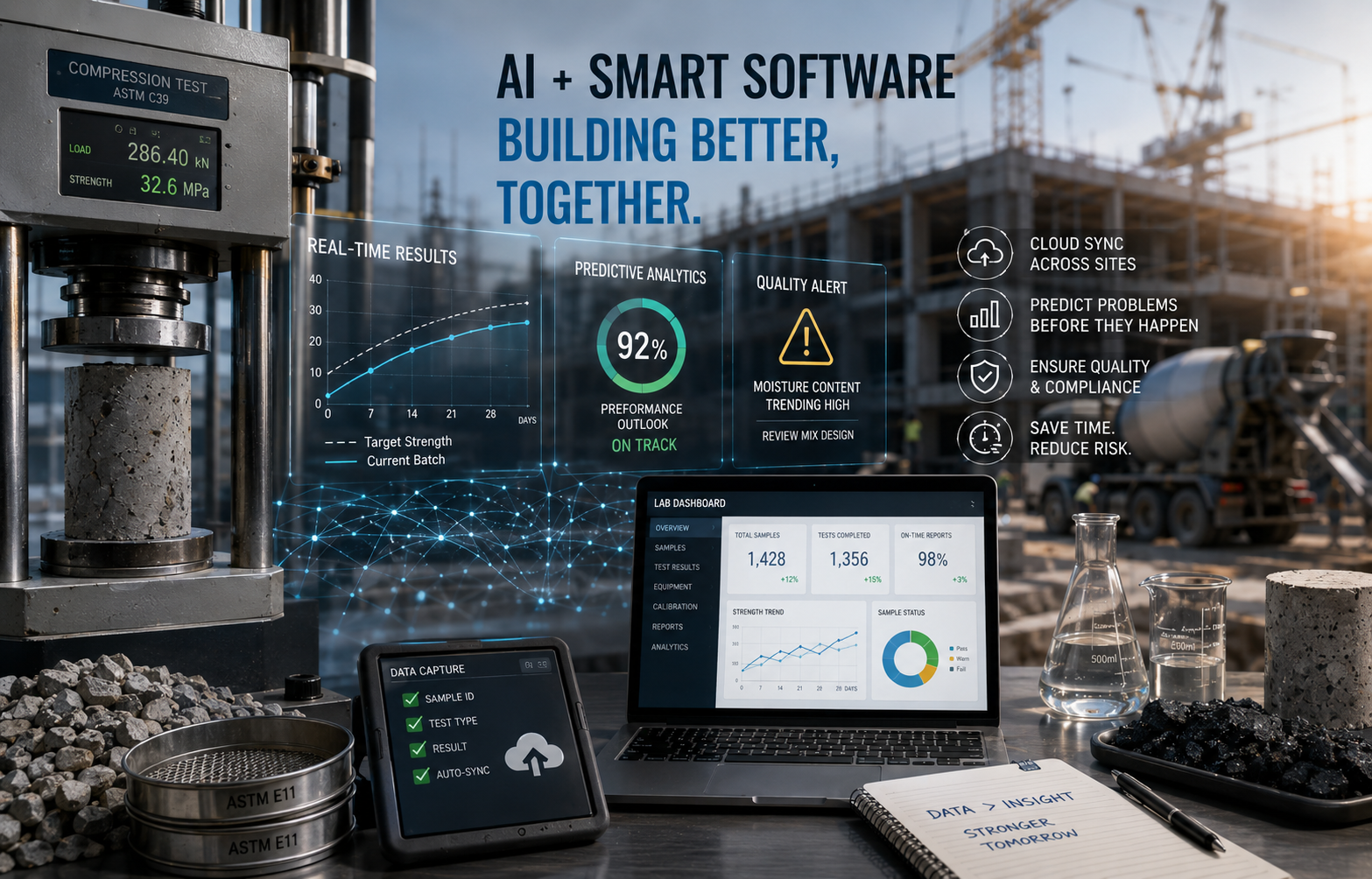
Automated data capture is probably the easiest one to picture. A moisture analyzer or compression tester pushes its reading straight into a digital log instead of a technician copying numbers onto a clipboard. Fewer transcription mistakes, and no more sheets that go missing between the bench and the report.
Then there's predictive flagging, which is a little more interesting. Models trained on a lab's own historical batch data can catch a mix trending toward failure before the 28-day strength test confirms it. It's not some black-box mystery either, it's pattern recognition doing something an experienced tech would half-sense anyway, just faster and across more samples than one person could track.
Calibration tracking sounds boring until you've sat through an audit without it. Whether it's a set of ASTM sieves or a soil compactor, equipment has to stay within spec, and software that logs calibration dates automatically kills that "wait, when did we last check this?" scramble.
And for outfits running tests across several sites, centralized dashboards mean a project manager two states away sees live results instead of waiting on a PDF that someone forgot to attach to an email.
Here's the thing though. None of this replaces decent equipment. A predictive model is only as good as what's feeding it, so sourcing reliable, properly calibrated gear still matters just as much as it did before any of this software existed. Labs pairing solid construction materials testing equipment with better data systems tend to see the real gains, because garbage readings in still means garbage predictions out, no matter how good the model is.
Where This Actually Helps, and Where It Doesn't (Yet)
Let's be honest about the limits. AI isn't replacing a trained technician's judgment in a construction lab, and it probably shouldn't try to. What it's actually good at is grinding through volume without getting sloppy, the kind of repetitive review a person's attention naturally drifts on after the hundredth sample of the day.
Image recognition is being used to spot surface cracking in concrete samples faster than someone doing a visual pass. Statistical models pick up on subtle drift in aggregate gradation across a large dataset, drift that's easy to miss scrolling through spreadsheets at 4pm on a Friday. These work because they're narrow. Ask AI to make a judgment call with half the context and it tends to fall apart. Ask it to churn through clean, structured data fast, and it does that part fine.
The labs getting real value out of this aren't trying to automate the whole operation. They pick two or three high-volume tasks, data entry, anomaly flags, standard report generation, build tools around those, and leave the interpretation and the actual testing to people who know what they're looking at.
If You're Thinking About Making This Shift
Doesn't need to be a full overhaul. A few starting points:
- Get your data digital and consistent before you touch predictive anything. You can't build useful analysis on inputs that are half handwritten and half spreadsheet.
- Digitize the boring stuff first, calibration logs, maintenance schedules, compliance paperwork. These are the easy wins and staff feel the time savings almost immediately.
- Keep the equipment side solid. No amount of software fixes a scale that's out of calibration. Working with an established supplier for soil and aggregate testing equipment keeps that foundation steady while the digital side catches up.
- Pilot on one product line or one site before rolling anything out everywhere at once. Testing labs already juggle enough variables without adding an unproven system across every location simultaneously.
Where This Is Headed
Construction materials testing isn't becoming a fully hands-off, automated process anytime soon. Given what's riding on structural integrity, that's probably how it should be. But the labs treating software as a way to cut friction, not replace expertise, are the ones getting more done with the same headcount and catching problems earlier than they used to.
The equipment hasn't stopped mattering. It's still the foundation everything else sits on. What's different now is that the data coming off that equipment finally does something useful instead of sitting in a filing cabinet somewhere.
Frequently Asked Questions
Quick answers related to this article from PerfectionGeeks.
1. How is AI used in construction materials testing?
2. Can AI replace construction materials testing equipment or laboratory technicians?
Conclusion
If you've got thoughts on where AI fits, or doesn't, in materials testing, worth a conversation. This corner of the industry is moving faster than most people watching from the outside would guess.

Meet BhanuPriya, COO at PerfectionGeeks Technologies. As the Chief Operating Officer, she drives operational excellence, business strategy, and innovation while sharing expert insights on artificial intelligence, IoT, software development, and digital transformation. Passionate about empowering businesses with scalable technology solutions and sustainable growth.