
Published 28 March 2026 | Updated 28 March 2026
Technology
How Smart Canadian Enterprises Are Using AI to Slash Operational Costs in 2026
Artificial Intelligence (AI) is reshaping the way Canadian enterprises operate, offering smarter, faster, and more cost-effective solutions. In 2026, businesses across industries are embracing AI to streamline workflows, enhance customer experiences, and reduce operational costs. From predictive analytics and generative AI to automation and edge computing, Canadian companies are leveraging advanced technologies to stay competitive. This blog explores how AI in Canada is driving enterprise growth, highlighting key trends, benefits, challenges, and best practices for successful adoption.
Why Canadian Businesses Are Investing in AI in 2026
Canadian enterprises are facing rising labor costs, global competition, and increasing customer expectations. To address these challenges, they are turning to AI business solutions. The demand for custom AI solutions for enterprises is growing, with every sector—from healthcare to retail—seeking automation and predictive insights. Partnering with an AI company in Canada ensures businesses can deploy scalable, secure, and industry-specific solutions.
Role of AI in Business Operations and Cost Optimization
AI is transforming operations management by automating repetitive tasks, optimizing supply chains, and improving resource allocation. With AI in operations management, enterprises can identify inefficiencies and reduce waste. AI-driven analytics also empower leaders to make smarter decisions, cutting unnecessary expenses and boosting productivity.
Key AI Trends in Business Automation for 2026
Canadian enterprises are adopting several AI trends in business automation:
Generative AI for Product Design and Content Creation: Generative AI is helping businesses design new products, create marketing content, and innovate faster. It reduces development costs and accelerates creativity, giving enterprises a competitive edge.
Predictive Analytics for Demand Forecasting: By analyzing historical and real-time data, predictive analytics enables companies to forecast demand, optimize inventory, and plan resources effectively. This reduces waste and improves profitability.
AI in Business Process Automation to Streamline Workflows: AI automates repetitive tasks across departments, from HR to supply chain. This streamlining improves efficiency, reduces errors, and frees employees to focus on strategic initiatives.
Edge AI for Real-Time Decision-Making: Edge AI processes data locally on devices, enabling instant insights without relying on cloud servers. This is vital for industries like healthcare and manufacturing where immediate responses are critical.
Explainable AI to Ensure Transparency and Compliance: Explainable AI (XAI) makes AI decisions understandable and transparent. It helps enterprises build trust, meet regulatory requirements, and ensure ethical use of AI in operations.
Benefits of AI in Business Operations
The benefits of AI in business operations are clear:
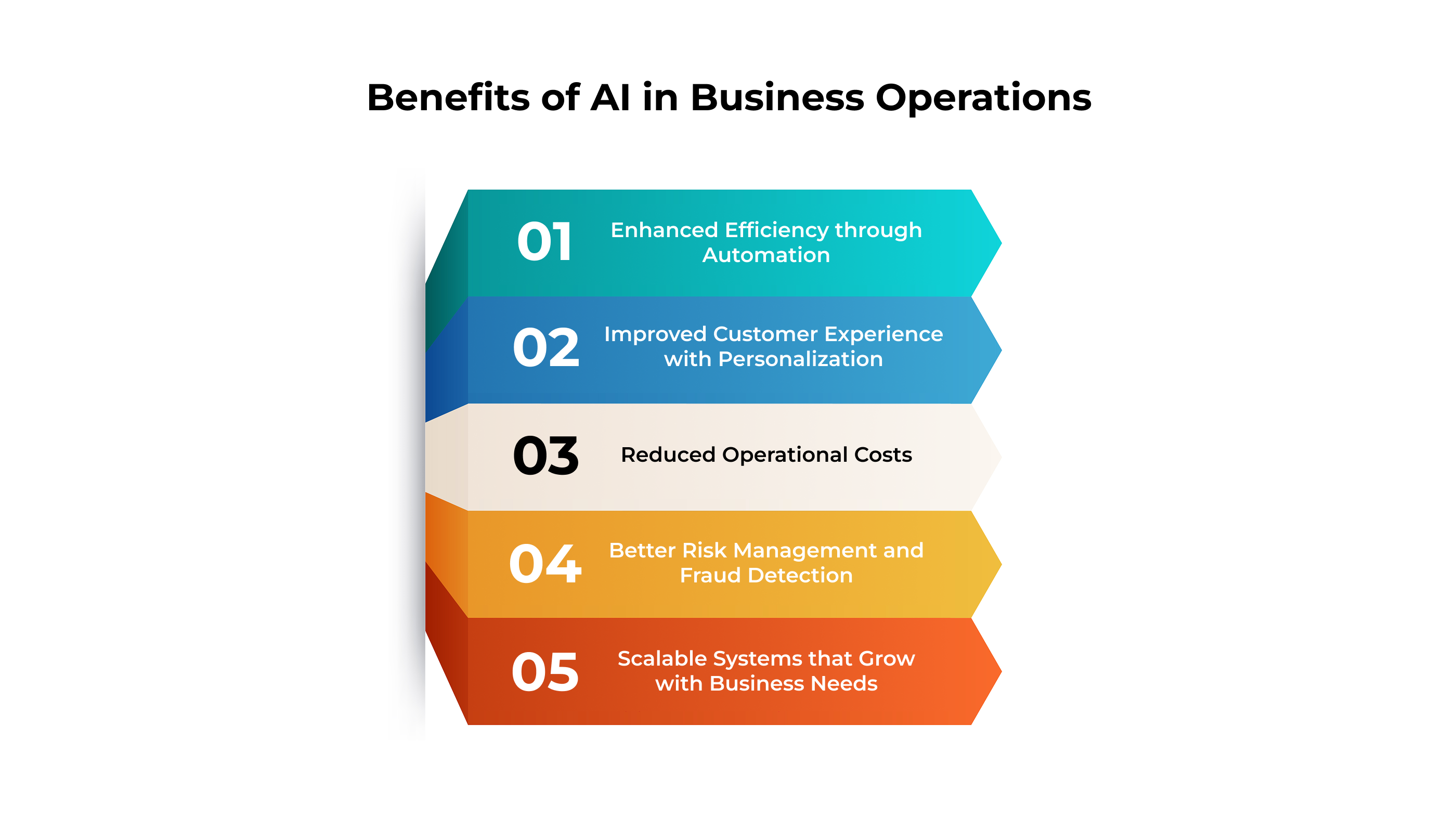
Enhanced Efficiency through Automation: AI automates repetitive tasks across departments, reducing manual effort and errors. This streamlining boosts productivity and allows employees to focus on strategic initiatives.
Improved Customer Experience with Personalization: AI analyzes customer data to deliver tailored recommendations, dynamic pricing, and personalized support. This creates stronger engagement and builds long-term loyalty.
Reduced Operational Costs: By optimizing workflows, supply chains, and resource allocation, AI helps enterprises cut waste and lower expenses. Automation also reduces labor costs in routine processes.
Better Risk Management and Fraud Detection: AI systems detect anomalies, predict risks, and identify fraudulent activities faster than traditional methods. This strengthens security and protects business assets.
Scalable Systems that Grow with Business Needs: AI-powered solutions are flexible and scalable, adapting to new data sources and expanding operations. This ensures enterprises can grow without being limited by outdated systems.
How AI Helps Reduce Operational Costs
Automation eliminates manual labor in repetitive tasks
AI helps businesses automate routine and repetitive tasks like data entry, report generation, and order processing. This reduces the need for large teams to handle manual work. Employees can focus on more important and strategic tasks instead of spending time on basic operations. Automation also reduces human errors, which can be costly for businesses. As a result, companies save both time and money. This is one of the biggest advantages of using AI in business operations.
Predictive maintenance prevents equipment failures
AI uses data and sensors to monitor machines and predict when they might fail. This helps businesses fix issues before they become serious problems. Instead of waiting for equipment to break down, companies can schedule maintenance in advance. This reduces downtime and avoids expensive repairs. It also increases the lifespan of machines and equipment. Overall, predictive maintenance helps businesses save significant operational costs.
Smart supply chain management reduces inventory waste
AI helps businesses manage their supply chain more efficiently by analyzing demand patterns and inventory levels. It ensures that companies order the right amount of products at the right time. This reduces overstocking and understocking issues. As a result, businesses can avoid wastage and storage costs. AI also improves delivery speed and logistics planning. This leads to better cost control and improved operational efficiency.
AI-driven customer support lowers service costs
AI-powered chatbots and virtual assistants can handle customer queries 24/7 without human intervention. This reduces the need for large customer support teams. Businesses can respond to customers quickly and efficiently, improving satisfaction. AI can handle multiple queries at the same time, which saves time and resources. It also reduces operational costs related to hiring and training staff. Overall, AI makes customer service more cost-effective and scalable.
Energy optimization cuts utility expenses
AI systems can monitor and manage energy usage in real time. They identify areas where energy is being wasted and suggest improvements. For example, AI can control lighting, heating, and cooling systems based on usage patterns. This helps reduce unnecessary energy consumption. Lower energy usage directly leads to reduced utility bills. Over time, this results in significant cost savings for businesses.
Cost-Saving Impact of AI in Canadian Enterprises
| AI Application | Cost-Saving Impact (2026) | Example Use Case in Canada |
| AI in Operations Management | 20–30% reduction in waste | Manufacturing optimization |
| AI in Business Process Automation | 25% faster workflows | Retail order processing |
| Predictive Analytics | 15–20% savings in demand planning | Supply chain forecasting |
| AI-Powered Customer Support | 40% lower service costs | Banking chatbots |
| Energy Optimization with AI | 10–15% utility savings | Smart building management |
Challenges in Implementing AI in Enterprises
High Upfront Investment in AI Infrastructure
Deploying AI requires significant spending on advanced hardware, cloud platforms, and specialized software. For many enterprises, these initial costs can be a barrier, especially when ROI is not immediate. Strategic planning and phased adoption are often needed to manage expenses effectively.
Shortage of Skilled AI Professionals
Canada faces a growing demand for AI talent, including data scientists, ML engineers, and AI strategists. The shortage makes it difficult for enterprises to build strong internal teams. Many businesses must rely on external partners or invest heavily in training programs.
Data Privacy and Compliance Concerns
AI systems rely on large volumes of sensitive data, raising concerns about privacy and regulatory compliance. Enterprises must adhere to Canadian data protection laws and global standards, which adds complexity and requires robust governance frameworks.
Resistance to Change within Organizations
Employees may fear job displacement or struggle to adapt to AI-driven workflows. Organizational resistance can slow down adoption and reduce efficiency gains. Effective change management and clear communication are essential to build trust and acceptance.
Need for Continuous Monitoring and Optimization
AI models degrade over time as data patterns evolve, leading to reduced accuracy. Enterprises must continuously monitor, retrain, and optimize models to maintain relevance. This requires ongoing investment in resources and technical expertise.
Best Practices for Successful AI Adoption in Canada
Define Clear Goals and Use Cases Before Implementation
Enterprises should identify specific problems AI will solve, such as cost reduction, customer personalization, or supply chain optimization. Clear objectives ensure focused adoption and measurable business outcomes.
Partner with an AI Solutions Provider in Canada for Expertise
Working with an experienced AI solutions provider Canada helps enterprises access industry knowledge, proven frameworks, and custom AI solutions. This reduces risks and accelerates successful deployment.
Invest in High-Quality Data to Ensure Accurate Results
AI models are only as good as the data they process. Clean, structured, and reliable data ensures accurate predictions and insights. Enterprises must prioritize data governance and invest in proper data management systems.
Focus on Scalability and Flexibility for Future Growth
AI systems should be designed to grow with business needs. Flexible architectures allow integration with new data sources, evolving workflows, and emerging technologies, ensuring long-term sustainability.
Monitor and Retrain Models Regularly to Maintain Relevance
Continuous evaluation and retraining keep AI models aligned with changing market conditions and customer behavior. This proactive approach ensures enterprises maintain accuracy, efficiency, and ROI over time.
Frequently Asked Questions
Quick answers related to this article from PerfectionGeeks.
1. How are Canadian enterprises using AI to reduce operational costs?
2. What are the key benefits of AI in business operations?
3. Why is AI important for operations management in 2026?
4. Why choose PerfectionGeeks as your AI solutions provider?
Conclusion
AI has become a game-changer for Canadian enterprises, enabling smarter operations, reduced costs, and sustainable growth. By adopting trends like generative AI, predictive analytics, and automation, businesses can unlock new opportunities while improving efficiency and customer satisfaction. Though challenges such as high investment and data privacy remain, following best practices and partnering with a trusted AI solutions provider in Canada ensures success. Beyond 2026, AI will continue to evolve, making it essential for enterprises to embrace innovation and stay ahead in the digital-first economy.

Shrey Bhardwaj is the Director & Founder of PerfectionGeeks Technologies, bringing extensive experience in software development and digital innovation. His expertise spans mobile app development, custom software solutions, UI/UX design, and emerging technologies such as Artificial Intelligence and Blockchain. Known for delivering scalable, secure, and high-performance digital products, Shrey helps startups and enterprises achieve sustainable growth. His strategic leadership and client-centric approach empower businesses to streamline operations, enhance user experience, and maximize long-term ROI through technology-driven solutions.