Published 20 February 2026 | Updated 29 May 2026
Technology
How AI is Changing the Way Custom Software Gets Built in 2026
Artificial Intelligence (AI) is no longer a futuristic idea it now drives modern software innovation. In 2026, AI in software development has become essential for businesses that want faster delivery, smarter automation, and scalable digital solutions. From generative AI in software development to advanced AI software development tools, the way custom software development services are built has completely transformed. This blog explains how AI is reshaping custom software development solutions, its benefits and challenges, and why partnering with a trusted AI software development company in USA like PerfectionGeeks matters.
Transform Your Digital Experience
How Is AI Changing Custom Software Development? AI is fundamentally reshaping custom software development in 2026 by automating code generation, accelerating testing, enabling smarter architecture decisions, and reducing delivery timelines by up to 55%. Rather than replacing developers, AI acts as a force multiplier — allowing engineering teams to build more sophisticated, reliable, and scalable software in less time and at lower cost.
- AI Is Now Inside the Development Process, Not Just the Product The biggest shift in 2026 is that AI is embedded into how software gets built — code generation, testing, architecture, deployment — not just added as a feature inside the finished product. This changes delivery speed, cost, and quality across the entire project.
- Speed Gains Are Substantial and Proven AI-assisted development reduces delivery timelines by 40–55% across project types. An MVP that traditionally took 16–24 weeks now takes 8–14 weeks. An enterprise platform that took 12–24 months now takes 8–15 months. These are not theoretical projections — they are outcomes documented across real projects.
- Cost Reduction Follows Directly from Speed Shorter timelines mean fewer engineering hours billed. Earlier defect detection means less expensive rework. Across the full project lifecycle, AI-assisted development consistently reduces total cost by 25–40% compared to traditional approaches.
- Quality Goes Up, Not Down A common concern is that AI-generated code introduces new risks. The data says the opposite. Teams using AI-integrated QA pipelines report up to 60% fewer defects reaching production, because AI catches vulnerabilities and anti-patterns earlier and more consistently than manual review alone.
- The 7 Development Stages Are All Affected AI is not just a coding tool. It improves requirements analysis, system design, code generation, code review, quality assurance, deployment, and post-launch monitoring — every stage of the lifecycle benefits, and the cumulative effect across a full project is transformative.
- Custom Software Demand Is Surging — AI Makes It Accessible The custom software development segment is growing at 22.71% CAGR. At the same time, developer talent is scarce and expensive. AI bridges that gap by multiplying what existing engineering teams can deliver — making custom software faster and more affordable than ever for businesses that previously could not justify the investment.
The State of AI in Custom Software Development: 2026 by the Numbers
Before diving into the how and why, it is worth understanding the scale of what is happening.
📊 Stat Callout: According to Gartner, global IT spending on software is projected to exceed $6 trillion in 2026, growing 9.8% year-over-year — the largest spending category increase across all IT segments. The custom software development segment alone is expanding at a 22.71% CAGR, nearly double the broader software market's growth rate.
📊 Stat Callout: GitHub reports that AI coding assistants now generate 46% of all code written by developers on its platform. Gartner projects this will reach 60% of all new code by the end of 2026.
📊 Stat Callout: A GitHub study of 4,800 developers found that tasks were completed 55% faster when using AI-assisted coding tools. Meanwhile, generative AI use in business functions jumped from 33% to 71% between 2023 and 2024 — a doubling in just 12 months, according to Stanford HAI's AI Index Report.
📊 Stat Callout: 84% of organisations are now using or planning to use AI in their software delivery lifecycle, per the Stack Overflow Developer Survey 2025.
These numbers tell a clear story. AI is not a peripheral experiment in software development — it is becoming the primary engine of how custom software gets built, deployed, and maintained.
What Is AI Changing Custom Software Development?
AI changing custom software development refers to the integration of artificial intelligence technologies — including generative AI, machine learning, natural language processing, and intelligent automation — directly into the process of designing, building, testing, and maintaining bespoke software solutions tailored to specific business needs.
In 2026, this is not about adding an AI chatbot to an existing product. It means AI is embedded into the development workflow itself — the tools engineers use daily, the processes teams follow, and the architecture decisions made before a single line of code is written.
In practical terms, AI changing custom software development looks like this:
- Developers describing a function in plain English and receiving working, production-ready code in seconds
- Automated test suites that learn from every release cycle and become more accurate over time
- Architecture tools that evaluate thousands of design patterns against your specific performance and compliance requirements
- Project management systems that predict delivery risks weeks before they become problems
- Post-launch monitoring that detects anomalies and surfaces improvements without waiting for a human to notice
The net result is a development process that is faster, more consistent, and less dependent on any individual developer's availability or experience. Human engineers shift from writing every line of code to guiding, reviewing, and improving what AI produces — a shift that elevates the quality of the work while dramatically reducing the time required to deliver it.
Why AI Changing Custom Software Development Matters in 2026
Several forces have converged in 2026 to make this shift more significant than at any previous point.
The competitive gap is now measurable and widening. Businesses using AI-assisted development are shipping features 40–55% faster than those using traditional approaches. In markets where speed-to-market is a competitive advantage — fintech, healthcare technology, retail, SaaS — that gap is no longer a minor efficiency difference. It is a strategic one.
Custom software demand is growing faster than the talent to build it. The custom software development segment is expanding at a 22.71% CAGR — nearly double the broader software market's growth rate. At the same time, the global developer talent shortage is worsening. AI tooling is the bridge between surging demand and constrained supply. It multiplies the output of the engineering team a business already has.
Client and end-user expectations have fundamentally risen. People now expect software to be intelligent, adaptive, and personalised as a baseline — not as a premium feature. Building these qualities into custom software without AI is increasingly expensive and slow. With AI, they become achievable within standard project timelines and budgets.
The cost of not adopting is becoming concrete. 84% of organisations are now using or planning to use AI in their software delivery lifecycle. Businesses that delay are not simply missing an efficiency gain — they are falling behind competitors who are delivering more, faster, at lower cost.
Regulatory and security complexity demands smarter tools. GDPR, the UK Online Safety Act, FCA digital operational resilience requirements, and NHS digital standards all create compliance obligations that must be factored into architecture from day one. AI-powered security scanning and compliance tooling makes this practical in a way that manual processes cannot match at scale.
The bottom line: in 2026, AI changing custom software development is not a future possibility to monitor. It is a present reality that directly affects delivery timelines, project costs, product quality, and competitive positioning.
How AI Is Changing Custom Software Development: Step-by-Step
Here is a precise, stage-by-stage breakdown of where and how AI transforms the custom software development lifecycle.
Step 1 — Requirements Gathering and Analysis AI-powered natural language processing tools analyse stakeholder conversations, existing documentation, and historical project data to automatically generate structured requirements, identify ambiguities, and flag conflicting assumptions before development begins. What previously took weeks of workshops can be completed in days, with greater accuracy and fewer gaps.
Step 2 — System Design and Architecture AI design assistants evaluate thousands of architectural patterns against your specific project requirements — performance targets, compliance needs, scalability projections — and recommend optimal structures. They also flag potential bottlenecks and security vulnerabilities at the design stage, before a line of code exists. Expensive architectural redesigns later in the project become significantly less common.
Step 3 — Code Generation and Development Generative AI tools (GitHub Copilot, Amazon CodeWhisperer, Cursor) suggest, complete, and generate production-ready code in real time as developers work. Developers describe what they need; the AI produces a working implementation that engineers review and refine. Boilerplate code, API integrations, and standard patterns are handled by AI. Developer time is redirected to complex logic, edge cases, and innovation.
Step 4 — Code Review and Security Scanning AI code review tools analyse every pull request automatically, flagging security vulnerabilities, performance anti-patterns, and logical errors before a human reviewer sees the code. This does not replace human code review — it makes it significantly faster and more focused by eliminating the obvious issues before the senior engineer's time is involved.
Step 5 — Quality Assurance and Testing AI-driven QA tools generate test cases automatically based on the codebase, run regression suites across multiple environments simultaneously, and learn from previous defect patterns to predict where new bugs are most likely to appear. Test coverage increases while manual QA effort decreases. Defects are caught earlier in the cycle, where they are cheapest to fix.
Step 6 — Deployment and CI/CD Optimisation AI monitors deployment pipelines in real time, predicting which builds are likely to fail before they reach production. Anomaly detection systems identify performance degradation or error spikes immediately after deployment and can trigger automated rollbacks. Release timing and canary deployment strategies are optimised by AI based on live traffic patterns.
Step 7 — Post-Launch Monitoring and Continuous Improvement AI-powered observability tools detect anomalies, predict capacity issues before they cause outages, and analyse user behaviour to surface UX improvements proactively. The system does not just alert teams to problems — it identifies improvement opportunities and surfaces them with supporting data.
Key Benefits of AI in Custom Software Development
Faster Time to Market AI automates the most time-consuming repetitive tasks across the development lifecycle — boilerplate coding, test case generation, documentation, and deployment monitoring. The result is development cycles that are 40–55% shorter than equivalent projects built using traditional methods. For businesses where speed-to-market determines competitive advantage, this is the most immediately impactful benefit.
Significant Cost Reduction Shorter timelines directly translate to lower project costs. AI tooling also reduces rework by catching defects earlier, when they are cheapest to fix. Across the full project lifecycle — from initial build through post-launch maintenance — AI-assisted development typically reduces total cost by 25–40% compared to traditional approaches.
Higher Software Quality AI-driven code review and testing consistently outperforms manual processes on defect detection rate, particularly for security vulnerabilities and performance anti-patterns. Teams using AI-integrated QA pipelines report up to 60% fewer defects reaching production.
Security Built In, Not Bolted On AI security scanning tools analyse code for vulnerabilities at every stage of development — not just at the end. This security-by-design approach means threats are identified and addressed when they are easiest and cheapest to remediate, rather than after they have reached live systems.
Scalable Architecture from Day One AI architecture tools evaluate scalability requirements against project constraints and recommend patterns that will support business growth without requiring expensive redesigns. Custom software built with AI-optimised architecture is designed to scale — not retrofitted to scale later.
Talent Leverage AI tooling effectively multiplies the output of your engineering team. A smaller, well-equipped team using AI-assisted development can consistently outperform a larger team working without it. In a market where skilled developers are expensive and scarce, this is a significant operational advantage.
Continuous Improvement Post-Launch AI-powered monitoring systems do not simply alert teams to problems. They analyse patterns, surface optimisation opportunities, and provide the data needed to make smart product decisions continuously — turning post-launch maintenance from a cost centre into a source of ongoing value.
Tools & Technologies Driving AI in Custom Software Development
| Category | Leading Tools | What They Do |
|---|---|---|
| Code Generation | GitHub Copilot, Amazon CodeWhisperer, Cursor, Tabnine | Generate, complete, and suggest production-ready code in real time |
| AI-Powered IDEs | Cursor, JetBrains AI Assistant, VS Code + Copilot | Full AI-native development environments with contextual code intelligence |
| Security Scanning | Snyk, Checkmarx, SonarQube | Automatically detect vulnerabilities, licence risks, and code quality issues in CI/CD pipelines |
| AI Testing & QA | Mabl, Testim, Applitools | Self-healing automated tests, visual regression detection, AI-generated test cases |
| Observability & Monitoring | Datadog AI, New Relic AI, Dynatrace Davis AI | Anomaly detection, predictive alerting, and root cause analysis |
| AI Project Management | Linear + AI, Jira AI, GitHub Projects | Sprint planning, risk prediction, and automated issue prioritisation |
| Generative AI Platforms | OpenAI API, Anthropic Claude API, Google Gemini API | Foundation models for building intelligent features into custom software products |
| Low-Code / No-Code + AI | OutSystems, Mendix, Microsoft Power Platform | Rapid application development with AI-assisted workflow generation |
How to choose: Most high-performing engineering teams in 2026 use a combination of these tools rather than a single platform. The selection depends on your tech stack, security requirements, and where AI will have the highest impact given your specific development workflow. A knowledgeable custom software development partner will help you identify the right combination for your project.
Cost & Timeline: What AI-Assisted Custom Development Costs in 2026
One of the most common questions from business leaders considering custom software projects: does AI-assisted development cost more or less than traditional approaches?
The answer, consistently, is less — and faster. Here are realistic benchmarks for 2026:
| Project Type | Traditional Timeline | AI-Assisted Timeline | Traditional Cost | AI-Assisted Cost |
|---|---|---|---|---|
| MVP / Proof of Concept | 16–24 weeks | 8–14 weeks | £40,000–£100,000 | £25,000–£70,000 |
| Mid-complexity web or mobile app | 6–10 months | 4–6 months | £120,000–£300,000 | £80,000–£200,000 |
| Enterprise platform (AI-integrated) | 12–24 months | 8–15 months | £400,000–£1M+ | £250,000–£700,000 |
| Healthcare / regulated software | 18–30 months | 12–20 months | £250,000–£600,000 | £150,000–£400,000 |
| Legacy modernisation | 18–36 months | 12–24 months | £300,000–£1M+ | £200,000–£750,000 |
What drives the savings? The biggest cost reductions come from three areas: less time spent on boilerplate and repetitive coding tasks, earlier defect detection (fixing bugs during development costs a fraction of fixing them post-launch), and shorter overall timelines reducing the total engineering hours billed.
What determines where in the range you land? Scope clarity at project start, the complexity of third-party integrations, data availability for AI components, and regulatory requirements all affect final cost. Projects with well-defined requirements and clean existing data consistently come in at the lower end of these ranges.
Practical tip: Phased delivery — building a working MVP first, then iterating based on real user feedback — consistently delivers better ROI than large upfront builds. It also reduces risk significantly by validating core assumptions before the full investment is committed.
Real-World Examples: AI Changing Custom Software Development in Practice
Example 1: AI-Powered Healthcare Patient Management Platform
A hospital network needed to replace an ageing patient management system that was creating administrative bottlenecks and data quality problems across its clinical teams. Working with an AI software development company, the new system was built using generative AI tools for both the development process and the product itself.
What AI changed in the build process: Code generation tools reduced development time by 40% by automating the data pipeline code, API integrations, and CRUD operations that make up the bulk of a system like this. Automated testing identified and resolved 280 defects before the system reached staging — defects that would have taken weeks to find and fix in a manual QA process.
What AI built into the product: The system incorporated predictive analytics to flag high-risk patients for clinical review, AI-assisted form completion to reduce manual data entry, and intelligent appointment scheduling that optimised clinic capacity automatically.
Outcomes: Manual data entry errors reduced by 70%. Administrative staff time on scheduling cut by 65%. Overall development delivered in 14 weeks versus an estimated 24 weeks using traditional methods.
Example 2: Real-Time Fraud Detection for a UK Fintech
A UK-based financial technology company needed a real-time fraud detection system capable of analysing millions of transactions per day with sub-second response times. The system needed to integrate with three existing payment platforms and comply with FCA reporting requirements.
What AI changed in the build process: Machine learning models were trained on historical transaction data in parallel with development rather than sequentially. AI-generated the data ingestion and normalisation layer — typically one of the most labour-intensive parts of this type of system — saving approximately six weeks of development time. The automated testing suite ran 12,000 test scenarios covering fraud pattern edge cases that would have taken a manual QA team months to document and execute.
What AI built into the product: The fraud detection engine itself uses continuously learning ML models that improve accuracy over time as new transaction data flows through the system. Fraud pattern detection accuracy reached 94% within the first month of live operation.
Outcomes: System delivered in 14 weeks. Estimated 10–12 months using conventional development. Post-launch fraud detection accuracy improved by 31% compared to the legacy rules-based system it replaced.
Example 3: AI-Personalised E-Commerce Platform for a National Retailer
A national retail brand needed a custom e-commerce platform capable of personalising the shopping experience for millions of customers in real time — something their existing off-the-shelf platform could not support. The project also needed to integrate with a legacy ERP system and three third-party logistics providers.
What AI changed in the build process: Pre-trained AI models were fine-tuned on the retailer's own customer and product data, reducing the time to build the personalisation engine by 50% compared to training from scratch. AI-assisted UI/UX analysis during development identified friction points in the checkout flow before launch, leading to design improvements that reduced cart abandonment by 22% from day one.
What AI built into the product: The personalisation layer continuously learns from new purchase and browsing data, meaning the recommendation engine improves automatically without manual retraining. The system also uses AI-driven inventory intelligence to surface personalised availability messaging that increases conversion on low-stock items.
Outcomes: Platform launched in 18 weeks. Cart abandonment down 22% versus the previous platform at launch. Revenue per session up 17% in the first quarter of live operation.
Challenges and Limitations of AI in Software Development
While AI is revolutionizing custom software development services, it comes with its own set of challenges that companies must carefully manage. Let’s break them down in detail:
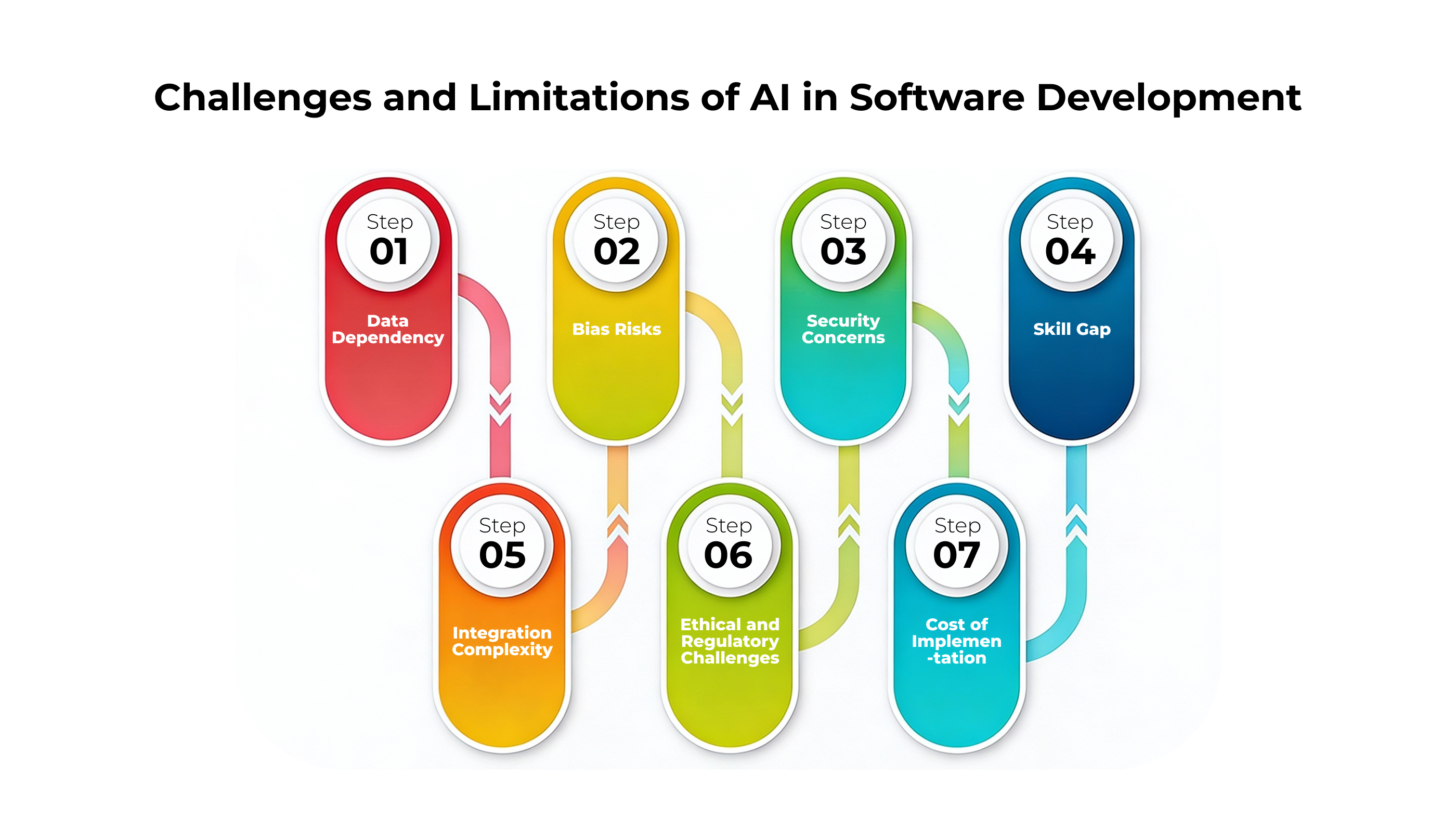
1. Data Dependency
AI models thrive on large, high-quality datasets. Without sufficient data, the models may produce inaccurate or incomplete results. For example, if a healthcare application is trained on limited patient records, its predictions may not be reliable. This makes data collection, cleaning, and management a critical but resource-intensive task.
2. Bias Risks
AI systems can unintentionally inherit biases from the datasets they are trained on. If the training data is skewed or unbalanced, the resulting software may deliver unfair or discriminatory outcomes. For instance, an AI recruitment tool trained on biased data could favor certain demographics over others. Ensuring fairness requires constant monitoring and ethical AI practices.
3. Security Concerns
AI-driven systems are vulnerable to adversarial attacks, where malicious inputs trick the model into making incorrect decisions. Hackers may exploit AI algorithms to bypass security measures or manipulate outputs. This means companies must invest in robust AI-driven security frameworks to safeguard their custom software.
4. Skill Gap
AI introduces new tools and workflows that require specialized knowledge. Many developers are still learning how to integrate AI effectively into software projects. Bridging this skill gap demands continuous training, upskilling, and collaboration between AI experts and traditional developers.
5. Integration Complexity
Adding AI into existing systems can be complex and costly. Legacy software may not be compatible with modern AI frameworks, requiring significant redesigns or migrations. This can slow down adoption for businesses with older infrastructure.
6. Ethical and Regulatory Challenges
Governments and industries are introducing stricter regulations around AI usage, especially concerning privacy and data protection. Companies must ensure compliance while still innovating, which can be a delicate balance.
7. Cost of Implementation
Although AI reduces long-term costs, the initial investment in tools, infrastructure, and talent can be high. Smaller businesses may struggle to afford advanced AI software development tools or build in-house expertise.
AI brings immense opportunities but also significant challenges. Companies must balance innovation with caution, ensuring that AI for custom software development is implemented responsibly, securely, and ethically. By addressing these limitations proactively, businesses can maximize the benefits of AI in software development while minimizing risks.
Why Partner with PerfectionGeeks for AI-Powered Custom Software
PerfectionGeeks is a trusted AI software development company in USA that specializes in delivering innovative, secure, and scalable custom software development solutions. By leveraging the best AI software development tools and advanced generative AI tools for software development, they help businesses accelerate project delivery, reduce costs, and achieve smarter results. Their expertise ensures that every custom software development service is tailored to meet unique business needs, combining creativity with cutting-edge AI technology. Partnering with PerfectionGeeks means gaining a reliable ally for future-ready, AI-powered software in 2026 and beyond.
Future Trends: AI and Custom Software in 2026 and Beyond
1. Generative AI 2.0: Generative AI will evolve from writing snippets of code to building entire applications autonomously. Developers will shift from manual coding to guiding AI systems, focusing on creativity, architecture, and innovation while AI handles repetitive tasks.
2. AI-Driven Security: Cybersecurity will be powered by AI systems that detect, predict, and neutralize threats in real time. These intelligent models will continuously learn from new attack patterns, ensuring that custom software remains secure against evolving cyber risks.
3. Hyper-Personalization: Software will adapt dynamically to each user’s behavior, preferences, and context. From personalized dashboards to tailored workflows, AI will deliver unique experiences that boost engagement and satisfaction across industries like healthcare, retail, and education.
4. AI Collaboration: Developers will work side by side with AI assistants that act like “junior developers.” These systems will suggest frameworks, optimize architecture, and accelerate coding, making collaboration between humans and AI seamless and highly productive.
5. Autonomous Project Management: AI will take over project management tasks by predicting timelines, allocating resources, and identifying risks early. This will reduce delays, cut costs, and ensure smoother delivery of custom software projects.
6. AI-Powered Low-Code/No-Code Platforms: Businesses will use AI-driven platforms to build applications without deep technical expertise. This democratization of software development will empower non-developers to create functional solutions quickly and efficiently.
7. Ethical and Responsible AI: As AI becomes central to software, companies will prioritize fairness, transparency, and bias-free algorithms. Ethical AI frameworks will be integrated into solutions to build trust and comply with global regulations.
8. AI in CI/CD Pipelines: Continuous integration and deployment will be automated by AI, ensuring faster releases with fewer failures. Predictive models will identify potential issues before deployment, reducing downtime and improving reliability.
9. AI-Enhanced User Experience (UX): AI will analyze user behavior to refine layouts, navigation, and accessibility features. Interfaces will evolve dynamically, creating smoother, more intuitive experiences tailored to user needs.
10. Industry-Specific AI Solutions: Custom software will increasingly include AI tailored to specific industries. Healthcare apps will predict patient needs, finance platforms will detect fraud, retail systems will personalize shopping, and education tools will adapt to student learning styles.
Ready to build smarter?
Talk to the PerfectionGeeks team about your custom software project. We will give you a clear, honest assessment of timelines, costs, and where AI can make the biggest difference for your specific needs.
Book a Free Consultation
Frequently Asked Questions
Quick answers related to this article from PerfectionGeeks.
1. What is AI changing custom software development?
2. How does AI changing custom software development actually work?
3. What are the key benefits of AI changing custom software development?
4. How long does AI-assisted custom software development take?
5. What are the best tools for AI changing custom software development in 2026?
Conclusion
AI is not changing custom software development at the edges — it is reshaping what is possible at the core. The businesses winning in 2026 are those that have recognised this shift and acted on it: commissioning custom software from partners with genuine AI capability embedded in their workflow, building products with AI intelligence from the ground up, and treating software as a continuously improving asset rather than a one-time build. The evidence is unambiguous. Teams using AI-assisted development ship faster, deliver higher quality, spend less, and build products that grow smarter over time. The competitive gap between AI-enabled and traditional development approaches is widening every quarter.
For businesses at the start of a custom software project in 2026, the practical implication is clear: choose a development partner whose AI capabilities are real, demonstrated, and integrated into their actual engineering practice — not referenced in a brochure.

Shrey Bhardwaj is the Director & Founder of PerfectionGeeks Technologies, bringing extensive experience in software development and digital innovation. His expertise spans mobile app development, custom software solutions, UI/UX design, and emerging technologies such as Artificial Intelligence and Blockchain. Known for delivering scalable, secure, and high-performance digital products, Shrey helps startups and enterprises achieve sustainable growth. His strategic leadership and client-centric approach empower businesses to streamline operations, enhance user experience, and maximize long-term ROI through technology-driven solutions.