
Published 31 March 2026 | Updated 31 March 2026
Technology
How Data Engineering Services Improve AI Accuracy and Cloud Analytics Efficiency
Artificial Intelligence (AI) and cloud analytics are transforming how businesses make decisions, but their success depends on one critical factor: data quality. Without clean, structured, and well-integrated data, even the most advanced AI models and cloud-based analytics solutions fail to deliver accurate insights. This is why data engineering services are essential. They provide the foundation for reliable AI predictions and efficient cloud analytics by building pipelines, integrating diverse sources, and ensuring that data is accessible and trustworthy. In this blog, we’ll explore how data engineering services and solutions improve AI accuracy and cloud analytics efficiency.
What Are Data Engineering Services?
Data engineering services involve designing, building, and maintaining systems that collect, store, and process data. These services ensure that businesses can handle large volumes of structured and unstructured data efficiently.
Key offerings include:
- Data integration engineering services – Combining data from multiple sources into a unified format.
- Data analytics engineering services – Preparing data for advanced analytics and reporting.
- Data engineering consulting services – Providing expert guidance on tools, pipelines, and architectures.
- Data engineering services company solutions – End-to-end support for data pipelines, architecture, and optimization.
By leveraging top data engineering services, organizations can ensure their AI and analytics systems run on high-quality data.
Role of Data Engineering in AI and Machine Learning
AI models require structured, reliable datasets to deliver accurate predictions. AI data engineering ensures that raw data is transformed into usable formats for machine learning.
Key Roles
Data Cleaning: Data cleaning removes duplicates, errors, and irrelevant information from raw datasets. This ensures that AI models are trained on accurate and consistent data, reducing noise and improving prediction reliability.
Feature Engineering: Feature engineering involves creating new variables or transforming existing ones to highlight meaningful patterns. By designing strong features, data engineers help machine learning models capture deeper insights and improve performance.
Pipeline Automation: Pipeline automation builds workflows that continuously feed real-time data into AI systems. This keeps models updated with the latest information, enabling faster decision-making and reducing manual intervention.
Agentic AI Data Engineering: Agentic AI data engineering uses autonomous AI agents to manage and optimize data workflows. These agents can monitor pipelines, detect issues, and self-correct, ensuring smooth and efficient data operations.
Generative AI for Data Engineering: Generative AI automates complex tasks such as schema design, anomaly detection, and data preparation. This reduces human effort, speeds up data readiness, and enhances the scalability of AI-driven projects.
Without strong data engineering, AI models risk bias, inefficiency, and poor accuracy.
How Data Engineering Improves AI Accuracy
AI accuracy depends on the quality of training data. Data engineering services & solutions improve accuracy by:
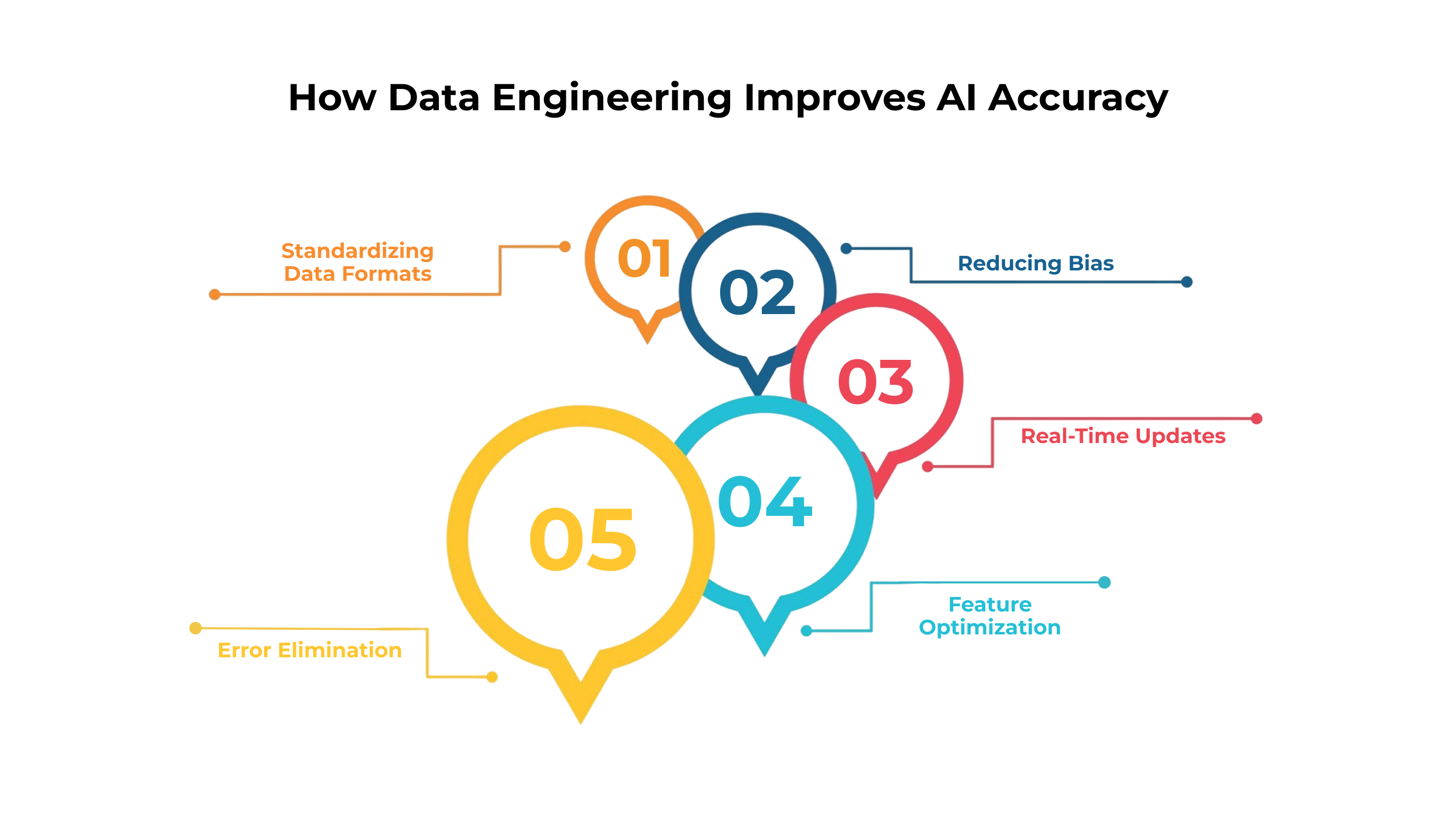
Standardizing Data Formats
When data comes from multiple sources, it often exists in different formats, structures, or units. Data engineering services & solutions standardize these formats, ensuring consistency across all datasets. This uniformity allows AI models to process information smoothly and avoid misinterpretations caused by incompatible data structures.
Reducing Bias
AI models can produce skewed results if the training data is biased or incomplete. Data engineering services help reduce bias by integrating diverse datasets and balancing representation. This ensures that predictions are fair, accurate, and applicable across different scenarios, improving trust in AI outcomes.
Real-Time Updates
AI systems are most effective when they work with the latest information. Data engineering builds pipelines that continuously feed real-time data into AI models. This keeps predictions current, enabling businesses to respond quickly to market changes, customer behavior, or operational shifts.
Feature Optimization
Features are the variables that AI models use to make predictions. Data engineers enhance these inputs by designing new features or refining existing ones to highlight meaningful patterns. Optimized features improve model accuracy, helping AI systems uncover deeper insights and deliver more precise results.
Error Elimination
Raw data often contains noise, inconsistencies, or missing values that can mislead AI models. Data engineering eliminates these errors through cleaning and validation processes. By ensuring that only high-quality data reaches the model, engineers improve accuracy and reduce the risk of unreliable predictions.
How Data Engineering Enhances Cloud Analytics Efficiency
Cloud analytics solutions allow businesses to process massive datasets without heavy infrastructure costs. However, efficiency depends on how well data is prepared.
Data engineering services company offerings enhance cloud analytics efficiency by:
- Building cloud-based analytics solutions that scale automatically.
- Optimizing storage and retrieval for faster queries.
- Automating ETL (Extract, Transform, Load) processes.
- Ensuring compliance and security in cloud environments.
- Supporting data analytics services and solutions for actionable insights.
With proper engineering, businesses reduce costs, improve speed, and gain deeper insights from their cloud analytics platforms.
Data Pipelines: The Backbone of AI and Cloud Analytics
Data pipelines automate the movement of data from source systems to AI and analytics platforms.
Components of Data Pipelines:
- Ingestion – Collecting data from multiple sources.
- Transformation – Cleaning and structuring data.
- Storage – Saving data in warehouses or lakes.
- Delivery – Feeding data into AI models or dashboards.
Strong pipelines ensure that AI and analytics systems operate efficiently and consistently.
Modern Data Architecture for Scalable AI and Analytics
Modern businesses generate enormous amounts of data every day, and to make sense of it, they need architectures that can scale seamlessly. Traditional systems often struggle with performance bottlenecks, but modern data architecture is designed to handle growing volumes of structured and unstructured data while supporting AI and cloud analytics. Let’s break down its key features in detail:
Cloud-Native Design – Built for Flexibility and Scalability
A cloud-native architecture is designed to run directly on cloud platforms, making it highly flexible and scalable. Unlike traditional on-premise systems, cloud-native solutions can automatically adjust resources based on demand. This means businesses can scale up during peak workloads and scale down when demand is low, ensuring cost efficiency and uninterrupted performance.
Data Lakes and Warehouses – Supporting Structured and Unstructured Data
Modern architectures use data lakes to store raw, unstructured data and data warehouses for structured, processed information. Together, they provide a unified environment where businesses can store everything from customer transactions to social media feeds. This dual approach ensures that AI models and analytics tools have access to both clean, structured datasets and rich, raw data for deeper insights.
AI-Driven Automation – Using AI for Data Engineering to Optimize Workflows
AI is increasingly being used within data engineering to automate repetitive tasks. For example, AI for data engineering can detect anomalies, optimize pipelines, and recommend schema designs. This automation reduces manual effort, speeds up data preparation, and ensures that workflows remain efficient even as data volumes grow. It also supports agentic AI data engineering, where autonomous AI agents manage and optimize data processes without constant human intervention.
Integration with Cloud Analytics Solutions – Seamless Connection Between Storage and Analytics Tools
A modern data architecture ensures smooth integration between storage systems and cloud analytics solutions. This means that data stored in lakes or warehouses can be instantly accessed by analytics platforms without delays. Seamless integration improves query performance, supports real-time dashboards, and enables businesses to make faster, data-driven decisions.
Why This Matters
By combining cloud-native scalability, flexible storage options, AI-driven automation, and seamless integration, modern data architecture eliminates performance bottlenecks. Businesses can scale their AI and analytics systems effortlessly, ensuring that insights remain accurate, timely, and actionable—even as data volumes continue to grow.
Key Business Benefits of Data Engineering Services
| Benefit | Impact on AI & Cloud Analytics |
| Improved Data Quality | Higher AI accuracy and reliable insights |
| Faster Processing | Efficient cloud analytics solutions |
| Scalability | Ability to handle growing data volumes |
| Cost Optimization | Reduced storage and processing costs |
| Compliance & Security | Safe handling of sensitive data |
| Real-Time Insights | Better decision-making with live data |
By partnering with a data engineering services company, businesses gain expertise that ensures long-term success in AI and analytics.
Challenges in Data Engineering
Despite its benefits, data engineering faces challenges:
Data Silos – Isolated systems make integration difficult
When data is stored in separate systems without proper connectivity, it creates silos. These silos prevent smooth integration, making it harder for AI and analytics platforms to access complete datasets for accurate insights.
Tool Complexity – Managing diverse platforms requires expertise
Data engineering often involves multiple tools for ingestion, transformation, storage, and analytics. Managing these diverse platforms requires specialized skills, and without expertise, workflows can become inefficient and error-prone.
Data Governance – Ensuring compliance with regulations
Businesses must follow strict data governance rules to protect sensitive information and meet compliance standards. Ensuring proper access controls, privacy, and regulatory alignment is a constant challenge for data engineers.
Scalability Issues – Handling exponential data growth
As organizations generate more data, scaling systems to handle exponential growth becomes difficult. Without modern architectures, performance bottlenecks can slow down AI training and cloud analytics processes.
Skill Gaps – Shortage of professionals skilled in AI data engineering
There is a growing demand for experts in AI data engineering, but skilled professionals are limited. This shortage makes it harder for businesses to build and maintain advanced data pipelines and architectures.
Overcoming these challenges requires strong data analytics consulting services and expert guidance.
Frequently Asked Questions
Quick answers related to this article from PerfectionGeeks.
1. What are data engineering services, and why are they important for AI?
2. How do data engineering services improve cloud analytics efficiency?
3. How does PerfectionGeeks help businesses with data engineering?
4. What industries benefit most from PerfectionGeeks’ data engineering services?
Conclusion
AI and cloud analytics cannot succeed without high-quality data. Data engineering services provide the foundation by ensuring clean, structured, and accessible datasets. From data integration engineering services to data analytics services and solutions, businesses can leverage these offerings to improve AI accuracy and enhance cloud analytics efficiency. By investing in top data engineering services, organizations build scalable architectures, efficient pipelines, and reliable insights. Whether through agentic AI data engineering, generative AI for data engineering, or cloud-based analytics solutions, the future of business intelligence depends on strong data engineering practices. A solid data foundation is not just a technical requirement it is the key to unlocking AI-driven success and sustainable growth.

Shrey Bhardwaj is the Director & Founder of PerfectionGeeks Technologies, bringing extensive experience in software development and digital innovation. His expertise spans mobile app development, custom software solutions, UI/UX design, and emerging technologies such as Artificial Intelligence and Blockchain. Known for delivering scalable, secure, and high-performance digital products, Shrey helps startups and enterprises achieve sustainable growth. His strategic leadership and client-centric approach empower businesses to streamline operations, enhance user experience, and maximize long-term ROI through technology-driven solutions.