
Published 30 March 2026 | Updated 26 September 2026
Technology
Why Insurance Companies Are Moving to Cloud: Use Cases, Cost & Future Trends
The cloud in insurance industry is no longer just a buzzword it’s a strategic necessity. Insurance companies worldwide are embracing cloud computing in insurance industry to improve efficiency, reduce costs, and deliver better customer experiences. From automation to advanced analytics, cloud adoption is reshaping how insurers operate. In this blog, we’ll explore why insurers are moving to the cloud, the use cases, costs, challenges, and future trends. We’ll also highlight how cloud technology for insurance companies is transforming the sector.
Cloud Computing in Insurance
The insurance industry has traditionally relied on legacy systems, which are expensive to maintain and slow to adapt. With rising customer expectations and digital disruption, insurers are turning to cloud computing in insurance to modernize operations.
Key benefits include:
- Faster innovation and product launches.
- Reduced infrastructure costs.
- Enhanced data security and compliance.
- Improved customer experience through automation.
How Cloud Adoption in Insurance Industry Works
Cloud adoption in the insurance industry is about shifting traditional IT systems to modern, scalable cloud platforms. Insurers begin by assessing their current infrastructure and defining goals such as cost reduction, faster claims processing, or improved customer engagement. Based on these needs, they select the right deployment model — public, private, or hybrid cloud. Once the model is chosen, legacy data is migrated securely to cloud platforms, ensuring compliance with strict regulations. Integration follows, where cloud systems connect seamlessly with existing applications like CRM, policy management, and claims systems. Automation tools powered by AI and machine learning are then implemented to streamline underwriting, fraud detection, and claims verification.
Finally, insurers test the systems for performance and compliance, train employees to adapt to cloud workflows, and continuously monitor performance and costs. In essence, cloud adoption works by modernizing operations, improving efficiency, and enabling insurers to deliver smarter, faster, and more secure services.
Use Cases of Cloud in Insurance Industry
Claims Processing Automation – Cloud-based AI tools automate claims verification and settlement, reducing manual paperwork. This speeds up the process, minimizes errors, and improves customer satisfaction by offering faster claim resolutions.
Customer Experience – Cloud enables chatbots, mobile apps, and self-service portals that allow customers to access policies, file claims, and get support anytime. This improves engagement and builds stronger relationships with policyholders.
Risk Assessment & Underwriting – Cloud analytics help insurers process large datasets quickly to evaluate risks more accurately. This allows underwriters to make better decisions and offer personalized policies based on real-time insights.
Data Storage & Security – Sensitive customer data is stored securely in the cloud with advanced encryption and compliance features. This ensures insurers meet regulatory requirements while reducing the risk of breaches.
Fraud Detection – Machine learning models hosted in the cloud analyze claims data to detect unusual patterns. This helps insurers identify fraudulent activities early and reduce financial losses.
Remote Collaboration – Cloud tools allow agents, underwriters, and claims teams to collaborate seamlessly across different locations. This improves efficiency, supports remote work, and ensures faster service delivery.
These use cases show how cloud technology for insurance companies is transforming operations, making them more efficient, secure, and customer-focused.
Cost of Cloud Computing in Insurance
The cloud computing in insurance industry cost depends on scale, services, and deployment model.
| Cloud Service Type | Description | Estimated Cost Range (Annual) |
| Public Cloud | Shared infrastructure, pay-as-you-go | $50,000 – $200,000 |
| Private Cloud | Dedicated infrastructure, higher security | $200,000 – $500,000 |
| Hybrid Cloud | Mix of public & private | $150,000 – $400,000 |
While upfront costs may seem high, insurers save significantly on IT infrastructure, maintenance, and scalability in the long run.
Key Factors Affecting Cloud Adoption Cost
Scale of Operations – Larger insurance companies need more storage, computing power, and advanced features, which increases overall cloud costs.
Type of Cloud Deployment – Public cloud is cheaper and flexible, while private cloud offers higher security but comes with higher expenses. Hybrid models balance both.
Data Migration Complexity – Moving legacy systems and large volumes of data to the cloud requires time, expertise, and resources, which adds to the cost.
Compliance & Security Needs – Insurance companies must meet strict regulations, and advanced compliance solutions increase investment requirements.
Automation in Cloud Computing Insurance – Adding AI and ML tools for claims, underwriting, and fraud detection raises upfront costs but significantly boosts efficiency and ROI.
Challenges of Cloud Adoption in Insurance
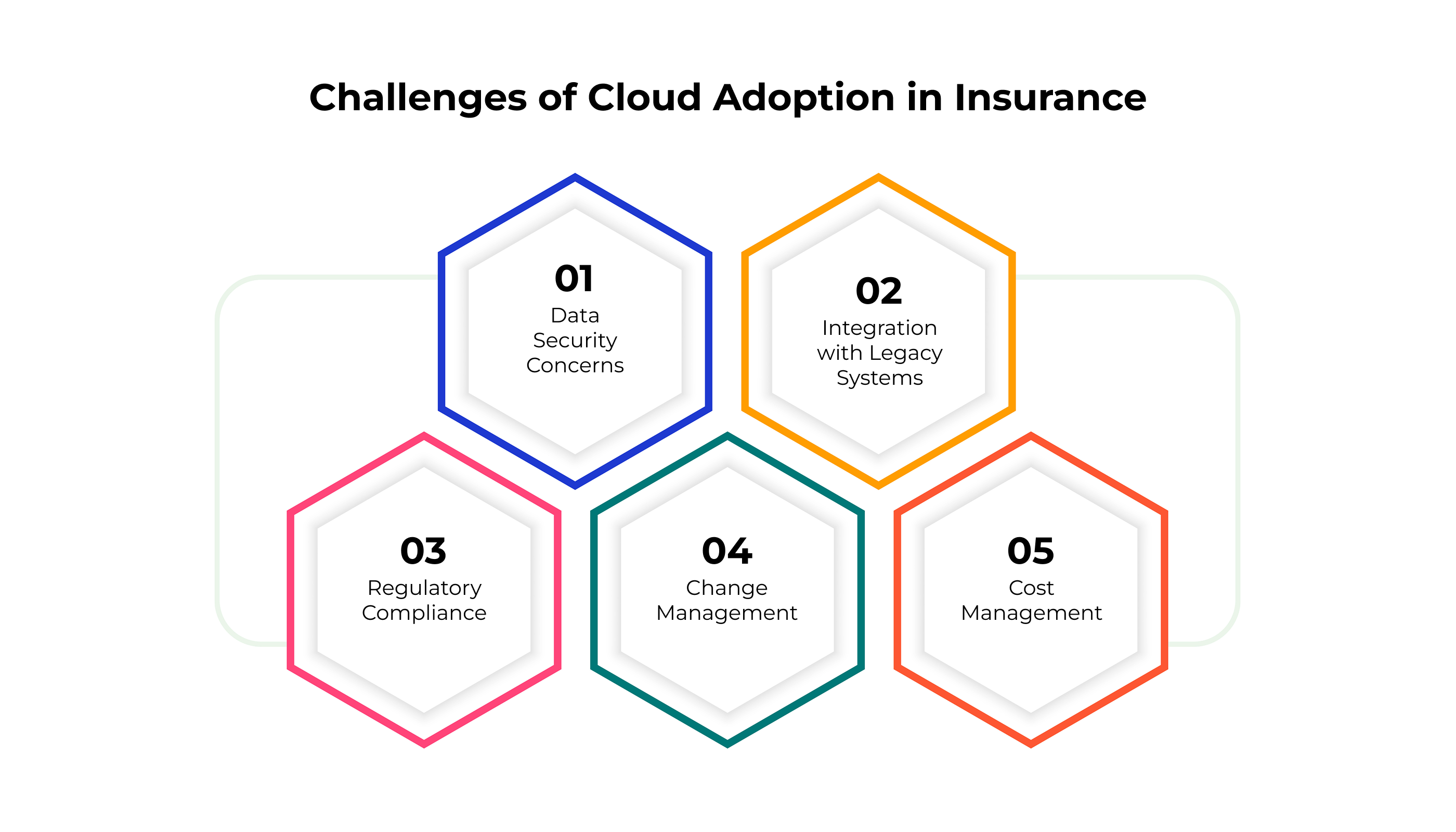
Data Security Concerns – Insurers handle sensitive customer data, so strict compliance and advanced security measures are essential to avoid breaches.
Integration with Legacy Systems – Migrating old, outdated systems to modern cloud platforms is complex and often requires custom solutions.
Regulatory Compliance – The insurance industry is heavily regulated, and ensuring cloud systems meet all legal standards can be challenging.
Change Management – Employees must adapt to new cloud-based workflows, which requires training and cultural change within the organization.
Cost Management – Without proper planning, cloud expenses can escalate due to scaling, integrations, and ongoing maintenance.
Step-by-Step Cloud Adoption Process for Insurance Companies
Assessment & Planning – The first step is to evaluate existing IT systems and identify gaps. Insurers must define clear cloud goals such as cost reduction, faster claims processing, or improved customer experience. This ensures the adoption strategy aligns with business objectives.
Choosing Deployment Model – Companies decide between public, private, or hybrid cloud depending on their needs. Public cloud is cost-effective, private cloud offers higher security, and hybrid cloud balances flexibility and control.
Data Migration – Legacy data and applications are securely transferred to cloud platforms. This step requires careful planning to avoid data loss and ensure compliance with industry regulations.
Integration – Cloud systems must be connected with existing applications like CRM, policy management, and claims systems. Proper integration ensures smooth workflows and avoids disruptions.
Automation Implementation – Insurers can add AI and machine learning tools to automate claims processing, underwriting, and fraud detection. This reduces manual work and speeds up operations.
Testing & Compliance – Before going live, insurers must test the system for performance, security, and compliance. Meeting regulatory standards is critical in the insurance industry.
Training & Change Management – Employees need training to adapt to cloud-based workflows. Change management ensures smooth adoption and helps staff embrace new technologies.
Monitoring & Optimization – After deployment, insurers must continuously monitor system performance, costs, and security. Regular optimization ensures maximum efficiency and long-term success.
This structured process helps insurance companies adopt cloud technology smoothly while minimizing risks and maximizing benefits.
Future Trends in Cloud Computing in Insurance
The future of cloud computing in insurance industry looks promising with these trends:
AI & Automation – Artificial intelligence combined with cloud computing will transform claims processing and underwriting. Insurers will use automation to verify documents, detect fraud, and assess risks faster. This reduces manual errors, speeds up decision-making, and enhances customer satisfaction. Over time, automation in cloud computing insurance will become the backbone of operational efficiency.
Blockchain Integration – Cloud platforms integrated with blockchain will bring transparency and trust to insurance processes. Smart contracts can automate policy issuance and claims settlement, reducing disputes. Blockchain ensures secure, tamper-proof records stored in the cloud, which strengthens compliance and fraud prevention. Together, cloud and blockchain will redefine how insurers manage policies and customer trust.
IoT Data Processing – With connected devices like smart homes, wearable health trackers, and connected cars, insurers will receive massive amounts of data. Cloud systems will process this IoT data to assess risks in real time. For example, driving behavior data can influence auto insurance premiums. Cloud adoption ensures scalability to handle such large datasets while enabling personalized risk management.
Personalized Insurance Products – Cloud analytics will allow insurers to design hyper-personalized policies tailored to individual customer needs. By analyzing customer data stored in the cloud, insurers can offer flexible premiums, customized coverage, and dynamic pricing. This trend will shift insurance from a one-size-fits-all model to a customer-centric approach, improving loyalty and retention.
Sustainability Focus – Moving to the cloud reduces reliance on physical data centers, lowering energy consumption and carbon footprint. Insurance companies adopting cloud technology will align with global sustainability goals. Cloud providers are increasingly investing in green energy, which means insurers benefit from eco-friendly IT infrastructure. This trend not only saves costs but also enhances brand reputation as socially responsible businesses.
These future trends show that cloud technology for insurance companies is not just about modernization — it’s about creating smarter, more transparent, and sustainable insurance ecosystems.
Frequently Asked Questions
Quick answers related to this article from PerfectionGeeks.
1. Why are insurance companies moving to the cloud?
2. How does automation in cloud computing insurance help insurers?
3. Why should I choose PerfectionGeeks for cloud adoption and app development?
Conclusion
The cloud in insurance industry is revolutionizing how insurers operate. From faster claims processing to better customer engagement, cloud computing in insurance offers unmatched benefits. While challenges like data security and compliance exist, the advantages far outweigh the risks. With growing cloud adoption in insurance industry, the future will see more automation, AI-driven insights, and personalized insurance products. For insurers, embracing cloud technology for insurance companies is not just an option — it’s the path to staying competitive in a digital-first world.

Shrey Bhardwaj is the Director & Founder of PerfectionGeeks Technologies, bringing extensive experience in software development and digital innovation. His expertise spans mobile app development, custom software solutions, UI/UX design, and emerging technologies such as Artificial Intelligence and Blockchain. Known for delivering scalable, secure, and high-performance digital products, Shrey helps startups and enterprises achieve sustainable growth. His strategic leadership and client-centric approach empower businesses to streamline operations, enhance user experience, and maximize long-term ROI through technology-driven solutions.