Published 13 May 2026 | Updated 2 June 2026
Technology
Building AI Workflows with LangChain in 2026: Complete Enterprise Guide
Artificial Intelligence has transformed the way enterprises build applications, automate operations, and improve customer experiences. As businesses continue adopting generative AI solutions, frameworks like LangChain have become essential for creating scalable and intelligent AI workflows. From chatbots and AI agents to enterprise automation systems, LangChain is helping organizations integrate large language models into real-world applications efficiently.
In this LangChain enterprise guide 2026, we will explore how enterprises can build AI workflows using LangChain, the latest trends, architecture strategies, use cases, benefits, challenges, and why businesses are increasingly choosing advanced AI workflow solutions for digital transformation.
Transform Your Digital Experience
LangChain Enterprise Guide 2026 is a strategic framework that helps businesses build, deploy, and scale AI-powered applications using Large Language Models (LLMs), AI agents, Retrieval-Augmented Generation (RAG), and workflow automation. It enables organizations to connect AI models with enterprise data, automate business processes, improve customer experiences, and create intelligent applications that deliver measurable business value. In 2026, LangChain has become a leading choice for enterprises looking to implement secure, scalable, and production-ready AI solutions.
- LangChain is a leading framework for developing enterprise-grade AI applications and AI agents.
- Businesses use LangChain to build chatbots, knowledge assistants, workflow automation systems, and intelligent search platforms.
- Retrieval-Augmented Generation (RAG) improves AI accuracy by connecting language models with company data.
- AI agents can automate complex tasks, make decisions, and interact with business systems with minimal human intervention.
- Enterprise AI adoption is accelerating across healthcare, finance, retail, manufacturing, and other industries.
- Successful LangChain implementation requires clear business goals, quality data, secure infrastructure, and ongoing monitoring.
- Common technologies used alongside LangChain include LangGraph, LangSmith, Pinecone, Weaviate, AWS, Azure, and OpenAI models.
- Development costs typically range from $10,000 to $500,000+, depending on project complexity and integrations.
- Implementation timelines can vary from 4 weeks for basic AI applications to 12 months for enterprise-wide deployments.
- Organizations that invest in LangChain-powered AI solutions can improve productivity, reduce operational costs, and gain a competitive advantage in the AI-driven economy.
At PerfectionGeeks Technologies, we help enterprises build next-generation AI-powered applications using modern frameworks, automation technologies, and scalable cloud infrastructures.
What is LangChain Enterprise Guide 2026?
The LangChain Enterprise Guide 2026 is a comprehensive roadmap for businesses looking to build, deploy, and scale AI-powered applications using the LangChain ecosystem. It helps organizations leverage Large Language Models (LLMs), Retrieval-Augmented Generation (RAG), AI agents, and workflow automation to improve business operations and customer experiences.
As enterprises increasingly adopt generative AI, LangChain has become one of the most popular frameworks for connecting AI models with business data, APIs, databases, and enterprise software. The guide provides best practices, implementation strategies, technology recommendations, and deployment frameworks for successful enterprise AI adoption.
Whether a company is building intelligent chatbots, internal knowledge assistants, automated workflows, or AI agents, LangChain provides the foundation needed to create scalable and production-ready AI solutions.
Why LangChain Enterprise Guide 2026 Matters in 2026
Artificial Intelligence has evolved from experimentation to a critical business technology. Organizations now require AI systems that are reliable, secure, explainable, and capable of delivering measurable business outcomes.
Growing Enterprise AI Adoption
Businesses across industries are investing heavily in AI-driven automation, customer support, analytics, and decision-making systems. LangChain helps accelerate these initiatives by simplifying AI application development.
Rise of AI Agents
AI agents are becoming capable of handling complex tasks independently. Enterprises use them to automate workflows, gather information, analyze data, and execute business processes with minimal human intervention.
Better Knowledge Management
Companies generate vast amounts of internal documentation and business data. LangChain-powered solutions enable employees to access information quickly through intelligent search and conversational interfaces.
Improved Productivity
By automating repetitive tasks and streamlining workflows, organizations can improve employee productivity while reducing operational costs.
Competitive Advantage
Businesses that successfully implement enterprise AI solutions gain a significant advantage through faster decision-making, enhanced customer experiences, and greater operational efficiency.
How to Implement LangChain Enterprise Solutions: Step-by-Step
Step 1: Define Business Goals
Identify the specific challenges you want AI to solve. Common objectives include:
- Customer support automation
- Internal knowledge assistants
- Workflow automation
- Document processing
- Data analysis
- Employee productivity enhancement
Clear objectives help establish project scope and success metrics.
Step 2: Select the Right Language Model
Choose AI models based on:
- Accuracy requirements
- Performance expectations
- Security considerations
- Budget constraints
- Compliance requirements
The model selection process directly impacts application quality and operational costs.
Step 3: Organize Enterprise Data
Prepare business data sources such as:
- Knowledge bases
- PDFs and documents
- Databases
- CRM systems
- ERP platforms
- Internal portals
High-quality data is essential for generating accurate AI responses.
Step 4: Implement Vector Search Infrastructure
Vector databases enable semantic search capabilities by storing document embeddings. This allows AI systems to retrieve relevant information efficiently before generating responses.
Step 5: Build Retrieval-Augmented Generation (RAG)
RAG combines language models with enterprise knowledge sources to improve response accuracy and reduce hallucinations.
Step 6: Develop AI Agents
AI agents can:
- Access external tools
- Retrieve information
- Execute workflows
- Interact with APIs
- Perform multi-step reasoning
These capabilities make enterprise applications more intelligent and autonomous.
Step 7: Integrate Enterprise Systems
Connect AI applications with existing business platforms, including:
- CRM software
- ERP systems
- Customer support platforms
- Communication tools
- Internal applications
Step 8: Implement Monitoring and Analytics
Track performance metrics such as:
- Response quality
- User engagement
- Retrieval accuracy
- Workflow efficiency
- System reliability
Step 9: Ensure Security and Governance
Enterprise AI systems should include:
- Data encryption
- Access control
- Audit logs
- Compliance monitoring
- Governance policies
Key Benefits of LangChain Enterprise Solutions
Faster AI Development
Pre-built components and integrations reduce development time and accelerate deployment.
Improved Customer Support
AI assistants provide faster and more personalized customer interactions.
Enhanced Automation
Businesses can automate repetitive and time-consuming tasks across departments.
Better Data Accessibility
Employees gain instant access to organizational knowledge through conversational AI interfaces.
Increased Operational Efficiency
AI-driven workflows reduce manual effort and improve business productivity.
Scalable Enterprise Architecture
LangChain supports enterprise-grade deployments capable of handling growing workloads and user demands.
Reduced Operational Costs
Automation and process optimization help lower operational expenses while improving output quality.
Tools & Technologies Used in LangChain Enterprise Development
| Category | Technologies |
|---|---|
| AI Models | GPT-4, Claude, Gemini, Llama |
| Frameworks | LangChain, LangGraph |
| Vector Databases | Pinecone, Weaviate, Qdrant, Chroma |
| Databases | PostgreSQL, MongoDB |
| Cloud Platforms | AWS, Microsoft Azure, Google Cloud |
| Monitoring | LangSmith, OpenTelemetry |
| API Integration | REST API, GraphQL |
| Deployment | Docker, Kubernetes |
| Security | IAM, RBAC, Encryption |
A successful enterprise implementation typically combines multiple technologies to create a secure, scalable, and high-performing AI ecosystem.
Cost & Timeline for LangChain Enterprise Development
Estimated Development Cost
| Solution Type | Estimated Cost |
|---|---|
| AI Chatbot | $10,000 – $30,000 |
| Enterprise Knowledge Assistant | $20,000 – $70,000 |
| RAG-Based Application | $25,000 – $80,000 |
| AI Workflow Automation Platform | $40,000 – $120,000 |
| Multi-Agent AI System | $75,000 – $250,000+ |
| Enterprise AI Platform | $150,000 – $500,000+ |
Estimated Project Timeline
| Project Scope | Timeline |
|---|---|
| Basic AI Chatbot | 4–8 Weeks |
| Knowledge Assistant | 6–10 Weeks |
| RAG Application | 8–12 Weeks |
| Workflow Automation Platform | 3–5 Months |
| Multi-Agent Platform | 4–8 Months |
| Enterprise-Wide Deployment | 6–12 Months |
Project complexity, integrations, compliance requirements, and infrastructure decisions significantly influence overall costs and timelines.
Real-World Examples of LangChain Enterprise Applications
Enterprise Knowledge Assistant
Organizations use AI-powered assistants to help employees find information across internal systems and documentation.
Customer Support Automation
AI chatbots resolve customer queries, provide instant responses, and reduce support workloads.
Financial Intelligence Platforms
Financial institutions automate report analysis, risk assessment, and data summarization.
Healthcare Information Systems
Healthcare providers use AI solutions for patient information retrieval, documentation assistance, and administrative support.
Legal Document Analysis
Law firms automate contract reviews, document summarization, and compliance checks.
Manufacturing Process Automation
Manufacturers leverage AI to monitor operations, optimize workflows, and improve production efficiency.
HR and Employee Support
AI assistants help employees access policies, training materials, and organizational resources.
Industries Benefiting from LangChain AI Workflows
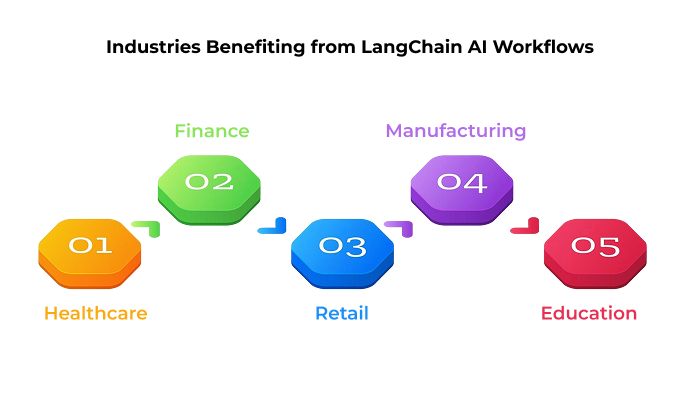
Healthcare
Applications include:
- AI patient assistants
- Clinical documentation
- Medical search systems
Finance
Use cases:
- Fraud detection
- AI investment assistants
- Financial reporting automation
Retail
Retailers use AI workflows for:
- Personalized recommendations
- Customer support
- Inventory forecasting
Manufacturing
Manufacturers leverage AI for:
- Predictive maintenance
- Workflow optimization
- Smart factory automation
Education
Educational institutions implement:
- AI tutoring systems
- Personalized learning assistants
- Automated assessment platforms
Key Technologies Used Alongside LangChain
Modern enterprise AI stacks often include:
| Technology | Purpose |
|---|---|
| Kubernetes | Container orchestration |
| Docker | Application deployment |
| Vector Databases | Semantic retrieval |
| FastAPI | AI API development |
| Cloud Platforms | Scalability |
| MLOps Tools | AI lifecycle management |
Combining these technologies improves AI workflow efficiency.
How LangChain Supports Digital Transformation
Digital transformation requires intelligent systems capable of adapting to business needs.
LangChain supports:
- AI-driven automation
- Intelligent data retrieval
- Business process optimization
- Enterprise decision intelligence
Organizations adopting AI workflows gain a significant competitive advantage.
Frequently Asked Questions
Quick answers related to this article from PerfectionGeeks.
1. What is LangChain used for?
2. Why is LangChain important for enterprises?
3. What is Retrieval-Augmented Generation (RAG)?
4. Can LangChain integrate with existing business systems?
Conclusion
Enterprise AI adoption is accelerating rapidly, and businesses need scalable frameworks to build intelligent, reliable, and automated systems. In this LangChain enterprise guide 2026, we explored how LangChain is transforming enterprise AI workflows through automation, AI agents, RAG architecture, and seamless integrations.
As enterprises continue investing in AI-powered operations, frameworks like LangChain will play a critical role in shaping the future of intelligent business systems.
Businesses that adopt AI workflow automation early will gain advantages in:
- Productivity
- Customer engagement
- Operational efficiency
- Decision-making
- Innovation
PerfectionGeeks Technologies helps enterprises design and deploy next-generation AI solutions that align with modern business goals and future-ready digital transformation strategies.

Shrey Bhardwaj is the Director & Founder of PerfectionGeeks Technologies, bringing extensive experience in software development and digital innovation. His expertise spans mobile app development, custom software solutions, UI/UX design, and emerging technologies such as Artificial Intelligence and Blockchain. Known for delivering scalable, secure, and high-performance digital products, Shrey helps startups and enterprises achieve sustainable growth. His strategic leadership and client-centric approach empower businesses to streamline operations, enhance user experience, and maximize long-term ROI through technology-driven solutions.