Published 7 May 2026 | Updated 23 May 2026
Technology
Enterprise Fine-Tuned LLM vs RAG 2026 — Complete Guide
Artificial Intelligence is transforming enterprise software development faster than ever before. As businesses increasingly adopt Large Language Models (LLMs) for automation, customer support, analytics, content generation, and decision-making, two major AI implementation approaches are dominating discussions in 2026: Fine-Tuned LLMs and Retrieval-Augmented Generation (RAG).
Organizations building AI-powered enterprise applications often struggle to decide which approach is better for scalability, accuracy, cost optimization, and long-term business value.
Should enterprises fine-tune their own LLMs for specialized performance, or should they adopt RAG architectures for real-time knowledge retrieval?
This complete guide explains the differences between fine-tuned LLMs and RAG systems, their business use cases, implementation costs, benefits, challenges, and future enterprise AI trends for 2026.
What is a Fine-Tuned LLM?A fine-tuned LLM is a pre-trained large language model that has been additionally trained on domain-specific enterprise data to improve performance for specialized tasks such as healthcare support, legal analysis, finance automation, or customer service. What is RAG (Retrieval-Augmented Generation)?RAG is an AI architecture that combines large language models with external knowledge retrieval systems. Instead of storing all information inside the model, RAG retrieves relevant real-time data from databases, documents, APIs, or enterprise systems before generating responses. Which is better: Fine-Tuning or RAG?The best approach depends on business goals:
Many enterprises now combine both approaches for optimal AI performance. Why are enterprises adopting RAG and fine-tuned LLMs?Businesses use these technologies to:
|
- Fine-tuned LLMs are optimized for specialized enterprise tasks and industry-specific workflows.
- RAG architectures improve AI accuracy through real-time knowledge retrieval.
- Fine-tuning offers better personalization, while RAG provides dynamic information access.
- Hybrid AI systems combining fine-tuning and RAG are emerging as the preferred enterprise strategy.
- Enterprise AI adoption is accelerating across healthcare, finance, legal tech, retail, and customer support.
- AI copilots and autonomous agents will transform enterprise operations in 2026.
- Security, governance, and compliance remain critical in enterprise AI implementation.
- Businesses investing early in scalable AI infrastructure gain long-term competitive advantages.
Understanding Enterprise AI Evolution in 2026
Enterprise AI has evolved beyond simple chatbots and automation tools. Modern organizations now require AI systems capable of:
- Understanding enterprise knowledge
- Generating contextual responses
- Automating workflows
- Accessing real-time business data
- Maintaining compliance and security
This demand has accelerated the rise of:
- Fine-tuned enterprise LLMs
- RAG-based AI architectures
- AI copilots
- Autonomous enterprise agents
As businesses scale AI adoption, choosing the right implementation model becomes critical.
What Is Enterprise LLM Fine-Tuning?
Fine-tuning is the process of training an existing large language model on company-specific datasets to improve its performance for specialized enterprise tasks.
How Fine-Tuning Works
The model learns from:
- Internal business documents
- Industry terminology
- Customer interactions
- Proprietary workflows
- Domain-specific datasets
This creates an AI system tailored specifically to enterprise requirements.
Benefits of Fine-Tuned Enterprise LLMs
Highly Specialized Outputs
Fine-tuned models perform exceptionally well in niche industries such as:
- Healthcare
- Legal tech
- Banking
- Insurance
- Manufacturing
Better Brand Consistency
Enterprises can control communication tone, response formats, and operational behavior.
Improved Task Automation
Fine-tuned AI systems automate repetitive enterprise processes more accurately.
Enhanced Customer Experience
AI assistants become more context-aware and industry-specific.
Challenges of Fine-Tuning
High Infrastructure Costs
Training and maintaining enterprise-grade models requires significant GPU and cloud resources.
Continuous Retraining Requirements
Models may become outdated if business knowledge changes frequently.
Large Dataset Dependency
Fine-tuning requires high-quality domain-specific training data.
Longer Deployment Timelines
Custom model training often increases development complexity and implementation time.
What Is Retrieval-Augmented Generation (RAG)?
RAG enhances AI systems by connecting LLMs to external enterprise knowledge sources.
Instead of relying solely on trained parameters, the model retrieves real-time information before generating responses.
RAG Data Sources Include:
- Enterprise databases
- PDFs and documents
- CRMs
- APIs
- Internal knowledge bases
- Cloud storage systems
This makes RAG highly scalable for enterprise AI applications.
Benefits of RAG Architecture
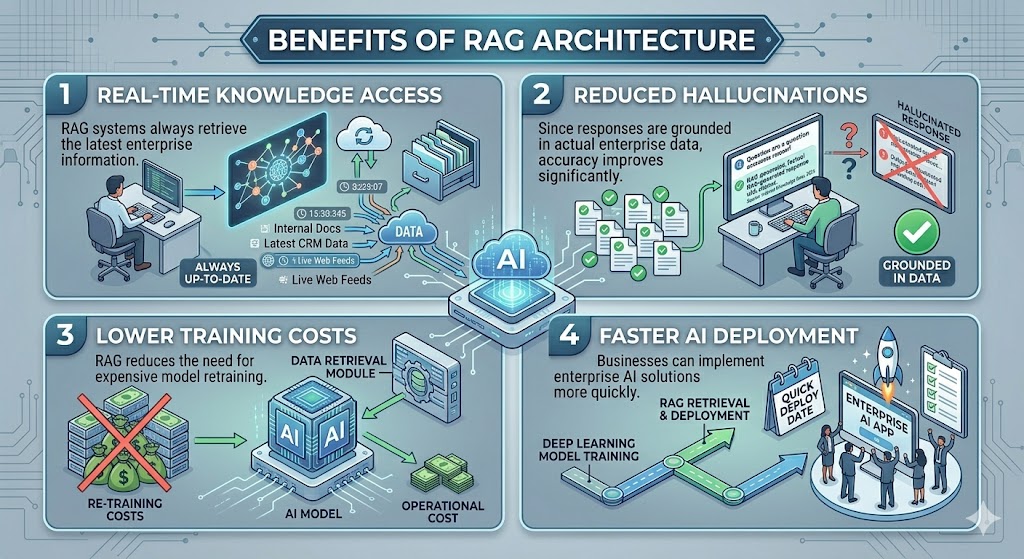
Real-Time Knowledge Access
RAG systems always retrieve the latest enterprise information.
Reduced Hallucinations
Since responses are grounded in actual enterprise data, accuracy improves significantly.
Lower Training Costs
RAG reduces the need for expensive model retraining.
Faster AI Deployment
Businesses can implement enterprise AI solutions more quickly.
Better Compliance and Governance
Enterprises maintain greater control over data sources and information access.
Industry Statistics: Enterprise AI and LLM Adoption
- Over 80% of enterprises are expected to deploy generative AI solutions by 2026.
- The global generative AI market is projected to exceed $200 billion within the next decade.
- RAG architectures are rapidly becoming the preferred enterprise AI deployment model due to lower operational costs.
- AI-powered enterprise automation can improve operational efficiency by up to 40%.
- More than 65% of businesses are investing in domain-specific AI assistants and copilots.
These trends highlight why enterprises are aggressively investing in AI infrastructure and LLM optimization strategies.
Fine-Tuned LLM vs RAG: Key Differences
| Feature | Fine-Tuned LLM | RAG |
|---|---|---|
| Knowledge Updates | Requires retraining | Real-time retrieval |
| Infrastructure Cost | High | Moderate |
| Response Accuracy | High for specialized tasks | High for dynamic data |
| Scalability | Complex | Easier |
| Deployment Speed | Slower | Faster |
| Best Use Case | Specialized enterprise workflows | Knowledge-intensive applications |
| Data Freshness | Limited | Real-time |
When Enterprises Should Choose Fine-Tuning
Best Use Cases
- Healthcare diagnosis assistants
- Legal document analysis
- Financial advisory systems
- Industry-specific customer support
- Brand-controlled AI assistants
Fine-tuning works best when businesses require highly specialized outputs and consistent enterprise behavior.
When Enterprises Should Choose RAG
Best Use Cases
- Enterprise search engines
- AI knowledge assistants
- Customer support chatbots
- Internal documentation systems
- Dynamic reporting platforms
RAG is ideal when enterprises frequently update data and require real-time contextual responses.
Build Enterprise AI Solutions with PerfectionGeeksLooking to develop scalable enterprise AI applications using fine-tuned LLMs or RAG architectures? Why Choose PerfectionGeeks?
Explore advanced AI development services with PerfectionGeeks and accelerate your AI transformation journey. |
Hybrid AI: Combining Fine-Tuning and RAG
Many enterprises are now combining both technologies for better performance.
Hybrid AI Systems Use:
- Fine-tuning for domain expertise
- RAG for real-time enterprise knowledge retrieval
This hybrid approach offers:
- Better contextual accuracy
- Reduced hallucinations
- Personalized responses
- Real-time data access
- Improved enterprise scalability
Hybrid AI architectures are expected to dominate enterprise AI development in 2026 and beyond.
Enterprise Use Cases for Fine-Tuned LLMs and RAG
Healthcare
AI assistants help doctors access patient records and clinical insights securely.
Financial Services
Banks use AI for fraud detection, investment analysis, and automated support systems.
Legal Tech
AI automates legal research, contract analysis, and compliance documentation.
Retail and E-Commerce
Businesses use AI for product recommendations, inventory optimization, and customer engagement.
Enterprise Knowledge Management
Organizations deploy AI copilots to streamline internal workflows and employee productivity.
Key Challenges in Enterprise AI Deployment
Data Security and Compliance
Enterprises must secure sensitive customer and operational data.
AI Hallucinations
Incorrect AI outputs can create operational and reputational risks.
Integration Complexity
AI systems must integrate with legacy enterprise infrastructure.
Infrastructure Scaling
Enterprise AI workloads require scalable cloud and GPU infrastructure.
Governance and Ethical AI
Organizations must ensure responsible and transparent AI usage.
Future Trends in Enterprise AI 2026
AI Copilots for Every Department
AI assistants will become standard across HR, finance, sales, operations, and customer support.
Autonomous Enterprise Agents
AI agents will independently execute workflows and business operations.
Smaller Specialized Models
Businesses will increasingly adopt lightweight domain-specific models.
Multi-Modal Enterprise AI
AI systems will process text, voice, video, and images simultaneously.
AI-Powered Workflow Automation
Enterprise operations will become increasingly autonomous through AI orchestration.
|
Frequently Asked Questions
Quick answers related to this article from PerfectionGeeks.
1. What is the difference between fine-tuning and RAG?
2. Is RAG better than fine-tuning?
3. Can enterprises combine RAG and fine-tuning?
4. Why is RAG becoming popular in enterprise AI?
5. What industries benefit most from enterprise LLMs?
6. Are fine-tuned LLMs expensive?
Conclusion
As enterprise AI adoption accelerates in 2026, both fine-tuned LLMs and RAG architectures are becoming essential components of modern digital transformation strategies. Fine-tuning delivers highly specialized and personalized AI capabilities, while RAG provides scalable access to real-time enterprise knowledge.
Rather than competing technologies, these approaches are increasingly complementary. Businesses that successfully combine domain-specific intelligence with dynamic retrieval systems will gain major advantages in automation, operational efficiency, and customer experience.
Organizations investing in enterprise AI should focus on scalability, governance, cloud infrastructure, security, and long-term adaptability while selecting the right AI architecture for their business needs.

Shrey Bhardwaj is the Director & Founder of PerfectionGeeks Technologies, bringing extensive experience in software development and digital innovation. His expertise spans mobile app development, custom software solutions, UI/UX design, and emerging technologies such as Artificial Intelligence and Blockchain. Known for delivering scalable, secure, and high-performance digital products, Shrey helps startups and enterprises achieve sustainable growth. His strategic leadership and client-centric approach empower businesses to streamline operations, enhance user experience, and maximize long-term ROI through technology-driven solutions.
![MVP App Development Cost in 2026: Build Fast, Validate, Then Scale [Complete Cost Breakdown Guide]](https://d31xy5iwtct4dk.cloudfront.net/uploads/1777976980033-mvp.webp)