

Published 18 May 2026
technology
Why React Server Components Change Everything for Web Dev in 2026
If you've been building React apps for a while, you already know the headaches: slow page loads, JavaScript bundles that balloon out of control, awkward data-fetching patterns, and SEO challenges that feel like they were bolted on as an afterthought. React Server Components — first introduced as an experiment and now a production-ready cornerstone of modern React web development — solve these problems at the architecture level. This guide breaks down exactly what they are, how they work, and why they matter so much in 2026.
- React Server Components run entirely on the server — zero JavaScript is shipped to the browser for server components, which directly reduces bundle size by 30–50% in large applications.
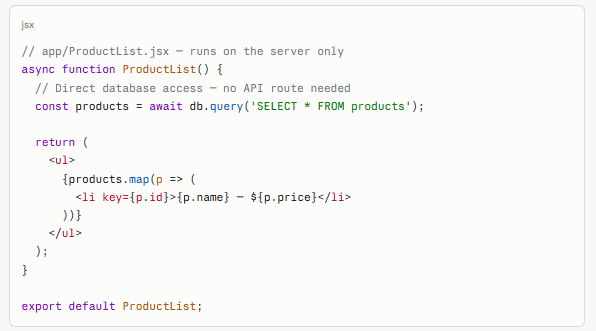
- Data fetching becomes dramatically simpler — you can use plain async/await inside Server Components to query databases directly, with no API routes, no useEffect, and no loading-state boilerplate needed.
- RSC is not the same as SSR — Server-Side Rendering still sends JavaScript to the browser for hydration; RSC components never send their code to the browser at all.
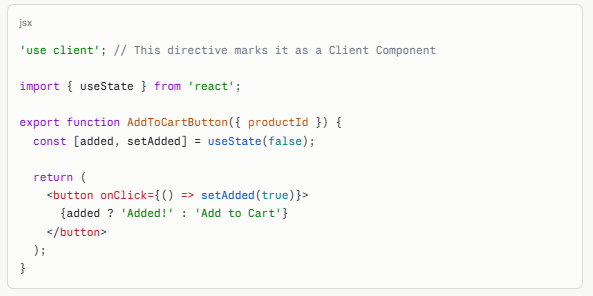
- Client Components still have their place — anything that needs useState, useEffect, event handlers, or browser APIs must be a Client Component. The two types work together in the same application.
- Next.js App Router makes RSC the default — every component in the app/ directory is a Server Component unless you explicitly add 'use client', nudging teams toward better performance automatically.
- SEO improves out of the box — because content renders on the server, search engines receive fully populated HTML on the first response without needing to execute any JavaScript.
- Security is stronger by design — database credentials, API secrets, and sensitive business logic never leave the server, eliminating an entire category of accidental data exposure.
- RSC is production-ready and ecosystem-supported in 2026 — major libraries, testing tools, and frameworks have all fully caught up, making this the right time to adopt RSC as your default React architecture.
What are React Server Components?
React Server Components (RSC) are a type of React component that runs exclusively on the server — not in the browser. When a user visits your page, these components execute on the server, generate their output, and send that finished result to the client. The browser never receives the JavaScript code for these components at all.
If you've ever asked yourself what are React Server Components and why does everyone keep talking about them — here's the short answer: they are the React team's solution to a fundamental problem in React app development. Traditional React runs everything in the browser. That means every component, even ones that just display static text or pull from a database, ships their JavaScript to the user's device. This wastes bandwidth, slows down load times, and makes scaling harder.
Server components react to this challenge by keeping server-side logic where it belongs — on the server. You get direct access to databases, file systems, and APIs without exposing that logic to the client. No API routes needed for simple data fetching. No client-side secrets leaking out. Just clean, efficient rendering.
Key insight: React Server Components are not the same as Server-Side Rendering (SSR). SSR still sends JavaScript to the browser for hydration. RSC components send only the rendered output — the component's JavaScript code stays on the server entirely and never reaches the user's device.
How Server Components Actually Work
Understanding how server components react architecture operates helps you use them correctly. Here's the flow in plain terms:
- A user requests a page in their browser.
- The server runs your Server Components — fetching data, querying databases, applying business logic.
- The server sends a serialized React component tree to the browser.
- Client Components (the interactive ones) hydrate in the browser using minimal JavaScript.
- The user sees a fully rendered, fast, and interactive page.
The result is that your application ships dramatically less JavaScript to the browser. Only the truly interactive pieces — buttons, forms, modals, dropdowns — need to load JavaScript. Everything else stays on the server.
Server Component Example (no JavaScript sent to browser):
Client Component Example (interactive, ships JavaScript):
React Server Components vs Client Components
One of the most common questions developers have when learning RSC is about the difference in react server components vs client components. The table below covers everything you need to know at a glance:
| Feature / Capability | Server Components | Client Components |
|---|---|---|
| Runs on | Server only | Browser (+ SSR on server) |
| JavaScript sent to browser | None (0 KB) | Yes |
| Direct database access | Yes | No (needs API) |
| Access to filesystem | Yes | No |
| useState / useEffect hooks | Not supported | Fully supported |
| Event handlers (onClick, etc.) | Not supported | Fully supported |
| Async data fetching | Native async/await | Via hooks or libraries |
| Access to browser APIs | No | Yes (window, localStorage) |
| SEO friendliness | Excellent | Needs SSR setup |
| Can import Server Components | Yes | No (only as children/props) |
| Can import Client Components | Yes | Yes |
| Bundle size impact | Zero | Adds to bundle |
| Secrets / API keys safety | Safe (server-only) | Risk of exposure |
| Caching support | Built-in fetch cache | Manual (SWR, React Query) |
The rule of thumb is simple: if a component doesn't need to be interactive, make it a Server Component. If it needs interactivity — state, effects, browser APIs, event listeners — make it a Client Component. Most well-architected apps end up with far more Server Components than Client Components, and that's exactly the point.
Key Benefits for React App Development
The impact on React app development in 2026 is massive. Here's why developers and teams are adopting RSC so quickly:
Dramatically Smaller JavaScript Bundles
Every Server Component you write is JavaScript that never reaches the browser. For large applications, this alone can cut bundle sizes by 30–50%. Smaller bundles mean faster downloads, faster parsing, and faster interactive pages — especially critical for users on mobile networks or lower-powered devices.
Simpler Data Fetching
Before RSC, fetching data in React meant dealing with useEffect, useState, loading states, and often an entire library like React Query or SWR. With Server Components, you write plain async/await at the top of your component. No hooks. No loading states for server-fetched data. No race conditions between renders and requests.
Better SEO Out of the Box
Search engines need to read your content to index it. Server Components render on the server, so your content is fully present in the initial HTML response. This makes React frontend development far more SEO-friendly without any special configuration or workarounds that used to be necessary with pure client-side React.
Improved Security
Database queries, API secrets, and sensitive business logic never leave the server. You no longer need to create a separate API layer just to hide your database credentials from the browser — the Server Component handles it naturally and securely.
Streaming and Progressive Rendering
React 18's streaming architecture pairs perfectly with RSC. Parts of your page can stream to the browser as they become ready, rather than waiting for the entire page to finish rendering before sending anything. Users see content sooner, even on slow connections.
Real-world result: Teams migrating large Next.js applications to the App Router (which uses RSC by default) consistently report 20–50% improvements in Core Web Vitals scores — directly impacting search rankings and conversion rates.
Next.js Server Components in Practice
Next.js Server Components represent the most mature and widely adopted implementation of RSC available today. Since Next.js 13 introduced the App Router, and with subsequent versions solidifying the patterns, developers now have a stable, production-ready system built on top of RSC.
In Next.js, every component inside the app/ directory is a Server Component by default. You opt into Client Component behavior only when you actually need it, by adding the 'use client' directive at the top of a file. This default-server approach naturally nudges developers toward better performance patterns without requiring extra effort.
| Next.js Feature | RSC Role | Key Benefit |
|---|---|---|
| App Router | Server Components by default | Optimal performance baseline |
| Layout components | Persistent server-rendered shells | Shared UI without re-rendering |
| Server Actions | Server-side mutations from client | Form handling without API routes |
| Suspense boundaries | Streaming partial UI | Progressive loading experience |
| Parallel routes | Multiple server-rendered slots | Complex dashboard layouts |
| Intercepting routes | Modal-style navigation | Instagram-style photo overlays |
| Metadata API | Server-generated SEO tags | Dynamic, accurate meta tags |
Other frameworks are following Next.js's lead. Remix, Astro, and even custom Node.js setups are adopting RSC patterns. The App Router's approach has become the reference implementation the entire React community looks to when designing their own RSC-based systems.
"Next.js made RSC approachable. But in 2026, RSC is no longer a Next.js-specific feature — it's becoming the standard way to think about React architecture across the entire ecosystem."
Modern Frontend Architecture with RSC
RSC changes how you think about modern frontend architecture at every level. The old mental model was: React runs in the browser, fetch data via APIs, manage state everywhere, ship JavaScript. The new model flips this on its head.
The Donut Model: Think of your application as a donut. The outer shell — layouts, navigation, page structure, data display — is Server Components (the dough). The holes — the interactive pieces like buttons, forms, and dropdowns — are Client Components. You end up with a mostly-server application that has small islands of client-side interactivity exactly where needed, and nowhere else.
Colocation of Data and UI: One of the biggest architectural wins with RSC is data colocation. Instead of lifting all data fetching to a top-level page component and drilling props down multiple levels, each Server Component fetches exactly the data it needs. React deduplicates requests automatically, so you don't need to worry about the same data being fetched twice.
Eliminating the Unnecessary API Layer: For internal data needs — dashboards, admin panels, content-heavy sites — RSC largely eliminates the need for a REST or GraphQL API sitting between your frontend and your database. You query the database directly in a Server Component. This simplifies your codebase significantly and removes entire categories of bugs that used to live in the API layer.
Important note: You still need APIs for third-party consumers, mobile apps, or when your data layer must be shared across multiple frontends. RSC doesn't replace APIs everywhere — it replaces the unnecessary ones.
Building Scalable React Applications
Building scalable React applications and scalable web applications that hold up under real production load requires thinking about performance at the architecture level, not just the component level. RSC makes scaling significantly easier in several important ways.
Reduced Server Load Through Caching
Server Components take full advantage of React's built-in fetch caching. Data fetched during rendering is automatically memoized for the duration of a request. You can also configure longer-lived caches for data that doesn't change frequently, reducing database pressure substantially during traffic spikes.
Parallelism Without Prop Drilling
Because each Server Component can fetch its own data independently, multiple data sources can be fetched in parallel without complex coordination at the page level. This naturally leads to faster overall page loads on data-heavy pages like dashboards and product listings.
Efficient Component Tree Updates
When a Server Component re-renders — on navigation or after a mutation via a Server Action — only the affected subtree re-renders. Client Components below Server Components don't lose their local state during these updates. This is a more efficient and less disruptive update model than traditional client-side React re-renders.
| Scaling Challenge | Old React Approach | RSC Solution |
|---|---|---|
| Large JavaScript bundles | Code splitting, lazy loading | Server Components ship 0 JS |
| Expensive data fetching | Client-side caching libraries | Built-in server-side fetch cache |
| Sensitive data exposure | API proxy layers | Data never leaves the server |
| SEO for dynamic content | Complex SSR/SSG setup | Server rendering by default |
| Slow Time to First Byte | Full page SSR must wait | Streaming with Suspense |
| Waterfall data fetching | Manual Promise.all patterns | Parallel component-level fetching |
React Development Trends in 2026
The React Ecosystem Has Matured
React Server Components are now fully supported by major libraries, frameworks, and development tools. Earlier compatibility issues have largely disappeared, making it easier for developers to build production-ready applications. Modern React ecosystems now offer stable patterns, better documentation, and smoother integration for large-scale projects.
React Compiler is Revolutionizing Performance
The React Compiler automatically optimizes components and reduces unnecessary re-renders without requiring heavy manual optimization. Developers no longer need to overuse hooks like useMemo and useCallback. This improves performance, simplifies development, and creates faster React applications by default.
Partial Prerendering (PPR) is Transforming Rendering
Partial Prerendering combines static and dynamic rendering within the same page. Static content loads instantly through CDNs, while dynamic sections render only when needed. This approach improves page speed, SEO performance, and user experience for modern web applications.
Full-Stack React is Becoming the Standard
React developers are now handling both frontend and backend responsibilities using Server Components. Tasks like data fetching, backend logic, and database interactions can be managed directly within React applications. This shift is turning React into a complete full-stack development ecosystem in 2026.
Frequently Asked Questions
Quick answers related to this article from PerfectionGeeks.
1. What are React Server Components in simple terms?
2. Do I need Next.js to use React Server Components?
3. Can I mix Server Components and Client Components in the same app?
4. Is it safe to use React Server Components in production in 2026?
Conclusion
React Server Components are reshaping modern web development by making applications faster, lighter, and more scalable. In 2026, businesses and developers are adopting RSC to improve performance, SEO, and user experience without adding unnecessary complexity to the frontend. By shifting rendering and data processing to the server, developers can build secure and highly efficient applications with reduced JavaScript load. As frameworks like Next.js continue to evolve, React Server Components are becoming the foundation of future-ready web apps. Companies that embrace this architecture early will gain a strong advantage in speed, scalability, and long-term development efficiency.

Shrey Bhardwaj
Director & Founder
Shrey Bhardwaj is the Director & Founder of PerfectionGeeks Technologies, bringing extensive experience in software development and digital innovation. His expertise spans mobile app development, custom software solutions, UI/UX design, and emerging technologies such as Artificial Intelligence and Blockchain. Known for delivering scalable, secure, and high-performance digital products, Shrey helps startups and enterprises achieve sustainable growth. His strategic leadership and client-centric approach empower businesses to streamline operations, enhance user experience, and maximize long-term ROI through technology-driven solutions.