

Published 18 May 2026 | Updated 18 May 2026
Technology
Golang Microservices in 2026: Architecture, gRPC and Cloud-Native Patterns
Go has earned its place as one of the most trusted languages for building backend systems at scale. Its simplicity, speed, and built-in concurrency make it a natural fit for microservices — and in 2026, the combination of Go with modern cloud-native tooling has become a dominant pattern across engineering teams worldwide. Whether you are just getting started or looking to sharpen your architecture decisions, this guide covers everything you need to know about building production-grade microservices with Go.
- Go's lightweight goroutines and fast compile times make it one of the best languages available for microservices architecture in production environments.
- gRPC with Protocol Buffers is the preferred communication protocol for Go-based microservices, offering better performance than REST for internal service-to-service calls.
- Cloud-native patterns — service discovery, health checks, distributed tracing, and circuit breakers — are essential parts of any mature Go microservices system.
- Kubernetes and Docker have become the standard deployment targets for Go microservices, and Go's small binary size makes containerization extremely efficient.
- A well-designed Golang microservices architecture separates concerns cleanly: each service owns its data, exposes a clear interface, and fails gracefully without taking down the whole system.
- In 2026, observability is not optional — structured logging, metrics, and tracing must be built into every service from day one.
Why Go Works So Well for Microservices
Not every programming language is equally suited to microservices. Some languages carry heavy runtimes, consume large amounts of memory per process, or start up slowly — all of which become real problems when you are running dozens or hundreds of small services. Go avoids all of these issues almost by design.
A Go binary compiles to a single self-contained executable. There is no virtual machine, no interpreter, and no large runtime to load. A typical Go microservice starts in milliseconds and consumes a fraction of the memory that an equivalent Java or Node.js service would use. When you are paying for container compute at scale, these differences add up fast.
Go's concurrency model deserves special mention. Goroutines — Go's lightweight threads — are cheap to create and efficient to run. You can handle thousands of concurrent connections without the overhead that comes with OS-level threads. For services that handle high request volumes, this is a significant structural advantage.
The language itself is intentionally small. There are no generics complexity traps, no complex inheritance hierarchies, and no magic framework behavior to debug at two in the morning. Go code tends to be readable, predictable, and easy to onboard new engineers into. For a microservices team where each service might be owned by a different squad, that consistency is genuinely valuable.
Finally, the standard library is remarkably capable. HTTP servers, JSON encoding, cryptography, testing, and more — all included without external dependencies. Golang backend development teams often find they need far fewer third-party packages compared to ecosystems like Node.js or Python, which means fewer supply chain risks and simpler dependency management.
Core Principles of Golang Microservices Architecture
Good microservices architecture is not about the language — it is about the decisions you make before writing a single line of code. That said, Go encourages several patterns that align naturally with sound microservices design.
Single Responsibility Per Service
Each service should do one thing well. A payments service handles payments. An inventory service handles inventory. They do not share databases, they do not call each other's internal functions, and they do not depend on each other's implementation details. This boundary clarity is what makes independent deployment and scaling possible.
Database Per Service
One of the most important — and most frequently violated — rules in microservices architecture in Go is that each service must own its data. Shared databases create tight coupling that undermines the entire point of microservices. If two services share a table, they cannot be deployed independently without coordination. Each service gets its own database, its own schema, and is solely responsible for the integrity of its data.
Designing for Failure
Microservices communicate over networks. Networks fail. Services go down. Any well-designed Go microservices system assumes that any call to any external service can fail at any time, and handles that gracefully — with timeouts, retries, circuit breakers, and sensible fallback behavior. Building for failure from the start is far easier than retrofitting it later.
API Contracts as the Source of Truth
The interface between services — whether REST, gRPC, or messaging — is a contract. Changing it carelessly breaks other services. In Go, teams typically define these contracts using Protocol Buffer definitions for gRPC or OpenAPI specifications for REST, version them carefully, and treat breaking changes with the same seriousness as breaking a public API.
| Architecture Principle | What It Means in Practice | Why It Matters |
|---|---|---|
| Single responsibility | One service, one domain | Independent deployment and scaling |
| Database per service | No shared schemas or tables | Loose coupling between services |
| Design for failure | Timeouts, retries, circuit breakers | System resilience under real conditions |
| API contracts | Versioned, explicit interfaces | Safe evolution without breakage |
| Stateless services | No in-memory session state | Easy horizontal scaling |
| Event-driven where appropriate | Async messaging for decoupling | Reduces synchronous dependencies |
Service Communication: gRPC vs REST
How your services talk to each other is one of the most consequential decisions in any microservices system. In 2026, Go teams have a clear preference for gRPC for internal service-to-service communication, while REST remains common for external-facing APIs.
What is Golang gRPC?
gRPC is a high-performance remote procedure call framework originally developed at Google and now a Cloud Native Computing Foundation project. It uses HTTP/2 as its transport and Protocol Buffers as its serialization format. Compared to JSON over HTTP/1.1, gRPC is significantly faster, more bandwidth-efficient, and provides strongly typed contracts that are enforced at compile time.
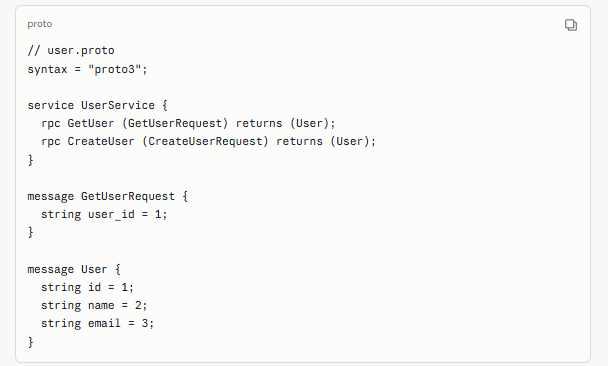
In a Go microservices system, you define your service interface in a .proto file, run the Go code generator, and get type-safe client and server code automatically. This eliminates an entire class of runtime errors that plague loosely typed REST APIs.
gRPC vs REST: The Honest Comparison
| Factor | gRPC | REST (JSON/HTTP) |
|---|---|---|
| Performance | Significantly faster (binary protocol) | Slower (text-based JSON) |
| Payload size | Smaller (Protocol Buffers) | Larger (JSON verbosity) |
| Type safety | Enforced at compile time | Runtime validation only |
| Streaming support | Built-in (bidirectional) | Limited (SSE, WebSockets separately) |
| Browser support | Needs gRPC-Web proxy | Native |
| Human readability | Not readable (binary) | Easy to inspect and debug |
| Learning curve | Steeper | Gentler |
| Tooling maturity | Very mature in 2026 | Extremely mature |
| Best for | Internal service-to-service | External / public APIs |
The practical recommendation for most teams is to use gRPC microservices for all internal communication between your Go services, and expose a REST or GraphQL gateway for external consumers. This gives you performance where it matters and compatibility where it is required.
Message Queues and Event-Driven Communication
Not every communication needs to be synchronous. For operations where the caller does not need an immediate response — sending emails, processing uploads, updating analytics — asynchronous messaging via systems like Kafka, NATS, or RabbitMQ is a better fit. Go has strong client libraries for all of these, and event-driven patterns reduce the synchronous dependencies between services, making the whole system more resilient.
Building a Go Microservice: Structure and Patterns
When you start a new Go microservice, the project structure you choose sets the tone for maintainability. The Go community has largely converged on a layered approach that keeps concerns cleanly separated.
Recommended Project Structure
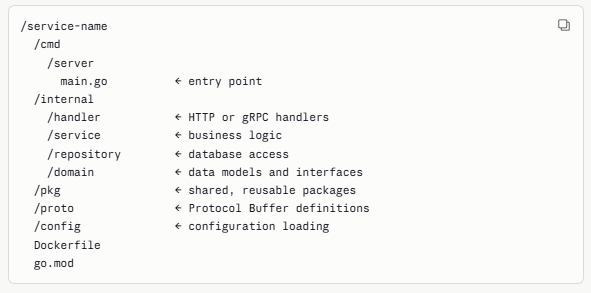
This structure keeps your business logic in the internal/service layer, completely decoupled from transport (HTTP, gRPC) and storage (Postgres, Redis). You can swap out a REST handler for a gRPC handler without touching your business logic. You can swap Postgres for another database without touching your handlers. This flexibility is what makes the service maintainable as requirements change.
Dependency Injection Over Global State
Avoid global variables. Pass dependencies — database connections, HTTP clients, configuration — through constructors. This makes your code testable, because you can inject mocks in tests, and it makes the dependencies of each component explicit and obvious.
Configuration Management
In cloud-native environments, configuration comes from environment variables, not hardcoded files. Go makes this clean with packages like os.Getenv or the popular viper library for more complex configuration needs. Secrets — database passwords, API keys — should come from a secrets manager like HashiCorp Vault or AWS Secrets Manager, never from environment variables checked into source control.
Cloud-Native Golang: Kubernetes, Docker and Beyond
Cloud native Golang development means building services that are designed to run in containerized, orchestrated environments from the start. In 2026, that means Docker and Kubernetes for the vast majority of teams.
Why Go and Docker Are a Natural Pair
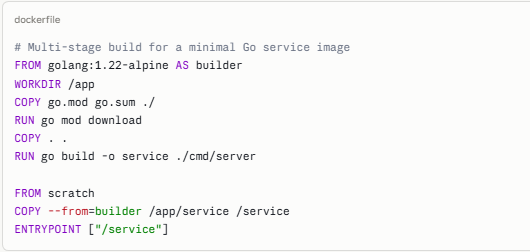
Go's compilation to a static binary makes Docker images extremely lean. A typical Go microservice Docker image built on a scratch or distroless base can be under 20 MB. Compare that to a Node.js service with a full npm dependency tree, or a Java service with a JVM — the difference in image size translates directly to faster pulls, cheaper storage, and faster pod startup times in Kubernetes.
Kubernetes Patterns for Go Microservices
Running Go microservices on Kubernetes well requires more than just writing a Deployment manifest. Here are the patterns that matter most:
| Kubernetes Pattern | Purpose | Go Implementation |
|---|---|---|
| Health checks (liveness/readiness) | Kubernetes knows when to restart or route traffic | /healthz and /ready HTTP endpoints |
| Resource limits | Prevents one service from starving others | Set in Deployment manifest |
| Horizontal Pod Autoscaler | Scale based on CPU/memory or custom metrics | Works with Prometheus metrics |
| ConfigMaps and Secrets | Inject config without rebuilding images | Mounted as env vars or files |
| Graceful shutdown | Finish in-flight requests before stopping | Signal handling in Go main() |
| Service mesh (Istio/Linkerd) | mTLS, traffic management, observability | Sidecar pattern, no app changes needed |
Service Discovery
In Kubernetes, service discovery is built in. Every service gets a DNS name that other services can use to reach it. For more complex scenarios — multi-cluster setups, hybrid cloud — tools like Consul provide more sophisticated service discovery and health checking capabilities that work well with Go Golang API development patterns.
Observability: Logging, Metrics and Tracing
You cannot fix what you cannot see. In a distributed system with many services, understanding what is happening across service boundaries requires three distinct signals: logs, metrics, and traces. In 2026, all three are non-negotiable for any production Go microservices system.
Structured Logging
Avoid plain text logs. Use structured logging — JSON format — so that logs can be queried and filtered by your logging platform (Datadog, Elastic, Grafana Loki). The slog package, now part of Go's standard library since Go 1.21, provides structured logging with zero external dependencies.
Metrics with Prometheus
Expose a /metrics endpoint in every service that Prometheus can scrape. At a minimum, track request count, request latency (as a histogram), and error rate for every endpoint. These three metrics form the RED method (Rate, Errors, Duration) and give you an immediate picture of service health.
Distributed Tracing with OpenTelemetry
When a request fails, you need to know which of your ten services caused the problem. Distributed tracing propagates a trace ID through every service call, letting you reconstruct the complete path of a request across your entire system. OpenTelemetry is the standard instrumentation library in 2026, with native Go support and exporters for Jaeger, Tempo, and major cloud providers.
| Observability Signal | Tool | What It Tells You |
|---|---|---|
| Structured logs | slog + Loki / Datadog | What happened and when |
| Metrics | Prometheus + Grafana | How the system is performing right now |
| Distributed traces | OpenTelemetry + Jaeger | Where a specific request went wrong |
| Alerts | Alertmanager + PagerDuty | When something needs human attention |
Security Patterns in Go Microservices
Security in a microservices system is more complex than in a monolith, because there are more moving parts and more network communication to secure.
Mutual TLS Between Services
Every service-to-service call should be encrypted and authenticated. Mutual TLS (mTLS) ensures that both the client and server verify each other's identity before any data is exchanged. In Kubernetes, a service mesh like Istio or Linkerd handles mTLS automatically without requiring any changes to your Go code.
JWT and OAuth2 for External Authentication
For external-facing APIs, use JWTs issued by a trusted identity provider (Auth0, Keycloak, AWS Cognito). Your API gateway validates the token before the request reaches your internal services. Internal services trust the gateway and do not need to re-validate tokens on every call.
Input Validation at Every Boundary
Never trust input from any source, including other internal services. Validate request payloads against your expected schema at every service boundary. With gRPC and Protocol Buffers, much of this is enforced by the type system, but business-level validation still belongs in your service layer.
Rate Limiting and DDoS Protection
Implement rate limiting at the API gateway level to protect your services from being overwhelmed. Go has excellent middleware libraries for rate limiting at the service level as well, using token bucket or leaky bucket algorithms.
Common Mistakes Teams Make
Even experienced teams fall into predictable traps when moving to Go microservices for the first time or scaling an existing system.
| Mistake | What Goes Wrong | Better Approach |
|---|---|---|
| Sharing a database across services | Creates tight coupling, impossible to scale independently | Enforce database per service from day one |
| Skipping timeouts on outbound calls | One slow service hangs all its callers | Always set context deadlines on every HTTP/gRPC call |
| Too many microservices too soon | Operational complexity outweighs the benefits | Start with a modular monolith, extract services when boundaries are clear |
| No distributed tracing | Impossible to debug failures across services | Instrument with OpenTelemetry from the first service |
| Hardcoded service addresses | Breaks immediately in any dynamic environment | Use service discovery or Kubernetes DNS |
| Ignoring backpressure | Fast producer overwhelms slow consumer | Use queues, rate limiting, and circuit breakers |
| Fat services with too many responsibilities | Defeats the purpose of microservices | Enforce bounded contexts strictly |
The most common mistake is moving to microservices too early. If your team is small and your domain is not yet well understood, a well-structured Go monolith with clean internal packages is far easier to operate. Extract services when you have a clear reason — independent scaling needs, team ownership boundaries, or genuinely different deployment lifecycles.
Why PerfectionGeeks Is the Right Partner for Your Golang Microservices Journey
Building microservices with Go is one thing. Building them correctly — with the right architecture decisions, the right team, and the right long-term strategy — is another challenge entirely. That is where PerfectionGeeks comes in.
PerfectionGeeks is a software development company with deep expertise in Golang backend development, cloud-native systems, and distributed architecture. Over the years, the team has helped startups, scale-ups, and enterprise clients design and deliver Go microservices systems that are built to last — not just built to ship.
What PerfectionGeeks Brings to the Table
Working with a specialized team matters when you are building something as complex as a microservices architecture in Go. Here is what sets PerfectionGeeks apart:
| Capability | What It Means for You |
|---|---|
| Golang microservices architecture design | Get your service boundaries and data ownership right from the start, avoiding costly refactors later |
| gRPC and REST API development | Experienced engineers who know when to use each and how to implement both cleanly |
| Cloud-native deployment | Kubernetes, Docker, and CI/CD pipelines configured for production from day one |
| Observability setup | Logging, metrics, and distributed tracing built into every service before go-live |
| Security implementation | mTLS, JWT authentication, secrets management, and rate limiting handled properly |
| Legacy system migration | Structured path from monolith to microservices without disrupting your existing business |
| Ongoing support and scaling | Long-term partnership as your system grows, not just project delivery and handoff |
Built for Real Business Problems
PerfectionGeeks does not offer a one-size-fits-all template. Every engagement starts with understanding your domain, your team structure, and your scaling needs before a single architecture decision is made. The goal is always to build a system that solves your specific problem efficiently — not to over-engineer or add complexity for its own sake.
Whether you need a full Golang microservices system built from scratch, a technical review of your existing Go architecture, a team to migrate a growing monolith into well-bounded services, or specialized expertise in Golang gRPC and cloud-native patterns — PerfectionGeeks has delivered exactly these outcomes for clients across industries including fintech, healthtech, logistics, and SaaS platforms.
Golang Expertise You Can Trust
The engineering team at PerfectionGeeks has hands-on experience with the full Go microservices stack — from writing clean service code and defining Protocol Buffer contracts, to configuring Kubernetes clusters, setting up Prometheus and Grafana dashboards, and implementing distributed tracing with OpenTelemetry. This is not surface-level familiarity. It is the kind of depth that only comes from building and operating real systems under real production load.
If you are evaluating Go language microservices for your next project, or looking to level up an existing system, PerfectionGeeks is the kind of partner that helps you make the right calls early — when they are still easy to make.
Frequently Asked Questions
Quick answers related to this article from PerfectionGeeks.
1. Why is Go a good choice for microservices compared to other languages?
2. What is the difference between gRPC and REST for Go microservices?
3. Do I need Kubernetes to run Go microservices?
4. How many microservices should a Go application have?
Conclusion
In 2026, Go continues to lead modern microservices development with its speed, simplicity, and scalability. Combined with gRPC, Kubernetes, and cloud-native patterns, Go enables businesses to build secure, high-performance distributed systems that are easier to manage and scale. Strong service boundaries, observability, and efficient communication are now essential for production-ready architectures. Whether launching a new platform or optimizing an existing backend, adopting modern Golang microservices practices helps teams improve reliability, reduce operational complexity, and prepare applications for long-term growth in a cloud-first world.

Shrey Bhardwaj
Director & Founder
Shrey Bhardwaj is the Director & Founder of PerfectionGeeks Technologies, bringing extensive experience in software development and digital innovation. His expertise spans mobile app development, custom software solutions, UI/UX design, and emerging technologies such as Artificial Intelligence and Blockchain. Known for delivering scalable, secure, and high-performance digital products, Shrey helps startups and enterprises achieve sustainable growth. His strategic leadership and client-centric approach empower businesses to streamline operations, enhance user experience, and maximize long-term ROI through technology-driven solutions.