
Published 14 April 2026 | Updated 14 April 2026
ai
How Much Does It Cost to Build an AI Coworker Like Claude?
Building an AI coworker like Claude is one of the most ambitious yet rewarding investments enterprises can make. Unlike traditional chatbots, Claude AI often called AI Claude acts as a true digital colleague, capable of reasoning, drafting, analyzing, and integrating seamlessly into workflows. Companies exploring enterprise AI coworker solutions often ask: What is Claude AI, and how much does it cost to build a similar system? This guide breaks down the Claude AI clone cost, factors, challenges, and ROI to help you plan effectively.
What is Claude AI?
Claude AI is an advanced conversational artificial intelligence developed by Anthropic. Designed with a strong focus on safety, reliability, and helpfulness, Claude is capable of understanding complex instructions, generating human-like responses, and assisting with a wide range of professional tasks. When businesses search for what is Claude AI, they are often looking for a solution that combines natural language understanding with enterprise-level security and scalability.
Key Characteristics of Claude AI
- Advanced Natural Language Understanding Claude excels at interpreting context, tone, and intent, enabling meaningful and coherent conversations.
- Large Context Window It can process and remember extensive information, making it ideal for analyzing long documents and maintaining context across conversations.
- Safety and Ethical Design Claude is built using a “Constitutional AI” approach, emphasizing responsible and ethical AI behavior.
- Enterprise-Ready Capabilities Businesses can integrate Claude with internal tools, making it a powerful AI coworker for operations such as customer support, HR, and knowledge management.
- Multifunctional Use Cases From coding assistance and research to content generation and workflow automation, AI Claude supports a wide range of business applications.
Key Features of an AI Coworker (Claude-Like System)
1. Advanced Natural Language Understanding (NLU)
A Claude-like AI coworker can understand and interpret human language with high accuracy. It recognizes context, intent, tone, and nuances, enabling meaningful and human-like conversations. This capability allows businesses to automate communication across customer support, HR, and internal operations.
2. Contextual Memory and Personalization
One of the most valuable features of a coworker AI is its ability to retain context from previous interactions. This enables personalized responses and continuity in conversations, making the AI more efficient and user-friendly. Contextual memory is particularly useful for long discussions, project collaboration, and knowledge management.
3. Knowledge Retrieval with Retrieval-Augmented Generation (RAG)
A Claude-like system integrates with enterprise databases and document repositories to provide accurate and up-to-date information. Using Retrieval-Augmented Generation (RAG), the AI can fetch relevant data before generating responses, reducing hallucinations and ensuring reliability in business-critical scenarios.
4. Workflow Automation and Task Execution
An effective AI coworker goes beyond conversation by automating repetitive and time-consuming tasks. It can schedule meetings, generate reports, manage emails, update CRM systems, and trigger business workflows. This automation significantly improves operational efficiency and reduces manual effort.
5. Seamless Integration with Enterprise Systems
To function as a true digital employee, the AI must integrate seamlessly with existing enterprise tools such as CRM, ERP, HRM, helpdesk platforms, and collaboration tools like Slack or Microsoft Teams. These integrations enable the AI to access real-time data and perform cross-functional tasks, making it a vital component of enterprise AI coworker solutions.
6. Robust Security and Compliance
Security is a critical requirement for any enterprise-grade AI coworker. A Claude-like system incorporates features such as end-to-end encryption, role-based access control (RBAC), secure authentication, and compliance with regulations like GDPR, HIPAA, and SOC 2. These measures ensure the protection of sensitive business and customer data while building trust and reliability.
Technology Stack Required to Build an AI Like Claude
Developing an advanced AI coworker similar to Claude requires a robust, scalable, and secure technology stack. Each layer of the architecture plays a vital role in ensuring seamless performance, scalability, and reliability. The table below outlines the key components, technologies, and their purposes.
| Category | Technologies/Tools | Purpose | Key Benefits |
| AI & Machine Learning Frameworks | TensorFlow, PyTorch, Hugging Face Transformers | Used to build, train, and fine-tune machine learning and deep learning models. | Flexibility, scalability, and strong community support for developing advanced AI systems. |
| Large Language Models (LLMs) | GPT-based models, LLaMA, Mistral, Custom Proprietary Models | Power natural language understanding and generation for the AI coworker. | Enables human-like conversations, contextual understanding, and domain-specific customization. |
| Backend Development | Python (FastAPI, Django), Node.js | Handles server-side logic, API development, authentication, and integration with AI models. | High performance, scalability, and seamless integration with AI/ML libraries. |
| Frontend Development | React.js, Angular (Web); Flutter, React Native (Mobile) | Provides intuitive user interfaces for web and mobile platforms, supporting generative AI in mobile app development. | Cross-platform compatibility, responsive design, and enhanced user experience. |
| Cloud Infrastructure | AWS, Google Cloud Platform (GCP), Microsoft Azure; GPU/TPU Resources | Hosts applications, manages data, and supports model training and inference at scale. | High availability, scalability, reliability, and cost-efficient resource management. |
| Databases & Vector Stores | PostgreSQL, MongoDB; Pinecone, Weaviate, FAISS | Stores structured/unstructured data and enables semantic search through embeddings. | Efficient data management and improved contextual information retrieval. |
| DevOps & MLOps | Docker, Kubernetes, CI/CD Pipelines, Prometheus, Grafana | Automates deployment, scaling, monitoring, and lifecycle management of AI models. | Faster releases, operational efficiency, and real-time performance monitoring. |
| Security & Compliance | End-to-End Encryption, Role-Based Access Control (RBAC), Compliance Frameworks (GDPR, HIPAA, SOC 2) | Ensures protection of sensitive data and adherence to regulatory standards. | Enhanced data security, user trust, and legal compliance. |
Development Approaches: Build vs Customize vs API Integration
Organizations looking to develop an AI coworker similar to Claude have three primary development approaches to choose from. Each option varies in terms of cost, customization, scalability, and time to market. Selecting the right approach depends on business goals, budget, and technical capabilities.
1. Build from Scratch
Description:
This approach involves developing a proprietary Large Language Model (LLM) along with the complete infrastructure required to support it. It includes data collection, model training, fine-tuning, deployment, and ongoing maintenance. Organizations opting for this method gain full ownership and control over the AI system.
Pros:
- Full Control Over Data and Customization: Businesses can tailor the AI to their exact requirements and maintain complete ownership of their data.
- Enhanced Security: Ideal for industries with strict compliance needs, such as healthcare and finance.
- Unique Competitive Advantage: A proprietary AI solution differentiates the organization from competitors.
Cons:
- Extremely High Cost: Significant investment is required for infrastructure, talent, and research.
- Longer Development Timeline: Building and training a model from scratch can take many months or even years.
- Requires Specialized Expertise: Skilled AI researchers, data scientists, and engineers are essential.
Estimated Cost: $500,000 – $5,000,000+
Best For:
Large enterprises with substantial budgets, strict data privacy requirements, and a need for a highly customized, proprietary AI solution.
2. Customize an Existing Model
Description:
This approach involves leveraging powerful open-source models such as LLaMA or Mistral and fine-tuning them using proprietary business data. It strikes a balance between customization and cost-effectiveness, enabling organizations to build a tailored coworker AI without the complexities of developing a model from scratch.
Pros:
- Lower Cost Than Building from Scratch: Eliminates the need for extensive research and initial model training.
- Faster Deployment: Development timelines are significantly reduced.
- High Customization: Fine-tuning allows the AI to align closely with specific business workflows and industry requirements.
Cons:
- Requires Technical Expertise: Skilled professionals are needed for fine-tuning, deployment, and optimization.
- Ongoing Maintenance: Continuous updates and monitoring are necessary to maintain performance and relevance.
Estimated Cost: $100,000 – $500,000
Best For:
Mid-sized to large organizations seeking a customized AI solution with moderate investment and faster time to market.
3. API Integration
Description:
API integration is the fastest and most cost-effective way to build an AI coworker. Instead of developing or fine-tuning a model, businesses integrate existing LLM APIs—such as Claude or GPT—into their applications. This approach enables rapid deployment with minimal infrastructure requirements.
Pros:
- Fastest and Most Cost-Effective: Significantly reduces development time and upfront investment.
- Minimal Infrastructure Requirements: No need to manage complex AI training environments.
- Easy Scalability: Cloud-based APIs allow seamless scaling as user demand grows.
Cons:
- Limited Control: Customization options are restricted compared to proprietary solutions.
- Recurring API Costs: Ongoing usage fees can accumulate over time.
- Data Dependency on Third Parties: Sensitive data may be processed by external providers, raising compliance considerations.
Estimated Cost: $20,000 – $100,000 (plus usage fees)
Best For:
Startups and small to mid-sized businesses aiming for quick deployment and cost efficiency without the need for deep customization
Cost Breakdown to Build an AI Coworker Like Claude
The ai chatbot development cost 2026 varies depending on complexity, features, and development approach. Below is a detailed cost table.
| Component | Description | Estimated Cost (USD) |
| Requirement Analysis & Planning | Market research, use-case definition | $5,000 – $15,000 |
| UI/UX Design | Web and mobile interface design | $8,000 – $25,000 |
| Model Selection & Training | LLM integration or fine-tuning | $30,000 – $300,000 |
| Backend Development | APIs, database, and server logic | $20,000 – $80,000 |
| Frontend Development | Web/mobile application | $15,000 – $60,000 |
| Integrations | CRM, ERP, and third-party tools | $10,000 – $40,000 |
| Cloud Infrastructure | Hosting, GPUs, storage | $10,000 – $50,000 annually |
| Security & Compliance | Data protection and audits | $8,000 – $30,000 |
| Testing & Quality Assurance | Functional and performance testing | $5,000 – $20,000 |
| Deployment & Maintenance | Ongoing support and updates | $10,000 – $50,000 annually |
Total Estimated Claude AI Clone Cost:
- Basic Solution: $20,000 – $100,000
- Mid-Level Custom Solution: $100,000 – $500,000
- Enterprise-Grade AI Coworker: $500,000 – $5,000,000+
Factors That Affect AI Development Cost
Several variables influence the custom ai chatbot development cost:
1. Complexity of Features
Advanced capabilities like multimodal support and real-time analytics significantly increase costs.
2. Model Training & Fine-Tuning
Training a proprietary model requires expensive GPU resources and large datasets.
3. Data Requirements
Data collection, cleaning, and annotation add to the overall budget.
4. Integration Needs
Connecting with enterprise systems such as CRM or ERP increases development time and cost.
5. Security & Compliance
Industries like healthcare and finance require strict compliance, raising expenses.
6. Scalability
Supporting thousands of users demands robust cloud infrastructure.
7. Development Team Location
Costs vary depending on whether the team is based in North America, Europe, or Asia.
8. Maintenance & Updates
Continuous improvements and monitoring are essential for long-term success.
Time Required to Build an AI Coworker
The development timeline depends on the chosen approach:
| Development Stage | Estimated Time |
| Planning & Research | 2–4 weeks |
| Design | 3–6 weeks |
| Development | 3–6 months |
| Testing | 4–8 weeks |
| Deployment | 2–4 weeks |
Total Time:
- API-Based Solution: 2–3 months
- Custom AI Solution: 4–8 months
- Fully Proprietary Model: 9–18 months
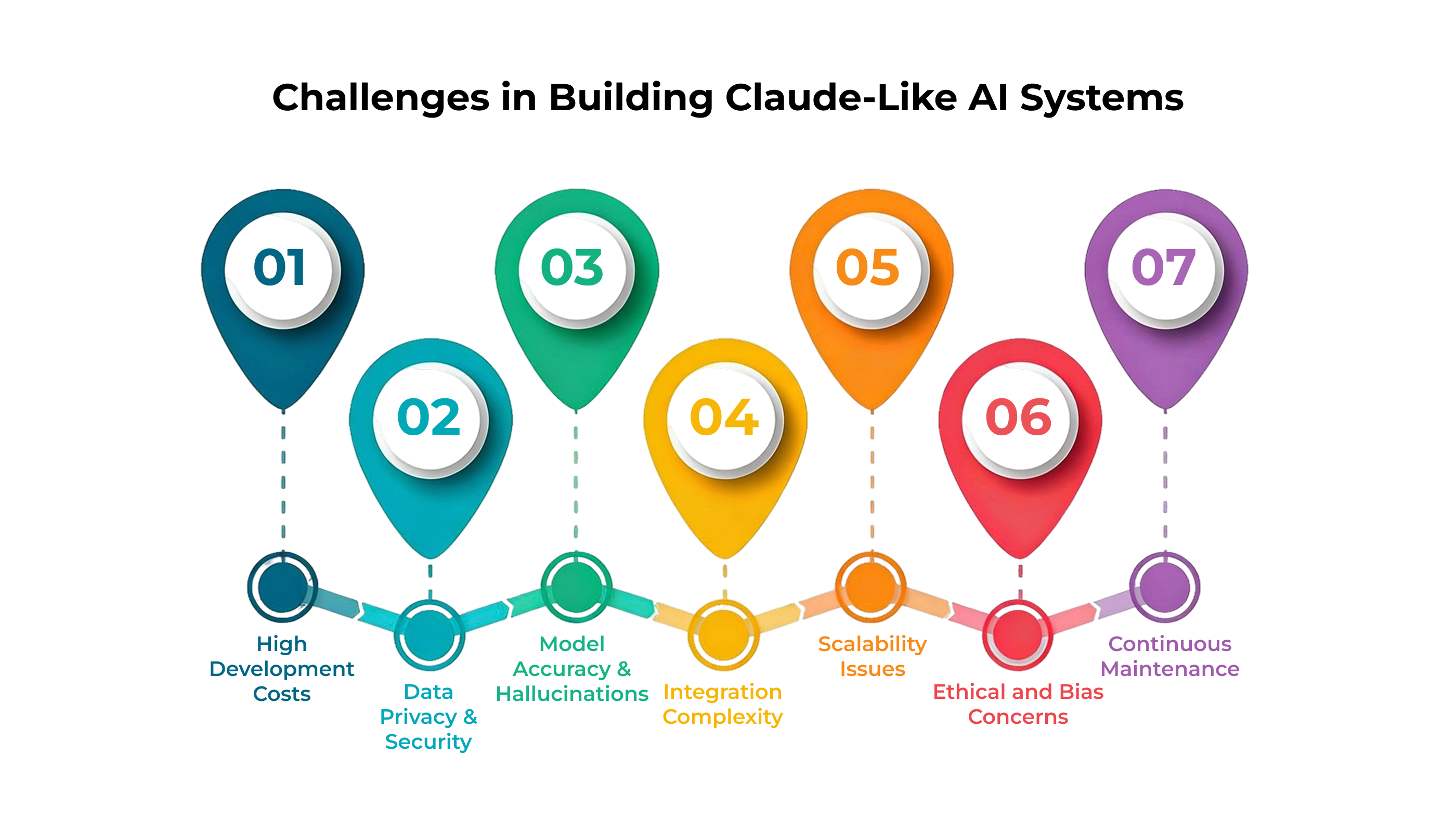
Challenges in Building Claude-Like AI Systems
1. High Development Costs
Building a Claude-like AI coworker involves significant financial investment in advanced technologies such as large language models (LLMs), cloud infrastructure, and skilled AI engineers. Expenses also include data acquisition, model training, and ongoing maintenance. These costs can increase further when developing enterprise AI coworker solutions with high scalability and security requirements.
2. Data Privacy & Security
AI coworkers often handle sensitive business and customer information, making data protection a top priority. Ensuring compliance with regulations like GDPR, HIPAA, or regional data laws requires robust encryption, access controls, and secure data storage. Any security breach can lead to legal penalties and damage to brand reputation, making privacy a critical challenge.
3. Model Accuracy & Hallucinations
Large language models sometimes generate incorrect or misleading information, commonly known as “hallucinations.” Ensuring factual accuracy requires techniques such as fine-tuning, retrieval-augmented generation (RAG), and continuous evaluation. Maintaining reliability is essential for building trust, especially in industries like healthcare, finance, and legal services.
4. Integration Complexity
Integrating a Claude-like coworker AI with existing enterprise systems—such as CRM, ERP, HRM, and communication platforms—can be technically challenging. Legacy systems may lack modern APIs, requiring custom connectors and middleware. Ensuring seamless data flow and interoperability often increases both development time and the custom AI chatbot development cost.
5. Scalability Issues
As user demand grows, the AI system must handle increased workloads without compromising performance. Achieving scalability requires robust cloud architecture, load balancing, and efficient resource management. Poor scalability can lead to latency issues and higher operational costs, impacting the overall effectiveness of the ai chatbot development cost 2026 strategy.
6. Ethical and Bias Concerns
AI models are trained on large datasets that may contain inherent biases, which can lead to unfair or discriminatory outputs. Addressing these concerns requires careful dataset curation, bias detection mechanisms, and ethical AI governance. Ensuring transparency and responsible AI practices is essential for maintaining user trust and regulatory compliance.
7. Continuous Maintenance
AI coworkers are not “set-and-forget” solutions; they require ongoing updates to remain effective. Regular monitoring, model retraining, performance optimization, and security patches are necessary to adapt to evolving business needs. Continuous maintenance ensures that the system stays accurate, secure, and aligned with organizational goals.
ROI & Business Benefits of AI Coworkers for Enterprises
Investing in enterprise AI coworker solutions offers substantial returns:
1. Increased Productivity
AI coworkers automate repetitive tasks such as scheduling, data entry, and report generation. This frees employees to focus on strategic initiatives that drive growth and innovation.
2. Cost Reduction
By reducing the need for manual labor and streamlining workflows, businesses save on staffing and operational costs. Over time, this leads to significant financial efficiency.
3. 24/7 Availability
Unlike human employees, AI coworkers are available round‑the‑clock. They provide continuous support to customers and internal teams, ensuring no downtime in service delivery.
4. Improved Decision-Making
AI coworkers analyze large volumes of data quickly and accurately. This enables leaders to make informed, data‑driven decisions that minimize risks and maximize opportunities.
5. Enhanced Customer Experience
AI coworkers deliver personalized, instant responses to customer queries. This improves satisfaction, builds trust, and strengthens long‑term customer relationships.
6. Scalability
AI solutions can easily scale as the business grows. Whether handling more customers or expanding into new markets, AI coworkers adapt without major infrastructure changes.
7. Competitive Advantage
Early adoption of AI coworker technology positions businesses ahead of competitors. It demonstrates innovation, efficiency, and readiness for the future of work.
Real-World Examples of AI Coworker Use Cases
1. Customer Support
AI chatbots handle FAQs, resolve issues, and escalate complex queries.
2. HR Assistance
Automates recruitment, onboarding, and employee support.
3. Sales Enablement
Provides product recommendations and lead qualification.
4. Software Development
Assists developers with code generation and debugging.
5. Healthcare Support
Helps manage patient inquiries and appointment scheduling.
6. Financial Services
Supports fraud detection and financial analysis.
These examples highlight the versatility of generative ai app development services across industries.
How PerfectionGeeks Can Help in AI Coworker Development
PerfectionGeeks is a trusted generative AI app development company that specializes in building secure, scalable, and cost‑effective enterprise AI coworker solutions. With expertise in custom AI chatbot development cost optimization, our team designs Claude‑like systems tailored to your business needs. From end‑to‑end generative AI app development services to seamless integration with enterprise tools, we deliver solutions that enhance productivity, reduce operational costs, and unlock new opportunities. Whether you’re exploring the Claude AI clone cost or planning to leverage generative AI in mobile app development, PerfectionGeeks provides the right mix of innovation and reliability to help you succeed.
Frequently Asked Questions
Quick answers related to this article from PerfectionGeeks.
1. What is Claude AI?
2. How much does it cost to build an AI coworker like Claude?
3. How long does it take to develop an AI coworker?
4. How can PerfectionGeeks help with AI development?
Conclusion
AI coworkers are reshaping the future of work by enhancing productivity, automating repetitive tasks, and enabling smarter decision-making. Understanding the ai chatbot development cost 2026 is essential for businesses planning to invest in this transformative technology. The Claude AI clone cost varies widely based on the chosen development approach, features, and scalability requirements. Whether you opt for API integration, model customization, or a fully proprietary solution, partnering with an experienced generative ai app development company ensures successful implementation.
PerfectionGeeks stands out as a trusted provider of generative ai app development solutions, helping organizations build intelligent and scalable coworker AI systems tailored to their needs. By leveraging expert knowledge and cutting-edge technologies, businesses can unlock the full potential of AI and gain a significant competitive advantage.

Written By Shrey Bhardwaj
Director & Founder
Shrey Bhardwaj is the Director & Founder of PerfectionGeeks Technologies, bringing extensive experience in software development and digital innovation. His expertise spans mobile app development, custom software solutions, UI/UX design, and emerging technologies such as Artificial Intelligence and Blockchain. Known for delivering scalable, secure, and high-performance digital products, Shrey helps startups and enterprises achieve sustainable growth. His strategic leadership and client-centric approach empower businesses to streamline operations, enhance user experience, and maximize long-term ROI through technology-driven solutions.