Published 20 March 2026 | Updated 20 March 2026
App
Why API Economy 2.0 is Transforming Digital Businesses
In today’s hyper-connected digital landscape, businesses are no longer operating in isolation. Instead, they are part of dynamic ecosystems where seamless integration, real-time data exchange, and automation define success. This transformation is largely driven by API Economy 2.0, a new era of digital innovation that goes beyond simple connectivity to enable composability, monetization, and intelligent automation.
At PerfectionGeeks, we help organizations leverage API Economy 2.0 to accelerate Digital Transformation, build scalable platforms, and unlock new revenue streams.
What is API Economy 2.0?
The API economy has evolved significantly over the past two decades. Initially, APIs were used to connect systems and improve operational efficiency. However, API Economy 2.0 represents a shift from simple integration to creating entire digital ecosystems.
According to industry insights, early API adoption focused on connectivity—helping systems communicate. Today, APIs act as strategic assets, enabling businesses to build products, partnerships, and platforms.
In simple terms:
API Economy 1.0 = Connectivity
API Economy 2.0 = Composability + Monetization + Ecosystems
Evolution from API Economy 1.0 to 2.0
API Economy 1.0 – The Connectivity Era
Between 2010 and 2020, businesses focused on:
- Integrating internal systems
- Connecting legacy software to cloud platforms
- Improving operational efficiency
APIs were considered backend tools managed by IT teams.
API Economy 2.0 – The Experience Economy
Today, APIs are:
- Products with revenue potential
- Building blocks for digital ecosystems
- Drivers of innovation and partnerships
Businesses now ask:
👉 “How can we create new services using APIs?”
This shift has made APIs central to Digital Transformation strategies.
Core Principles of API Economy 2.0
1. Composability
Businesses can create new applications by combining multiple APIs.
For example:
- Payment API + Delivery API + Analytics API = Complete eCommerce experience
- This modular approach enables faster innovation.
2. Open Integration
Organizations no longer operate in silos. APIs enable cross-industry collaboration such as:
- FinTech + E-commerce
- Healthcare + Insurance
- Logistics + AI
This openness fuels innovation and scalability.
3. API Monetization
APIs are now treated as products with:
- Subscription models
- Pay-per-use pricing
- Partner revenue sharing
This creates entirely new revenue streams for businesses.
4. Automation & Intelligence
Modern APIs integrate with AI and automation tools to:
- Trigger workflows automatically
- Enable predictive decision-making
- Improve operational efficiency
5. Governance & Security
With increased openness comes the need for:
- Strong API security
- Compliance with regulations
- Data privacy controls
- APIs must be secure, scalable, and trustworthy.
Key Drivers Behind API Economy 2.0
1. Cloud Computing
Cloud-native technologies allow APIs to scale globally with minimal infrastructure costs.
2. Standardization & Tools
Technologies like:
- OpenAPI
- GraphQL
- gRPC
have simplified API development and integration, making it accessible to developers worldwide.
3. AI & Machine Learning
AI systems rely heavily on APIs for:
- Data exchange
- Model integration
- Real-time processing
APIs are now the backbone of intelligent systems.
4. Regulatory Push
Open banking and data-sharing regulations have forced organizations to adopt APIs, accelerating digital transformation.
5. Customer Expectations
Modern users expect:
- Seamless digital experiences
- Real-time services
- Omnichannel access
APIs enable businesses to meet these expectations efficiently.
APIs as Strategic Business Assets
Today, APIs are no longer just technical tools—they are business enablers.
Key Benefits:
- Faster innovation cycles
- Improved scalability
- Enhanced customer experiences
- New revenue streams
- Stronger partnerships
Organizations with mature API strategies achieve significantly higher growth rates compared to competitors.
Industry Use Cases of API Economy 2.0
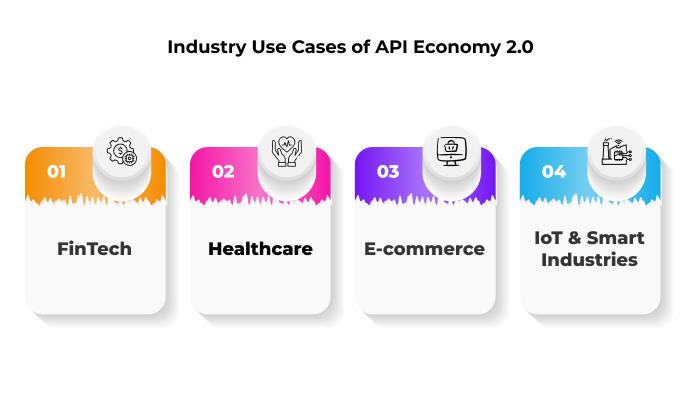
1. FinTech
- Open banking APIs enable secure financial data sharing
- Digital wallets and payment gateways rely on APIs
2. Healthcare
- APIs connect hospitals, labs, and insurance providers
- Enable real-time patient data access
3. E-commerce
- APIs integrate payment, logistics, and inventory systems
- Enable personalized shopping experiences
4. IoT & Smart Industries
- APIs connect devices, sensors, and analytics platforms
- Enable automation and predictive maintenance
Architecture of API Economy 2.0
1. API Gateway
Acts as the entry point for all API requests, handling:
- Security
- Traffic management
- Monitoring
2. Microservices Architecture
Breaks applications into smaller, independent services:
- Faster development
- Better scalability
- Improved fault isolation
3. Integration Middleware
Connects legacy systems with modern applications:
- Ensures smooth data flow
- Supports hybrid environments
4. Security Layer
Includes:
- OAuth authentication
- Data encryption
- Zero-trust architecture
5. Observability & Analytics
Tracks:
- API performance
- Usage metrics
- Business outcomes
Monetizing APIs in API Economy 2.0
APIs are now revenue-generating products.
Common Monetization Models:
| Model | Description |
|---|---|
| Pay-per-use | Charge per API call |
| Subscription | Monthly/annual plans |
| Freemium | Free basic access, paid premium |
| Revenue sharing | Partner-based earnings |
This approach turns APIs into scalable business assets.
Role of APIs in Digital Transformation
Digital Transformation is about using technology to improve business processes, customer experiences, and innovation.
APIs enable this transformation by:
- Connecting systems
- Enabling automation
- Supporting real-time data exchange
- Facilitating innovation
Without APIs, digital transformation would be slow and inefficient.
API Economy 2.0 and Ecosystem Growth
Modern businesses are building ecosystems rather than standalone products.
Key Ecosystem Benefits:
- Faster market expansion
- Increased customer reach
- Collaborative innovation
- Shared revenue opportunities
APIs act as the foundation of these ecosystems.
Future of API Economy
The next phase is already emerging:
API Economy 3.0
- AI-driven APIs
- Autonomous integrations
- Machine-to-machine communication
Businesses that adopt API Economy 2.0 today will lead tomorrow’s digital ecosystem.
How PerfectionGeeks Helps Businesses Leverage API Economy 2.0
At PerfectionGeeks, we specialize in helping businesses embrace API Economy 2.0 and accelerate their Digital Transformation journey.
Our Services Include:
1. Custom API Development
We design scalable and secure APIs tailored to your business needs.
2. API Integration
We connect your systems, applications, and platforms seamlessly.
3. API Monetization Strategy
We help you turn APIs into revenue-generating assets.
4. Cloud & Microservices Architecture
We build modern, scalable systems using cloud-native technologies.
5. Security & Compliance
We ensure your APIs are secure, compliant, and reliable.
6. End-to-End Digital Transformation
From strategy to execution, we guide your entire transformation journey.
Why Choose PerfectionGeeks?
- Expert development team
- Industry-specific solutions
- Scalable and secure architecture
- Cost-effective services
- Proven experience in API development
We empower businesses to become platform-driven enterprises.
Challenges in API Economy 2.0
Despite its benefits, there are challenges:
- Security risks
- Data privacy concerns
- Integration complexity
- Governance issues
However, with the right strategy and partner like PerfectionGeeks, these challenges can be effectively managed.
Best Practices for Adopting API Economy 2.0
- Adopt an API-first approach
- Focus on developer experience
- Ensure strong security measures
- Monitor API performance
- Build scalable architecture
Frequently Asked Questions
Quick answers related to this article from PerfectionGeeks.
1. What is API Economy 2.0?
2. How does API Economy 2.0 support Digital Transformation?
3. Can APIs generate revenue?
4. Why is API security important?
5. How can PerfectionGeeks help?
Conclusion
API Economy 2.0 is not just a technological trend—it is a fundamental shift in how businesses operate and grow. By enabling composability, monetization, and ecosystem-driven innovation, APIs are transforming industries worldwide.
For businesses aiming to stay competitive, adopting API-driven strategies is no longer optional—it’s essential.
With the expertise of PerfectionGeeks, you can successfully navigate this transformation, unlock new opportunities, and build a future-ready digital business.

Written By Shrey Bhardwaj
Director & Founder
Shrey Bhardwaj is the Director & Founder of PerfectionGeeks Technologies, bringing extensive experience in software development and digital innovation. His expertise spans mobile app development, custom software solutions, UI/UX design, and emerging technologies such as Artificial Intelligence and Blockchain. Known for delivering scalable, secure, and high-performance digital products, Shrey helps startups and enterprises achieve sustainable growth. His strategic leadership and client-centric approach empower businesses to streamline operations, enhance user experience, and maximize long-term ROI through technology-driven solutions.
.webp)