
Published 20 March 2026 | Updated 6 July 2026
Technology
How AI Makes Voice Assistants Smarter, Faster, and More Human-Like
Voice assistants have become one of the most widely used AI applications in the modern digital world. From Siri and Alexa to Google Assistant and Cortana, these AI voice assistants are transforming how people interact with technology. What started as simple command-based tools has now evolved into intelligent voice assistants capable of understanding context, emotions, and complex queries. The driving force behind this evolution is voice assistant AI technology, powered by artificial intelligence voice assistant systems
- AI voice assistants have become significantly smarter, faster, and more human-like due to advancements in NLP and machine learning.
- Natural Language Processing (NLP) enables better understanding of user intent and conversational context.
- Speech recognition technology has improved accuracy, reducing errors in voice commands and responses.
- Generative AI is helping voice assistants deliver more natural, personalized, and contextual conversations.
- Businesses are integrating voice assistants into apps, websites, and smart devices to improve user experience.
- Voice AI is widely used in customer support, healthcare, smart homes, and e-commerce platforms.
- Faster processing speeds allow real-time responses, making interactions smoother and more efficient.
- Personalization features enable assistants to learn user behavior and provide tailored recommendations.
- Despite progress, challenges like privacy concerns and data security still need careful attention.
- AI voice assistants are becoming a key part of digital transformation across industries.
What is AI-Powered Voice Assistants ?
An AI-powered voice assistant is a digital tool that uses speech recognition technology, voice recognition AI, and conversational AI to interact with users. These assistants can perform tasks such as setting reminders, controlling smart devices, answering questions, and even making purchases. The rise of virtual assistant AI has been fueled by advancements in AI software development companies and conversational AI development companies, which are constantly innovating to make assistants more natural and efficient.
How Voice Assistants Work: A Step-by-Step Process
Voice assistants rely on a combination of voice recognition AI and speech recognition technology to function. Here’s a simplified process:
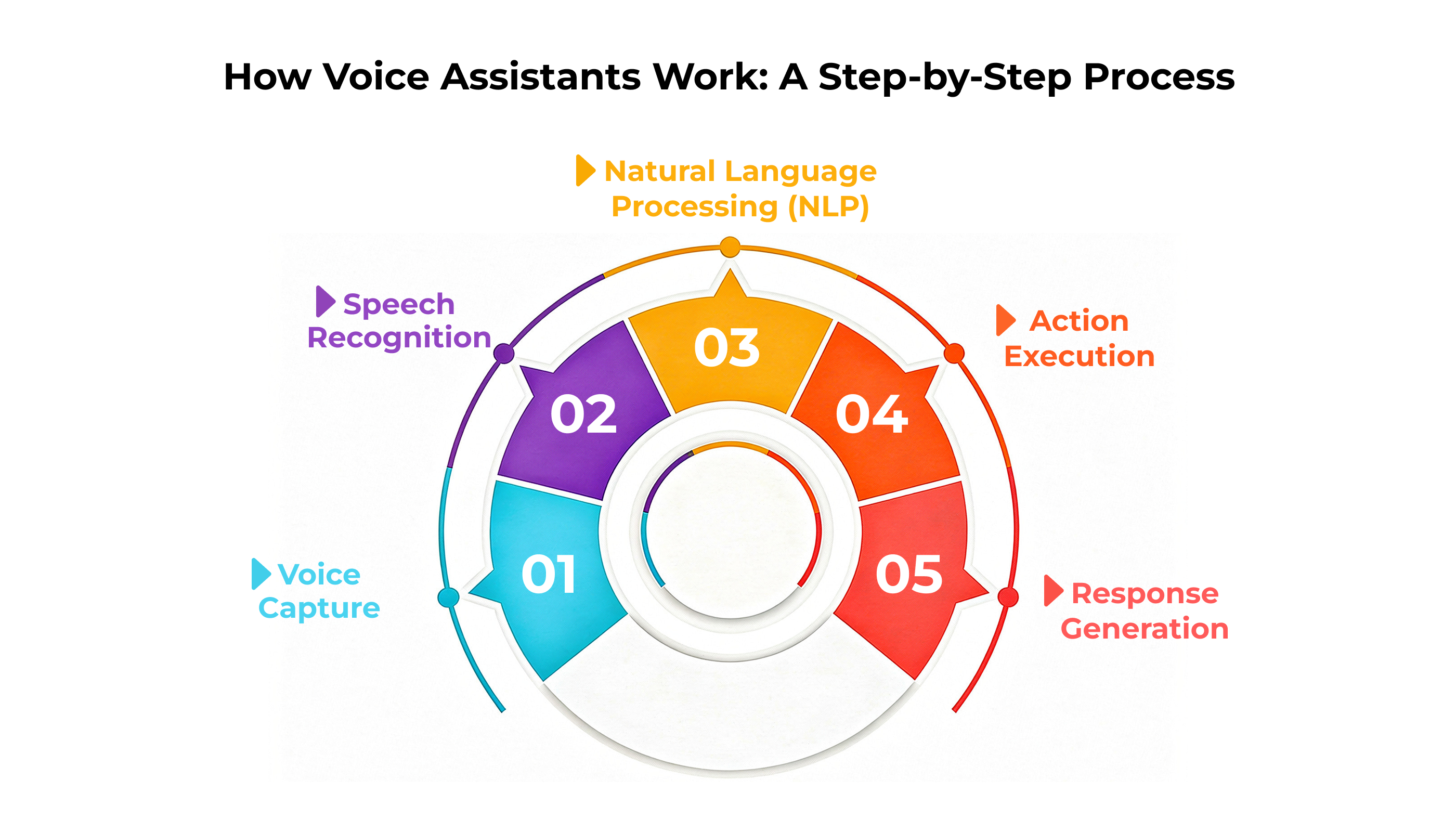
Voice Capture: The process begins when a user speaks to the device. The microphone captures the audio input clearly, even in noisy environments. Advanced filtering techniques help isolate the user’s voice for better accuracy. This step ensures the system receives a clean voice signal to process.
Speech Recognition: Once the voice is captured, speech recognition technology converts the spoken words into text. This is powered by voice recognition AI, which analyzes sound patterns and matches them with known words. It continuously improves accuracy by learning from different accents and speech styles. This step turns human speech into machine-readable data.
Natural Language Processing (NLP): After converting speech to text, the system uses NLP to understand the meaning behind the words. It identifies user intent, context, and even tone to interpret what the user really wants. NLP allows the assistant to go beyond simple commands and understand complex sentences. This makes interactions more natural and human-like.
Action Execution: Based on the interpreted request, the assistant decides what action to take. It may search the internet, control a smart device, or fetch information from a database. AI algorithms ensure the correct response is selected quickly and efficiently. This step connects user intent with real-world actions.
Response Generation: Finally, the assistant generates a response using conversational AI. It converts the output into natural-sounding speech or text, making the interaction feel human-like. The response is designed to be clear, relevant, and helpful. This completes the communication loop between the user and the assistant.
This process makes smart voice assistants capable of handling complex queries and delivering accurate results.
Role of Natural Language Processing (NLP) in Voice Assistants
NLP is the backbone of voice assistant AI technology. It allows assistants to understand human language, including slang, accents, and contextual meaning. For example, if you say, “Book me a flight to London next Friday,” NLP identifies the action (book), destination (London), and time (next Friday).
Without NLP, assistants would only recognize words but fail to understand intent. With NLP, they become intelligent voice assistants capable of engaging in meaningful conversations.
How Machine Learning Improves Voice Recognition Accuracy
Machine learning (ML) plays a critical role in improving voice recognition AI. By learning from user interactions, ML models adapt to accents, speech patterns, and preferences. Over time, this makes assistants more accurate and personalized.For instance, if a user frequently asks for sports updates, the assistant learns this preference and proactively provides relevant information. This continuous improvement is what makes AI voice assistants smarter and more reliable.
Learning from Large Data Sets: Machine learning models are trained on massive amounts of voice data from different users. This helps systems understand various accents, tones, and speaking styles, improving overall accuracy.
Continuous Improvement Over Time: Voice assistants keep learning from user interactions. The more they are used, the better they become at recognizing speech patterns and correcting past mistakes.
Accent and Language Adaptation: Machine learning allows systems to adapt to regional accents and multiple languages. This ensures better understanding even when pronunciation varies.
Noise Reduction and Sound Filtering: Advanced algorithms can separate background noise from the user’s voice. This helps improve recognition accuracy even in noisy environments.
Contextual Understanding: Machine learning helps voice assistants understand the context of a conversation. This allows them to interpret words correctly based on meaning rather than just sound.
Error Detection and Correction: AI models can identify incorrect interpretations and adjust responses. Over time, this reduces errors and enhances user experience.
Personalized Voice Recognition: Systems can learn individual user voices and preferences. This leads to more accurate and tailored responses for each user.
Real-Time Processing Enhancements: Machine learning improves the speed of processing voice inputs. Faster analysis leads to quicker and more accurate responses.
Integration with Natural Language Processing (NLP): Machine learning works with NLP to better understand human language. This combination ensures that voice assistants not only hear correctly but also understand intent.
Speech Recognition and Voice Understanding Technologies
Speech recognition technology enables assistants to convert spoken language into text. Combined with voice recognition AI, it allows assistants to identify not just words but also the speaker’s identity, tone, and emotion. Modern assistants use deep learning models to handle multiple languages and dialects, making them accessible worldwide. This technology is the foundation of enterprise AI voice solutions, helping businesses deploy assistants that can serve diverse customers.
Personalization: How AI Makes Assistants More Human-Like
One of the biggest advantages of AI-powered voice assistants is personalization. With the help of advanced algorithms and custom voice assistant development, these systems learn from user behavior, preferences, and past interactions to deliver a more natural and human-like experience.
Music Recommendations
AI analyzes listening habits, favorite genres, and skipped tracks to suggest personalized playlists. Over time, it understands mood and preferences, making recommendations feel more intuitive and relevant.
Shopping Assistance
Voice assistants track past purchases, browsing behavior, and preferences to recommend products. This makes shopping faster and more convenient, as users receive suggestions tailored to their needs.
Smart Home Control
AI learns daily routines and adjusts smart devices accordingly. For example, it can dim lights at night or set the temperature based on user comfort, creating a seamless living experience.
Personalized Responses and Conversations
Assistants remember user preferences like language, tone, and frequently asked queries. This helps them respond in a more natural and conversational way, making interactions feel less robotic.
Routine-Based Automation
AI can create daily routines such as morning alarms, news updates, or reminders. These automated actions save time and make the assistant feel like a helpful companion.
This level of personalization transforms voice assistants from simple tools into intelligent companions. By adapting to individual users, AI makes interactions more engaging, efficient, and human-like.
Speed and Efficiency: Real-Time Processing with AI
AI ensures that virtual assistant AI systems deliver responses in real-time. With cloud computing and optimized algorithms, assistants can process queries instantly.
This speed is crucial for tasks like navigation, emergency alerts, or financial transactions. By reducing latency, AI app development services make assistants faster and more efficient than traditional search methods.
Key AI Technologies in Voice Assistants
| Technology | Role in Voice Assistants |
| Natural Language Processing | Helps understand context, meaning, and intent behind spoken words. |
| Machine Learning | Improves accuracy by learning from user interactions and adapting to preferences. |
| Speech Recognition | Converts spoken language into text for processing. |
| Voice Recognition AI | Identifies speaker identity, tone, and emotion for personalized responses. |
| Conversational AI | Enables assistants to engage in natural, human-like conversations. |
| Real-Time Processing | Ensures fast responses by leveraging cloud computing and optimized algorithms. |
Challenges in Making Voice Assistants Truly Human-Like
Privacy Concerns
Voice assistants collect and process large amounts of personal data, including voice recordings and user behavior. This raises concerns about data security, storage, and potential misuse. To build trust, companies must implement strong encryption, transparent policies, and strict privacy controls.
Bias in AI Models
AI systems are trained on existing datasets, which may not represent all accents, languages, or cultures equally. This can lead to inaccurate responses or poor recognition for certain users. Continuous training and diverse datasets are essential to reduce bias and ensure fair user experiences.
Dependence on Connectivity
Most voice assistants rely on cloud-based processing to function effectively. Without a stable internet connection, their performance can drop significantly or stop altogether. Developing offline capabilities and edge AI solutions is important to improve reliability.
Complex Queries
While voice assistants can handle simple commands easily, they often struggle with complex, multi-step, or ambiguous questions. Understanding context, tone, and intent remains a challenge. Advancements in conversational AI and natural language understanding are needed to make interactions more human-like.
Future of AI-Powered Voice Assistants
The future of AI voice assistants looks promising, with several trends shaping their evolution:
Emotion Recognition: Assistants will detect emotions more accurately, offering empathetic responses.
Hyper-Personalization: Through custom voice assistant development, assistants will anticipate needs before users ask.
Offline Capabilities: Improved AI models will allow assistants to function without constant internet access.
Integration with AR/VR: Voice assistants will become central to immersive digital environments.
Enterprise AI Voice Solutions: Businesses will deploy assistants for customer service, productivity, and automation, making them essential in corporate ecosystems.
Frequently Asked Questions
Quick answers related to this article from PerfectionGeeks.
1. What is an AI voice assistant?
2. How does artificial intelligence make voice assistants smarter?
3. What are the main challenges in developing intelligent voice assistants?
4. How does Perfectiongeeks contribute to AI voice assistant development?
Conclusion
AI has revolutionized voice assistants, making them smarter, faster, and more human-like. With speech recognition technology, voice recognition AI, and conversational AI, these assistants are becoming indispensable in everyday life and across industries. While challenges such as privacy and bias remain, the opportunities are immense. As voice assistant development companies and AI software development companies continue to innovate, assistants will evolve into true digital companions.
In the end, AI is not just making assistants better it is redefining how humans interact with machines. And as organizations like Perfectiongeeks highlight and support these innovations, the future of AI-powered voice assistants looks brighter than ever.

Avantika creates SEO-driven technology content focused on AI, app development, and digital innovation. She combines strategic storytelling with search optimization to produce engaging, research-backed content that improves brand visibility, audience engagement, and organic growth across competitive digital markets.

 Is Driving Economic Transformation in Saudi Arabia.jpg)