Published 14 January 2026 | Updated 14 January 2026
Technology
Why Startups Should Choose MVP Over Full App Development?
Starting a startup is exciting but can be tough. Many founders want to build a perfect app with all features, but this often leads to wasting time, money, and creating something users don’t need. If you are not sure about starting without any risk, an MVP (Minimum Viable Product) is a smart option to go for. An MVP concentrates on the main features first, thus allowing you to test your idea quickly and with less resource wastage. In this blog, you will see the reasons for the startup choice of an MVP and how PerfectionGeeks can assist you in creating it correctly.
What is an MVP?
An MVP is a business strategy that limits the features of your app and presents a clear view of your marketability idea at the same time. It contains the very few features that are needed to resolve your users’ main problem, no extra, no distractions. The primary goal of an MVP is to validate your product idea quickly by obtaining feedback from actual users and data from the market before investing in a complete product.
Why Should Startups Choose MVP Over Full App Development?
1. Save Time and Money — The Most Precious Startup Resources
Startups usually have limited budgets and need to meet their deadlines quickly. A complete app development, with all of its functionalities, can take several months or even more than one year to be finished and will cost you a lot of money. The MVP method allows you to release the product in an accelerated manner, usually in 1 to 3 months, and at a cost that is only a small fraction of that of the finished product. This does not simply mean that you can start working with real users and attract early revenue or interest without depleting your funds.
By focusing on the essentials only, you will not be wasting any time and money on features that might never be used, thus you will keep your startup lean and focused.
2. Validate Your Idea Early – Avoid the Risk of Building the Wrong Product
It is a common scenario among startups that they design the product according to their perception of the users’ needs instead of the actual needs of the users. Validation is a risk. With an MVP, the testing of the assumptions done by the developer is based on releasing a working product to the real users. Their reaction and also the feedback give a very meaningful insight into whether the product is a good fit for the market.
This early validation is a lifesaver in terms of money spent on an idea that does not address a real problem or has very little demand. In case the market is not responsive, then also you gain the benefit of being able to pivot or improve your product early, thereby saving yourself from bigger failures later.
3. Focus on Core Features – Less is More
A frequent error made is attempting to jam-pack your app with every conceivable feature, all in the hope that it will cater to all the users. Generally, this would lead to the opposite of what was intended, by creating a situation where the users are overwhelmed and the development process is complicated. The creation of an MVP makes it compulsory to strip the app down to its core features—the “must-haves” that cater to the primary user problem. Your product will then be simple, user-friendly, and easy to enhance.
With that defined focus, the users will soon realize the benefit of your product and you can later confidently add features based on authentic user interest instead of mere speculation.
4. Get Real User Feedback and Continuously Improve
The MVP launch entails an early product placement for the users. It is your chance to get the honest and unbiased opinions about what works and what doesn’t. Rather than sitting on it for a couple of months or a year and then discovering the issues, you will be learning continuously and thus to improve your product through iterations. This feedback loop will create a product that transforms according to the real user needs thus, the chances of long-term success are increased.
5. Attract Investors with Proof of Concept and Traction
Investors are looking to cut down their risks. A Complete application with zero users would likely be a not very convincing case. But an MVP signifies that the concept has already become quite popular the users are being involved, and the revenue model is promising.
Displaying an MVP with active users measurable and with demand verifiable, you establish trust of investors and it becomes easier to get funding to up your app’s scale.
Challenges Startups Face When Choosing MVP Over Full App Development
Ultimately, the decision to develop an MVP can be a challenging one. Knowing about the challenges will surely assist startups in their initial preparations.
Defining What “Minimum” Means
The process of feature prioritization will lead to tough decision making and eventually disappointment. Not just the less important features, also the very important ones will be dropped and the final product may not even be recognized as the original idea. A solid product vision and a strict focus on the users’ problems will be required for proper scoping.
Managing Expectations of Early Users
MVPs being very rudimentary, the early users might consider the app as not good enough or not user-friendly. The app may be difficult to use and even discourage users if there is no proper communication about the use of the app. The primary goal of the MVP should be very specifically and realistically communicated up to a point where it is clear that it is not the final product.
Balancing Speed with Quality
Speed is associated with MVP, however, hasty development could result in bugs, crashes, or a bad user experience. This loss of quality reflects directly on the brand and leads to lower retention rates. It is required that the young companies engage into the quality assurance and usability process, but without exhausting the development resources.
Interpreting Feedback and Prioritizing Improvements
It may happen that user feedback is inconsistent and too much at the same time. The startups should create a data analysis and feature prioritization process along with “feature creep” management during iterations.
Common Mistakes Startups Make When Building an MVP
Avoid these to save time and money:
A Lot of Features: The addition of features that are not needed spoils the MVP's aim. Simplicity should be the aim and core value the focus.
No Market Research: You can be misled by your assumptions. Always conduct a research on your target users and competitors first.
Not Testing Properly Before Launch: The release of a faulty MVP can backfire. Make sure the testing is done extensively to provide a seamless experience.
Not Paying Attention to User Feedback: User feedback is like your roadmap. Be attentive to it and take action on it fast.
MVP and Prototype Mistaken for One Another: A prototype is usually either a non-working model or just a design. On the other hand, an MVP should be a fully functioning product that users can interact with.
Build Your MVP in 5 Straightforward Steps
Here’s a clear roadmap to build your MVP effectively:
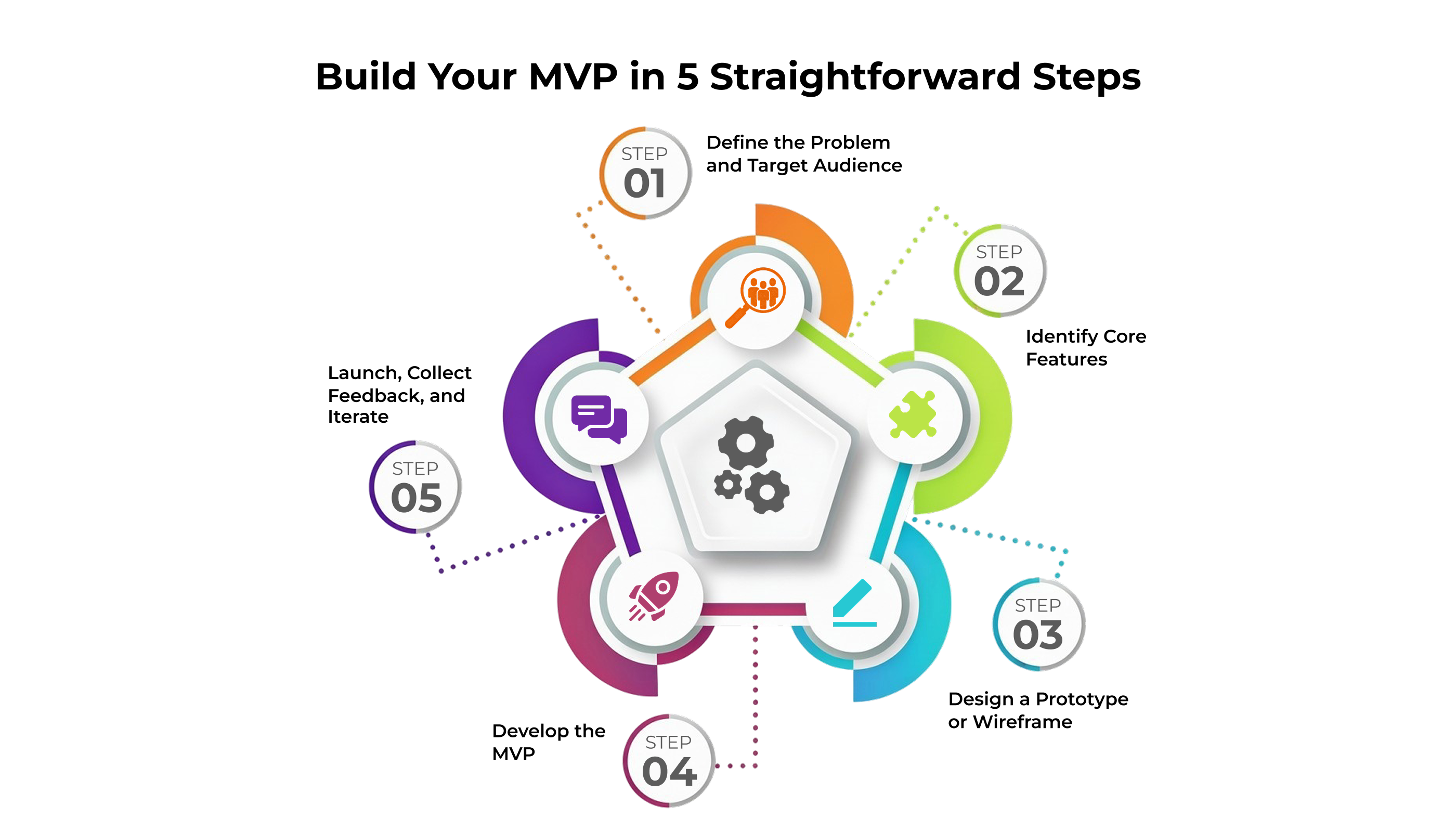
Step 1: Define the Problem and Target Audience
Knowing exactly what the problem is that your product intends to tackle is a prerequisite for creating a real gem. Identifying your target audience not only helps to specify the features and the corresponding messages but also gives you the insight on how to speak to them.
Step 2: Identify Core Features
Make a point of the features that solve the problem directly and do not complicate the product excessively. This also results in keeping development simple and thus preventing the draining of resources on the features that are not needed.
Step 3: Design a Prototype or Wireframe
Drawing or wire-framing gives the initial view of what the users will go through while using the product. It also means getting feedback from the concerned parties and the users upfront to fine-tune the flow before any coding happens.
Step 4: Develop the MVP
Create only those basic features which are necessary to prove your concept in the market. It is important for the MVP to be operational and pleasant to the user but it does not have to be completely neat or rich in features.
Step 5: Launch, Collect Feedback, and Iterate
The strategy of targeting a small group for the release of your MVP allows you to check the validity of your assumptions and to find out what needs to be improved. The feedback from users and the data through analytics will be used to determine the areas of the next product development phases and to bring about product enhancement.
Is MVP Development Risky for Early-Stage Startups?
Many startups hesitate to launch an MVP because they worry about presenting an incomplete product or fear failure. However, the real risk lies in not launching at all or investing heavily in a full app without understanding the market.
MVP development is actually a smart way to reduce risk. It allows you to test your business idea with minimal investment and gather real user feedback. This helps you make necessary adjustments or pivot your product based on market needs, greatly reducing the chance of complete failure.
When approached thoughtfully—with a focus on quality and thorough research—building an MVP is one of the safest strategies for new startups to enter the market confidently.
How PerfectionGeeks Supports Startups in Building Effective MVPs
PerfectionGeeks Technologies has already supported a number of startups in dealing with the difficult road of MVP development. Our team of professionals, which has considerable experience, combines technical know-how and business strategy to produce MVPs that lead startups to success.
What We Offer:
- Thorough consultation for setting clear MVP objectives and identifying user pains.
- Market research and competition analysis for the correct positioning of your product.
- User-centered design along with agile development to build an MVP that is clean and functional.
- User feedback collection post-launch and iterative improvements to ensure that your product keeps growing.
- Affordable, clear pricing to make MVP development within reach for all.
The partnership with PerfectionGeeks is like having a reliable counselor who knows the difficulties of startups and brings solutions that are customized to your dreams.
Case Study: How an MVP Helped a Startup Save Time and Money
One of our clients came with a great idea for a social fitness app but had limited funds. They initially planned to develop a full app with multiple features, which could take over six months and a large budget.
PerfectionGeeks suggested starting with an MVP focusing on workout tracking, goal setting, and basic social sharing — the three core features users really needed.
We developed and launched the MVP in just 8 weeks. Early users loved the simplicity and utility, and their feedback helped us fine-tune the product.
Thanks to the MVP, the client:
- Saved over 50% of their initial budget.
- Secured seed funding by showing strong user engagement.
- Scaled their app gradually based on real market needs.
This case proves MVP is not just theory — it’s a proven path to success.
MVP vs Full App Development
| Aspect | MVP | Full App Development |
| Time to Market | 1-3 months | 6 months to 1+ year |
| Development Cost | Lower | Higher |
| Features Included | Core essentials only | Complete, polished feature set |
| User Feedback | Early and ongoing | Late, often after launch |
| Risk Level | Lower | Higher |
| Flexibility | High, easy to pivot | Low, costly to change |
| Investor Appeal | Shows real traction | Full product expected |
Frequently Asked Questions
Quick answers related to this article from PerfectionGeeks.
1. What exactly is an MVP and why is it important for startups?
2. How do I decide which features to include in my MVP?
3. Can I build an MVP without a big budget?
4. What happens after the MVP stage?
Conclusion
For startups, MVP development is not an option but a mandatory to minimize risk, conserve resources, and early validate ideas. Rather than wagering all on the complete app, MVP allows you to construct, discover, and expand progressively with assurance.If you consider it right to go for the intelligent way, PerfectionGeeks Technologies is ready to assist you. With our professional MVP development services, you will receive the ideal mix of strategic advice and technical skill to realize your startup dream.

Shrey Bhardwaj is the Director & Founder of PerfectionGeeks Technologies, bringing extensive experience in software development and digital innovation. His expertise spans mobile app development, custom software solutions, UI/UX design, and emerging technologies such as Artificial Intelligence and Blockchain. Known for delivering scalable, secure, and high-performance digital products, Shrey helps startups and enterprises achieve sustainable growth. His strategic leadership and client-centric approach empower businesses to streamline operations, enhance user experience, and maximize long-term ROI through technology-driven solutions.