
Published 17 March 2026 | Updated 17 March 2026
App
Building Smarter Applications: Integrating AI and ML into Modern Software Development
In today’s digital-first world, software is no longer just a tool—it’s an intelligent system that learns, adapts, and evolves. Businesses are rapidly shifting toward Smarter Applications: Integrating AI and ML to stay competitive, enhance user experiences, and drive innovation.
At PerfectionGeeks, recognized as a Best Software Development Company, we empower businesses to transform traditional applications into intelligent ecosystems using artificial intelligence (AI) and machine learning (ML).
What Does It Mean to Build Smarter Applications?
Building smarter applications involves embedding AI and ML capabilities directly into software systems. These technologies allow applications to:
- Learn from user behavior
- Predict outcomes
- Automate decisions
- Continuously improve over time
Unlike traditional applications that follow static rules, AI-powered systems become adaptive and predictive, enabling businesses to deliver more value to users.
Why AI and ML Are Essential in Modern Software Development
Modern users expect personalized, fast, and intuitive digital experiences. AI and ML help meet these expectations by transforming applications into intelligent systems.
Key Reasons to Integrate AI & ML
- Personalization: Tailor content and recommendations based on user behavior
- Predictive Intelligence: Anticipate user needs and future trends
- Automation: Reduce manual effort and increase efficiency
- Data Utilization: Turn large datasets into actionable insights
- Competitive Advantage: Deliver smarter and faster solutions
AI-driven systems enable businesses to move from reactive decision-making to proactive intelligence, which is essential in today’s competitive landscape.
Role of AI and ML in Software Development Lifecycle (SDLC)
AI and ML are transforming every stage of the software development lifecycle.
1. Intelligent Automation
AI-powered tools automate repetitive tasks such as coding, testing, and debugging. Developers can now use AI assistants to generate code snippets, detect bugs, and improve efficiency.
This reduces development time and allows teams to focus on innovation.
2. Smarter Decision-Making
AI analyzes large datasets in real time, helping teams make better decisions regarding:
- Feature prioritization
- Resource allocation
- Product strategy
This leads to more accurate planning and improved project outcomes.
3. Accelerated Development Lifecycle
With predictive analytics, teams can estimate timelines, identify bottlenecks, and optimize workflows.
AI-driven insights help organizations deliver products faster without compromising quality.
4. Quality Assurance and Testing
AI enhances testing by:
- Automatically generating test cases
- Detecting anomalies
- Improving regression testing
This results in more reliable software and faster time-to-market.
5. Continuous Learning and Improvement
Machine learning models continuously learn from new data, enabling applications to evolve and remain relevant over time.
Core Technologies Powering Smarter Applications
1. Machine Learning
Machine learning enables systems to learn from data and improve performance without explicit programming.
Applications include:
- Recommendation engines
- Fraud detection
- Predictive analytics
2. Natural Language Processing (NLP)
NLP allows applications to understand and process human language.
Use cases include:
- Chatbots
- Voice assistants
- Sentiment analysis
3. Computer Vision
Computer vision enables machines to interpret visual data.
Examples include:
- Facial recognition
- Image classification
- AR/VR applications
4. Predictive Analytics
Predictive analytics uses historical data to forecast future outcomes, helping businesses make proactive decisions.
Practical Applications of AI & ML in Software
AI and ML are transforming industries by enabling smarter applications across various domains:
Healthcare
- Predictive diagnosis
- AI-powered imaging
- Virtual health assistants
Fintech
- Fraud detection
- Risk assessment
- Automated customer support
Retail & eCommerce
- Personalized recommendations
- Dynamic pricing
- Visual search
Manufacturing & Logistics
- Predictive maintenance
- Supply chain optimization
- Automation
Education
- Adaptive learning platforms
- AI tutors
- Performance analytics
These applications demonstrate how AI transforms software into intelligent systems that adapt and evolve.
Step-by-Step Process to Integrate AI & ML into Applications
At PerfectionGeeks, we follow a structured approach to building intelligent software solutions.
Step 1: Define Business Objectives
Identify the problem AI will solve—such as personalization, automation, or prediction.
Step 2: Data Collection and Preparation
AI relies on high-quality data. Clean, structured, and unbiased data is essential for accurate results.
Step 3: Choose the Right Model
Select appropriate ML models:
- Supervised learning (prediction)
- Unsupervised learning (clustering)
- Reinforcement learning (adaptive systems)
Step 4: Model Training and Validation
Train models using frameworks like TensorFlow or PyTorch and validate performance.
Step 5: Integration with Application Architecture
Embed AI models into backend systems or use cloud APIs for scalability.
Step 6: Testing and Optimization
Continuously monitor accuracy and performance to improve results.
Step 7: Deployment and Continuous Learning
Deploy using MLOps practices and ensure continuous updates as data evolves.
Tools and Frameworks for AI Integration
Modern AI development is supported by powerful tools and platforms:
AI Frameworks
- TensorFlow
- PyTorch
- Scikit-learn
- Keras
Cloud Platforms
- Google Cloud AI
- AWS AI
- Microsoft Azure AI
These tools make AI integration faster, scalable, and more efficient.
Benefits of Integrating AI and ML
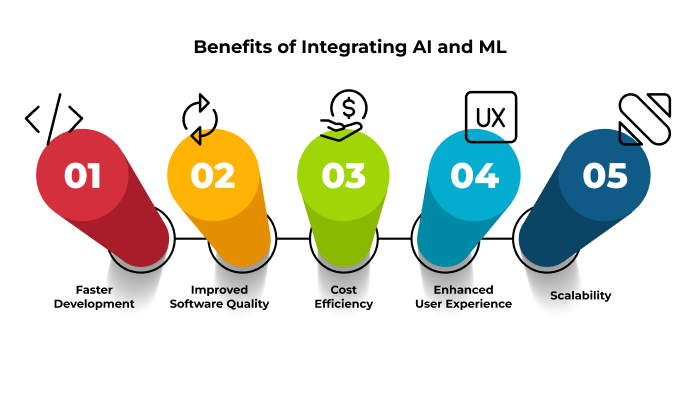
1. Faster Development
AI automates coding and testing, reducing development time significantly.
2. Improved Software Quality
AI detects bugs early, ensuring more reliable applications.
3. Cost Efficiency
Automation reduces development and maintenance costs.
4. Enhanced User Experience
AI enables real-time personalization and intuitive interfaces.
5. Scalability
AI systems can handle large volumes of data and users efficiently.
Challenges in Integrating AI and ML
While AI offers immense benefits, businesses must overcome certain challenges:
1. Data Quality and Bias
Poor data leads to inaccurate predictions and unreliable systems.
2. Integration Complexity
Combining AI models with existing systems requires advanced expertise.
3. High Initial Investment
AI implementation requires resources, infrastructure, and skilled professionals.
4. Ethical and Legal Concerns
Issues such as data privacy, transparency, and bias must be addressed carefully.
5. Model Maintenance
AI models require continuous monitoring and retraining to remain effective.
Future Trends in AI-Driven Software Development
The future of software development is AI-first. Key trends include:
1. Generative AI
AI tools that generate code, designs, and documentation automatically.
2. Edge AI
Processing data on devices instead of the cloud for faster performance and privacy.
3. AIOps
AI-driven DevOps for automated monitoring and issue resolution.
4. Human-AI Collaboration
Developers working alongside AI tools to enhance productivity and creativity.
5. Autonomous Systems
Applications that make decisions with minimal human intervention.
These trends highlight how AI will continue to reshape the software development landscape.
How PerfectionGeeks Delivers Smarter Applications
As a Best Software Development Company, PerfectionGeeks specializes in building intelligent, scalable, and future-ready applications.
Our Expertise Includes:
- AI and ML integration
- Custom software development
- Intelligent automation solutions
- Predictive analytics systems
- AI-powered mobile and web applications
Why Choose PerfectionGeeks?
Proven expertise in Smarter Applications: Integrating AI and ML
- End-to-end development and deployment
- Scalable and secure solutions
- Data-driven approach
- Focus on innovation and performance
We help businesses unlock the full potential of AI by transforming ideas into intelligent digital solutions.
Best Practices for AI Integration
To successfully implement AI and ML, businesses should follow these best practices:
- Start with clear objectives
- Use high-quality data
- Choose scalable architectures
- Combine AI with human insights
- Continuously monitor and improve models
Frequently Asked Questions
Quick answers related to this article from PerfectionGeeks.
1. What are smarter applications in modern software development?
2. How does AI and ML improve software development?
3. Why should businesses invest in AI-powered applications?
4. What industries benefit the most from AI and ML integration?
5. Why choose PerfectionGeeks as the Best Software Development Company?
Conclusion
The integration of AI and ML into modern software development is revolutionizing how applications are built, deployed, and experienced.
By embracing Smarter Applications: Integrating AI and ML, businesses can create intelligent systems that deliver personalized experiences, improve efficiency, and drive innovation.
At PerfectionGeeks, we combine cutting-edge technology with deep expertise to help businesses stay ahead in the digital era. As a Best Software Development Company, we are committed to building smarter, faster, and future-ready applications that deliver real business value.
The future belongs to intelligent software—and now is the time to embrace it.

Shrey Bhardwaj is the Director & Founder of PerfectionGeeks Technologies, bringing extensive experience in software development and digital innovation. His expertise spans mobile app development, custom software solutions, UI/UX design, and emerging technologies such as Artificial Intelligence and Blockchain. Known for delivering scalable, secure, and high-performance digital products, Shrey helps startups and enterprises achieve sustainable growth. His strategic leadership and client-centric approach empower businesses to streamline operations, enhance user experience, and maximize long-term ROI through technology-driven solutions.