Published 6 April 2026 | Updated 6 April 2026
Technology
Maritime Insurance Claim Software Development for UAE: A Complete Guide for Ports & Insurers
The UAE is one of the world’s leading maritime hubs, with busy ports, global shipping routes, and a strong logistics network. With this rapid growth comes a major challenge managing insurance claims efficiently. Traditional manual processes are slow, error-prone, and costly. This is where maritime insurance claim software plays a crucial role. In this detailed guide, we’ll explore everything about maritime insurance claim software development, its benefits, features, challenges, and why UAE ports, insurers, and logistics companies must adopt it in 2026.
What is Maritime Insurance Claim Software?
Maritime insurance claim software is a digital solution designed to automate and manage insurance claims related to shipping, cargo, vessels, and port operations. It helps insurers, port authorities, and logistics companies track, process, and settle claims quickly and accurately. This type of maritime insurance software replaces traditional paperwork with automated workflows, improving efficiency and reducing human errors. It also integrates with port systems, shipping databases, and financial tools for seamless operations.
Why UAE Needs Maritime Insurance Claim Software
The UAE handles millions of tons of cargo every year. With such high volume, insurance claims related to damage, delays, or losses are common. Managing these claims manually creates several problems:
- Delayed claim processing
- High operational costs
- Lack of transparency
- Increased risk of fraud
- Poor customer experience
By adopting insurance claim management software, businesses can overcome these challenges and improve overall efficiency.
With growing digital transformation, insurance software development UAE is becoming essential for maritime businesses to stay competitive.
Key Features of Maritime Insurance Claim Software
1. Automated Claim Processing
Automation reduces manual work by allowing claims to be filed, verified, and approved digitally. This speeds up settlements and minimizes human errors.
2. Real-Time Tracking
Users can track the progress of their claims from submission to settlement. This transparency builds trust and keeps all stakeholders informed.
3. Document Management
The system securely stores invoices, inspection reports, and certificates in one place. This makes it easy to access and share documents when needed.
4. AI-Based Risk Assessment
Artificial intelligence analyzes claim data to detect fraud and assess validity. This ensures fair settlements and reduces financial losses.
5. Integration with Port & Logistics Systems
The software connects with shipping and cargo platforms, enabling smooth data exchange. This helps insurers and ports work together more efficiently.
6. Multi-User Access
Different users—insurers, surveyors, and clients—can log in securely. Role-based access ensures that each user sees only the information relevant to them.
7. Reporting & Analytics
The system generates detailed reports and insights on claim trends. These analytics help insurers make better decisions and improve operations.
Benefits of Maritime Insurance Claim Software
Faster Claim Processing: Automation shortens settlement times, ensuring claims are resolved quickly.
Cost Reduction: By reducing manual work, insurers save on administrative expenses.
Improved Transparency: Real-time tracking ensures clarity and accountability for all parties involved.
Better Security: Advanced encryption protects sensitive shipping and financial data from cyber threats.
Enhanced Customer Experience: Quick and fair settlements lead to higher satisfaction among shipping companies and clients.
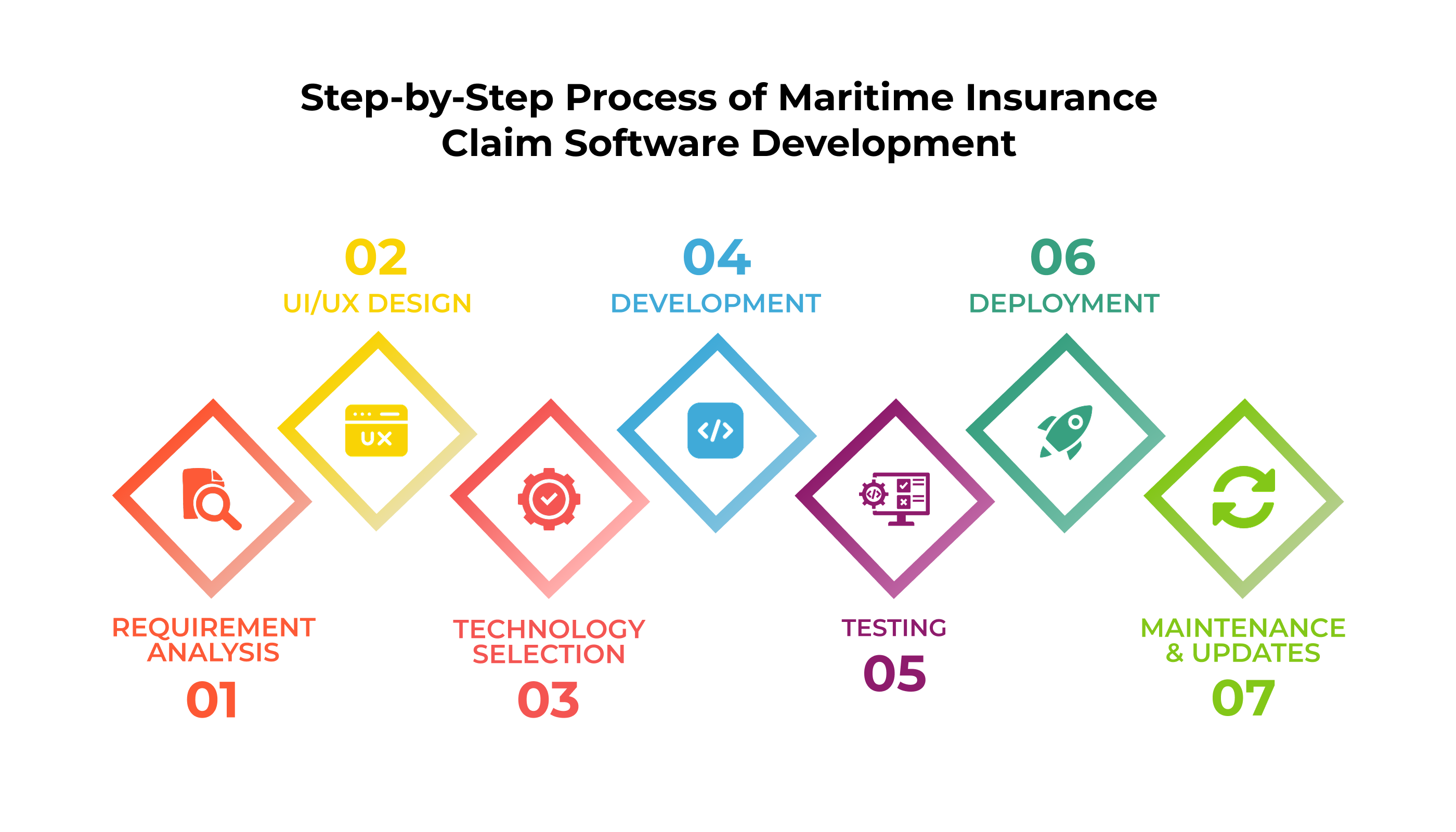
Step-by-Step Process of Maritime Insurance Claim Software Development
Building maritime insurance claim software development involves several steps:
1. Requirement Analysis
The first step is to understand the needs of ports, insurers, and logistics companies. This involves gathering information about claim volumes, workflows, compliance requirements, and integration needs. A clear requirement analysis ensures the software is tailored to real-world maritime challenges.
2. UI/UX Design
A user-friendly interface is critical for smooth navigation. Designers create layouts that simplify claim filing, document uploads, and tracking. Good UI/UX reduces training time and ensures that insurers, surveyors, and clients can use the system easily.
3. Technology Selection
Choosing the right technologies determines the software’s efficiency and scalability. Cloud computing ensures accessibility, AI powers fraud detection, and blockchain adds transparency to claim records. Selecting modern tools makes the system future-ready for UAE’s growing maritime industry.
4. Development
This is where the actual coding and system building happen. Developers create the core features such as automated claim processing, document management, and analytics dashboards. Integrations with port and logistics systems are added to ensure seamless operations.
5. Testing
Before deployment, the software undergoes rigorous testing. Security tests protect sensitive data, performance tests ensure speed, and usability tests confirm ease of use. Testing helps identify and fix errors, ensuring the system is reliable in real-world scenarios.
6. Deployment
Once tested, the software is launched for actual use by insurers and ports. Deployment may involve cloud hosting or on-premise installation, depending on client needs. Training sessions are often conducted to help users adapt quickly.
7. Maintenance & Updates
Software development doesn’t end at deployment. Regular updates are needed to improve performance, add new features, and strengthen security. Maintenance ensures the system evolves with industry changes and continues to meet user expectations.
Challenges in Maritime Insurance Claim Software Development
While the benefits are clear, there are some challenges in developing and implementing maritime insurance claim software:
Complex Regulations: UAE maritime and insurance laws require strict compliance, and ensuring the software meets both local and international standards can be difficult.
Integration Issues: Connecting new maritime insurance claim software with existing port, logistics, and insurer systems often involves complex technical adjustments.
Data Security Risks: Handling sensitive cargo and financial data demands strong encryption and cybersecurity measures to prevent breaches.
High Initial Investment: Developing custom marine insurance software solutions requires significant upfront costs, which may be challenging for smaller insurers.
User Adoption: Training staff to adapt to new insurance claim management software can take time, and resistance to change may slow implementation.
How Maritime Software is Transforming UAE Ports & Insurers
Digital transformation is reshaping the maritime industry in the UAE. With maritime insurance software, businesses can:
- Automate complex workflows
- Reduce fraud with AI and blockchain
- Improve collaboration between stakeholders
- Enhance operational efficiency
This transformation is making UAE ports smarter, faster, and more reliable.
Why Choose PerfectionGeeks for Maritime Insurance Software Development?
When it comes to building reliable maritime insurance claim software, choosing the right development partner is critical. PerfectionGeeks brings deep expertise in insurance software development UAE, with a proven track record of delivering secure, scalable, and user-friendly solutions for ports and insurers. We specialize in maritime software development that integrates advanced technologies like AI for fraud detection, blockchain for transparent records, and cloud computing for accessibility. Our team ensures compliance with UAE’s strict maritime and insurance regulations, while also focusing on ease of use for insurers, surveyors, and clients.
By partnering with PerfectionGeeks, you gain a trusted technology partner who understands the complexities of the maritime industry and delivers tailored marine insurance software solutions that improve efficiency, reduce risks, and enhance customer satisfaction.
Future Trends in Maritime Insurance Software
The future of maritime insurance claim software is driven by innovation:
- AI & Machine Learning: Smarter claim processing and fraud detection
- Blockchain: Secure and transparent transactions
- Cloud-Based Solutions: Scalable and cost-effective systems
- Automation: Reduced manual work and faster operations
These trends will further enhance the efficiency of maritime claim processing software in the coming years.
Frequently Asked Questions
Quick answers related to this article from PerfectionGeeks.
1. What is maritime insurance claim software?
2. Why is it important for UAE ports and insurers?
3. Can the software integrate with existing systems?
Conclusion
The maritime industry in the UAE is growing rapidly, and managing insurance claims efficiently is more important than ever. Traditional methods are no longer sufficient in today’s fast-paced digital world. By investing in maritime insurance claim software, businesses can automate processes, reduce costs, and improve customer satisfaction. Whether you are a port authority, insurer, or logistics provider, adopting maritime insurance claim software development is a smart move for long-term success. Partnering with experts like PerfectionGeeks ensures you get a reliable, scalable, and future-ready solution tailored to your business needs.

Written By Shrey Bhardwaj
Director & Founder
Shrey Bhardwaj is the Director & Founder of PerfectionGeeks Technologies, bringing extensive experience in software development and digital innovation. His expertise spans mobile app development, custom software solutions, UI/UX design, and emerging technologies such as Artificial Intelligence and Blockchain. Known for delivering scalable, secure, and high-performance digital products, Shrey helps startups and enterprises achieve sustainable growth. His strategic leadership and client-centric approach empower businesses to streamline operations, enhance user experience, and maximize long-term ROI through technology-driven solutions.