Published 28 January 2026 | Updated 22 May 2026
app
Summary Of Ebay — Complete Guide 2026
If you’ve ever wondered how eBay generates its massive revenue or how its unique business model operates, the answer lies in its role as a powerful online marketplace that connects millions of buyers and sellers worldwide. eBay doesn’t sell products directly; instead, it provides a platform where sellers list items and buyers purchase them, earning money through listing fees, final value fees, advertising, and subscription services. Its operational success is driven by advanced technology, trust-building mechanisms, and constant innovation, making it one of the leading marketplaces globally. This blog will break down exactly how eBay’s business model works, explore its revenue streams, and offer insights into its marketplace operations.
Quick AnswerSummary of eBay refers to an overview of how the eBay marketplace operates, earns revenue, and connects buyers with sellers globally. Founded in 1995, eBay is one of the world’s largest online marketplace platforms where individuals and businesses can buy and sell products through auctions and fixed-price listings. In 2026, eBay continues to generate billions in revenue through seller fees, promoted listings, advertising, and payment processing services. |
- The summary of eBay explains how the platform connects buyers and sellers globally.
- eBay primarily earns through commissions, advertising, and seller fees.
- The marketplace model reduces inventory risks for the company.
- Startups and businesses use eBay for low-cost ecommerce expansion.
- In 2026, AI and mobile commerce are shaping the future of eBay’s growth strategy.
What Is Summary Of Ebay?
The summary of eBay explains the complete business structure, marketplace model, and revenue strategy of one of the largest ecommerce companies in the world. eBay is an online marketplace platform that allows individuals and businesses to sell products directly to consumers through auctions and fixed-price listings.
Founded by Pierre Omidyar in 1995, eBay transformed online shopping by introducing consumer-to-consumer digital commerce. Today, the platform operates in multiple countries including the USA, India, the UK, Germany, and Australia.
The summary of eBay company operations includes:
- Online marketplace services
- Seller listing tools
- Advertising and promoted listings
- Payment processing
- Global shipping support
- Buyer protection programs
In 2026, eBay remains one of the most recognized ecommerce marketplaces worldwide with millions of active buyers and sellers.

How Ebay Works
eBay works as a multi-vendor ecommerce marketplace where third-party sellers list products and buyers purchase them directly through the platform. The company itself usually does not own inventory. Instead, it acts as a digital intermediary connecting buyers and sellers.
The ebay marketplace business model includes:
- Seller creates a product listing
- Buyers search for products
- Auction or fixed-price purchase happens
- eBay processes payments
- Seller ships the item
- eBay earns commissions and transaction fees
One reason why the best summary of eBay is important for startups is because many entrepreneurs use the platform to validate products before launching independent ecommerce stores.

eBay’s Business Model and Market Position
The eBay business model operates as a traditional marketplace business model. The platform serves as an intermediary who connects buyers with sellers while generating revenue through its sales and service fee structure. eBay maintains a strong market presence in the United States because it competes against major companies such as Amazon. What sets eBay apart from other platforms is its combination of auction-style sales and extensive product range which includes both collectibles and electronics.
eBay Stats and Facts – Funding and Major Milestones
- Founded in 1995 by Pierre Omidyar, eBay quickly evolved from a simple auction site to a global marketplace.
- eBay achieved its first public offering three years after its launch in 1998, which generated approximately $63 million for the company.
- eBay currently has more than 159 million active users who conduct business with sellers from various parts of the world.
- The platform processes multiple billion-dollar transactions throughout the year while eBay reports gross merchandise volume (GMV) that exceeds $100 billion.
- Over the years, eBay expanded internationally, entered new markets, and acquired major companies like PayPal (until its spin-off in 2015).
- In recent years, eBay’s focus shifted to simplifying the user experience, integrating Managed Payments, and boosting mobile commerce.
How Does Ebay Make Money?
One of the most searched questions online is: “How does eBay make money?”
The answer lies in its marketplace commission structure and advertising ecosystem.
Main Revenue Sources of Ebay
1. Seller Listing Fees
eBay charges insertion fees when sellers exceed free listing limits.
2. Final Value Fees
The company earns commissions on completed sales. This is one of the largest sources of eBay revenue.
3. Promoted Listings
Sellers pay for increased visibility inside search results.
4. Payment Processing Fees
eBay earns revenue through managed payment services.
5. Subscription Plans
Business sellers can subscribe to premium store plans with advanced features.
According to eBay Investor Relations, the company continues to generate billions in annual revenue through its marketplace ecosystem.
Another report from Statista highlights that eBay remains among the leading ecommerce platforms globally in terms of marketplace traffic and active users.
Want to Build a Marketplace App Like Ebay?
PerfectionGeeks helps startups and enterprises build scalable ecommerce and marketplace applications with advanced features, payment integrations, and AI-powered user experiences.
Key Benefits / Use CasesContent to Add
Why Businesses Use Ebay
Global Reach
Sellers can access international customers without building a separate ecommerce infrastructure.
Lower Startup Costs
The summary of eBay cost advantages shows that businesses can start selling with minimal upfront investment.
Easy Product Validation
Startups often use eBay to test product demand before scaling operations.
Built-In Traffic
Unlike standalone ecommerce websites, eBay already has millions of monthly buyers.
Trust and Security
Buyer protection and seller ratings increase trust for online transactions.
Ebay Revenue Model Explained
The eBay revenue model is based primarily on transaction-based monetization. Instead of manufacturing products, eBay earns by facilitating transactions between users.
This business model is known as:
- Marketplace business model
- Platform economy model
- Consumer-to-consumer ecommerce model
- Peer-to-peer selling platform
If someone asks “eBay is a form of?”, the correct answer is:
eBay is a form of online marketplace ecommerce platform.
The summary of eBay 2026 business strategy focuses heavily on:
- AI-powered recommendations
- Mobile commerce
- Cross-border selling
- Seller advertising tools
- Payment optimization
Step-by-Step Guide to Selling on Ebay
Step 1: Create an Ebay Seller Account
Users can register as individual or business sellers.
Step 2: Research Products
Analyze trending categories and pricing competition.
Step 3: Create Optimized Listings
Add:
- High-quality images
- SEO-focused titles
- Accurate descriptions
- Competitive pricing
Step 4: Set Shipping Options
Offer local and international shipping methods.
Step 5: Promote Listings
Use eBay promoted listing tools to increase visibility.
Step 6: Manage Customer Service
Respond quickly to improve seller ratings and reviews.
Operational Insights: How eBay Manages Its Marketplace
Running a marketplace with millions of users requires strong operational systems. Here’s how eBay manages it all:
Technology Infrastructure
- eBay relies on cloud computing and sophisticated servers to process millions of transactions every day.
- Smart algorithms power search results, helping buyers find the best matches quickly.
Trust and Safety
- eBay implements buyer protection policies to secure transactions.
- The platform uses feedback ratings and dispute resolution systems to maintain reliability.
Data Analytics
- eBay continuously analyzes buyer and seller behavior to improve user experience.
- Data helps sellers optimize their listings and target potential buyers.
Key Challenges Faced by eBay in the Competitive Marketplace
While eBay has enjoyed tremendous success as a leading online marketplace, it faces several ongoing challenges that impact its growth and operations:
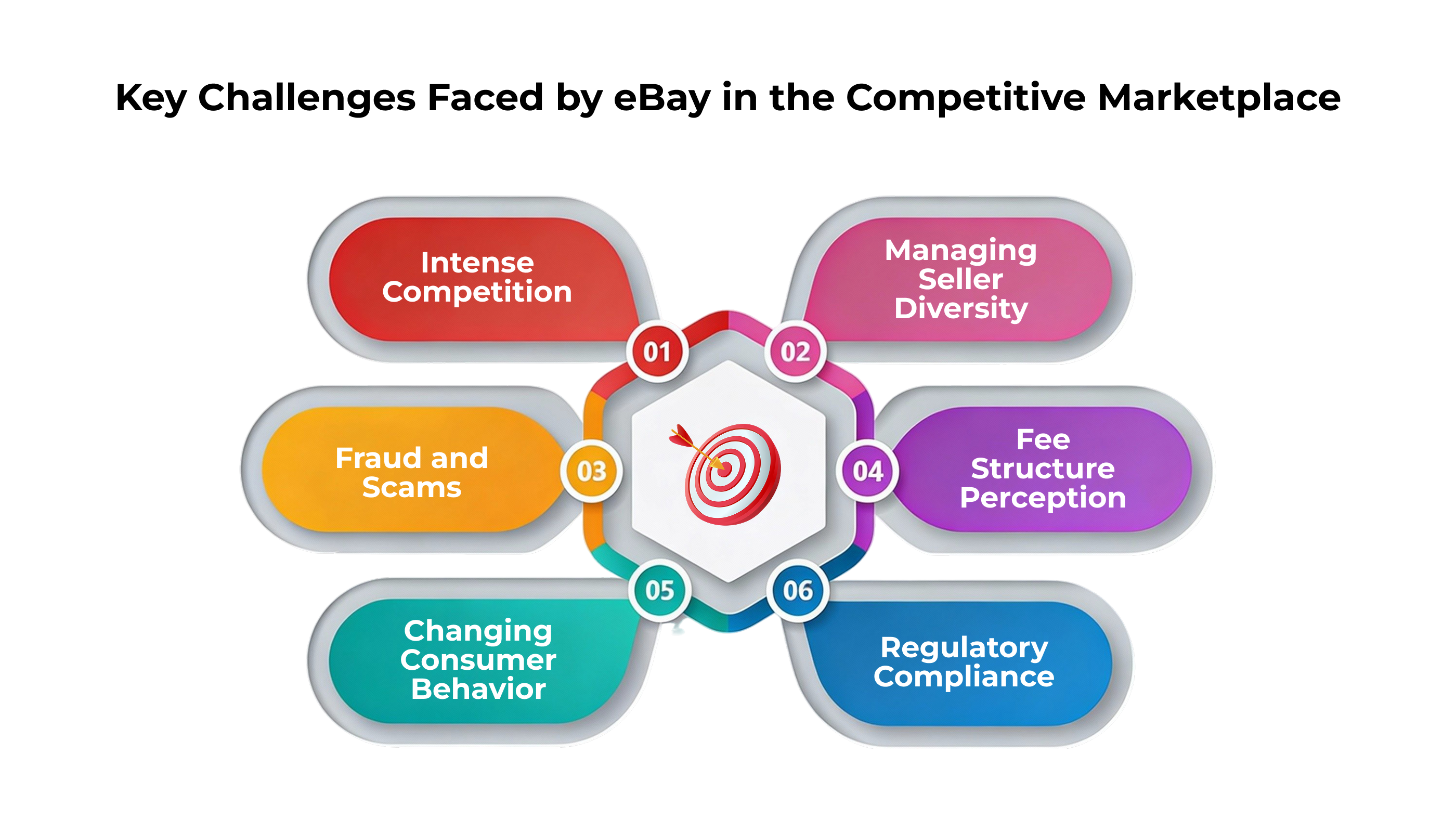
1. Intense Competition
eBay competes with major players like Amazon, Etsy, and newer marketplaces that continuously innovate and attract sellers and buyers. Staying relevant and differentiating itself in such a crowded space is a constant challenge.
2. Fraud and Scams
With millions of transactions happening daily, eBay must constantly combat fraudulent listings, counterfeit products, and scams. Ensuring buyer and seller trust requires sophisticated monitoring and quick dispute resolution.
3. Changing Consumer Behavior
Shifts toward mobile shopping and social commerce mean eBay must continually upgrade its mobile app and user experience to meet evolving customer expectations.
4. Managing Seller Diversity
eBay hosts a wide range of sellers—from casual individuals to large businesses—each with different needs. Balancing these diverse requirements while maintaining consistent quality is complex.
5. Fee Structure Perception
Some sellers find eBay’s fees—especially final value and payment processing fees—high compared to competitors. This can discourage new sellers or push existing sellers to other platforms.
6. Regulatory Compliance
Operating globally means navigating different countries’ laws regarding taxes, consumer protection, and data privacy. Staying compliant without disrupting user experience is a significant operational challenge.
Common Mistakes to Avoid
Poor Product Images
Low-quality or unclear product images reduce buyer trust and make listings look unprofessional. Customers on eBay usually decide within seconds whether to click on a product or not. Using high-resolution images from multiple angles can significantly improve clicks and conversions.
Incorrect Pricing Strategy
Pricing products too high can drive customers to competitors, while pricing too low can reduce profits. Sellers should research competitor pricing, shipping costs, and market demand before setting prices. A balanced pricing strategy helps businesses remain competitive in the eBay marketplace.
Weak Product Descriptions
Short or unclear descriptions confuse buyers and reduce search visibility. Product descriptions should include important details such as size, features, condition, shipping information, and keywords naturally. Well-written descriptions improve SEO rankings and increase customer confidence.
Ignoring SEO Keywords
Many sellers fail to optimize listings with relevant search terms like “summary of ebay,” “ebay marketplace,” or product-specific keywords. Without SEO optimization, listings may not appear in search results. Using targeted keywords in titles and descriptions improves organic visibility and traffic.
Delayed Shipping
Late shipping negatively impacts customer satisfaction and seller ratings. Buyers expect fast and accurate delivery updates in 2026. Businesses that consistently ship on time are more likely to receive positive reviews and repeat customers.
Low Customer Response Time
Slow replies to customer questions can reduce trust and lead to lost sales. Quick communication helps buyers feel confident before making a purchase. Fast response times also improve seller performance metrics on eBay.
Depending Only on One Marketplace
Relying completely on a single platform like eBay can be risky for long-term business growth. Changes in marketplace policies, fees, or competition can impact sales. Businesses should also build their own ecommerce website and diversify across multiple sales channels.
Expert Tips for 2026
Optimize for Mobile Buyers
Most online shoppers now browse and purchase products using smartphones. Sellers should use mobile-friendly images, short descriptions, and easy-to-read product titles for better user experience. Mobile optimization improves engagement, conversions, and search visibility.
Use AI Pricing Tools
AI-powered pricing tools help sellers automatically adjust prices based on market trends, demand, and competitor activity. Dynamic pricing improves competitiveness and increases the chances of winning more sales. In 2026, AI-driven pricing strategies are becoming essential for ecommerce success.
Focus on Customer Reviews
Positive customer reviews build trust and improve seller credibility. Buyers are more likely to purchase from sellers with high ratings and strong feedback scores. Encouraging satisfied customers to leave reviews can improve visibility and conversion rates.
Invest in Sponsored Listings
Sponsored listings help products appear at the top of eBay search results. This paid visibility strategy increases impressions, clicks, and conversions, especially in highly competitive categories. Businesses using promoted listings often gain faster sales growth.
Expand Internationally
Cross-border ecommerce is growing rapidly, creating new opportunities for eBay sellers worldwide. Businesses can increase revenue by selling products in countries like the USA, UK, Canada, and Australia. International expansion also helps brands reach larger customer audiences in 2026.
Ready to Build Your Own Ecommerce Marketplace?
Whether you want to create an auction platform, multi-vendor marketplace, or ecommerce app like eBay, PerfectionGeeks can help you launch faster with scalable technology solutions.
Frequently Asked Questions
Quick answers related to this article from PerfectionGeeks.
1. What is the summary of eBay?
2. How does eBay make money?
3. Is eBay an ecommerce platform?
4. What type of business model does eBay use?
5. Is eBay profitable in 2026?
Conclusion
eBay’s business model is a proven marketplace framework that successfully brings together millions of buyers and sellers worldwide. By generating revenue through listing fees, final value fees, advertising, and subscriptions, eBay maintains a strong and sustainable business. Its continuous focus on trust, technology, and user experience keeps it competitive against other major platforms. For anyone looking to start or grow an eBay business, understanding how the platform works and leveraging tools like Seller Hub is vital. To navigate challenges and maximize growth, partnering with experienced professionals like PerfectionGeeks can provide the guidance and solutions needed for success.

Shrey Bhardwaj is the Director & Founder of PerfectionGeeks Technologies, bringing extensive experience in software development and digital innovation. His expertise spans mobile app development, custom software solutions, UI/UX design, and emerging technologies such as Artificial Intelligence and Blockchain. Known for delivering scalable, secure, and high-performance digital products, Shrey helps startups and enterprises achieve sustainable growth. His strategic leadership and client-centric approach empower businesses to streamline operations, enhance user experience, and maximize long-term ROI through technology-driven solutions.