
Published 14 November 2025 | Updated 8 July 2026
Technology
Custodial vs Non-Custodial Wallets: Key Differences Explained
Choosing the right crypto wallet is one of the most important steps in managing digital assets safely. Whether you are investing, trading, or simply storing cryptocurrency, the type of wallet you use determines how much control and security you have. Among the different wallet types available, custodial and non-custodial wallets are the most commonly used. Although they perform similar functions, the way they handle private keys and user control makes them very different. This blog explains custodial vs non-custodial wallets in clear and simple words so you can make an informed decision.
What Is a Custodial Wallet — Complete Guide 2026
|
- A custodial wallet is a cryptocurrency wallet where a third-party provider manages and stores the user’s private keys and digital assets.
- Custodial wallets are popular among beginners because they simplify crypto management and offer password recovery and customer support.
- Centralized crypto exchanges commonly use custodial wallets to provide seamless trading, storage, and transaction experiences.
- The biggest advantage of custodial wallets is convenience, while the main limitation is reduced user control over private keys.
- Non-custodial wallets provide complete ownership and decentralization but require users to manage their own security and recovery phrases.
- Businesses often prefer custodial wallets for easier compliance, crypto payment integration, and operational efficiency.
- Security remains a critical factor when choosing a crypto wallet solution, making trusted providers and strong cybersecurity measures essential.
- Blockchain adoption, Web3 growth, and increasing cryptocurrency usage are driving rapid expansion in the crypto wallet industry.
- Modern custodial wallet solutions now include features like multi-device access, staking, portfolio management, and integrated trading services.
- Choosing between custodial and non-custodial wallets depends on user experience, security preferences, technical expertise, and investment goals.
- Companies investing in blockchain development and crypto wallet infrastructure are positioned to benefit from the growing digital asset economy.
- As cryptocurrency adoption continues to rise, secure and scalable wallet solutions will play a major role in the future of digital finance.
How Does a Custodial Wallet Work?
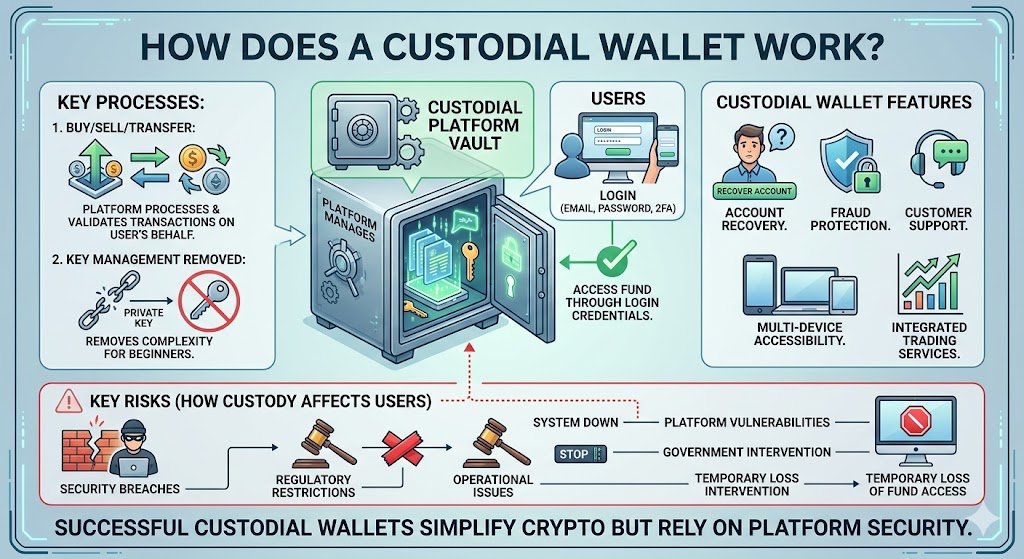
A custodial wallet works by allowing a third-party platform, such as a cryptocurrency exchange or wallet provider, to manage and store the private keys associated with a user’s crypto assets. Instead of directly controlling their wallet credentials, users access their funds through login credentials such as email addresses, passwords, and two-factor authentication systems.
When users buy, sell, or transfer cryptocurrencies using a custodial wallet, the platform processes and validates transactions on their behalf. This simplified approach removes the complexity of private key management, making custodial wallets ideal for beginners entering the cryptocurrency market.
Most custodial wallet providers also offer additional features such as account recovery, fraud protection, customer support, multi-device accessibility, and integrated trading services. Popular cryptocurrency exchanges often use custodial wallet systems to streamline crypto trading and asset management for millions of users globally.
However, because the wallet provider controls the private keys, users rely heavily on the platform’s security infrastructure. If the provider experiences security breaches, regulatory restrictions, or operational issues, users may temporarily lose access to their funds.
Benefits of Using a Custodial Wallet
Custodial wallets offer several advantages for cryptocurrency users, especially beginners and businesses entering the blockchain ecosystem. One of the biggest benefits is ease of use. Since private keys are managed by the wallet provider, users do not need advanced technical knowledge to store, transfer, or trade digital assets securely.
Another major advantage is account recovery support. Unlike non-custodial wallets, where losing a private key can permanently lock users out of their funds, custodial wallets typically allow password recovery and identity verification processes. This makes them more user-friendly and accessible for mainstream adoption.
Custodial wallets also provide enhanced convenience through integrated cryptocurrency trading, staking, portfolio management, and fiat payment services. Many centralized exchanges combine custodial wallet functionality with advanced crypto investment tools, enabling users to manage multiple digital assets from a single platform.
Security infrastructure is another important benefit. Established custodial wallet providers invest heavily in cybersecurity systems, cold storage solutions, encryption technologies, and fraud monitoring systems to protect customer assets.
For businesses, custodial wallets simplify cryptocurrency payment processing, digital asset management, and blockchain-based financial operations. Enterprises integrating crypto payment gateways often prefer custodial wallet systems because of compliance support and operational simplicity.
Building a Crypto Wallet or Blockchain Platform?PerfectionGeeks helps startups and enterprises build secure blockchain solutions including:
With 200+ successful digital solutions delivered since 2014, we help businesses launch scalable and secure blockchain applications. Get a Free Consultation Today → |
What is Blockchain Wallet?
Before comparing the two wallet types, it is important to understand what a blockchain wallet or digital wallet actually is. A crypto wallet does not store your coins the same way a traditional wallet stores money. Instead, it holds your private keys, which act like a password that gives you access to your cryptocurrency on the blockchain.
If you have the private keys, you control the crypto. If someone else holds them, they control it. This leads to the key difference between custodial and non-custodial wallets.
What Is a Custodial Wallet?
A custodial wallet is a type of wallet where a third-party service provider stores and manages your private keys on your behalf. If you want an easy explanation for what is a custodial wallet, think of it like a bank. Your money is in your account, but the bank controls and protects it for you. Many exchanges and wallet companies offer a custodial wallet crypto system to make the process simple for beginners. Since users do not have to manage private keys themselves, custodial wallets feel more convenient and less technical.
Key features of a custodial crypto wallet include:
- A company or exchange holds your private keys
- Easy to recover access through email or phone verification
- Simple interface suitable for new users
- You must trust the provider to keep your assets safe
Some companies provide advanced security and smooth performance, making them the Best custodial wallet options for everyday users.
What Is a Non-Custodial Wallet?
A non-custodial wallet gives full control and ownership to the user. If someone asks what is a non custodial wallet, the simplest answer is: a wallet where you hold your private keys, and only you can access your cryptocurrency. If you want to understand the non custodial wallet meaning, it refers to a wallet that does not rely on a third party for storage or control. Instead, you manage your seed phrase (a series of words used to recover your wallet). This level of control increases security but also increases responsibility.
Key features of non-custodial wallets include:
- You have full control of your private keys
- Higher security since no third party can access your funds
- No dependence on an exchange or company
- Recovery depends on your seed phrase
Experienced users often look for the best non custodial wallet that supports multiple cryptocurrencies, offers strong encryption, and provides a user-friendly experience.
Which Wallet Type Should You Choose?
There is no single correct choice because both wallet types have benefits depending on your needs.
A custodial wallet is better for you if:
- You are a beginner
- You prefer easy recovery options
- You trade frequently on exchanges
- You want customer support
A non-custodial wallet is better for you if:
- You want full independence and ownership
- You focus on long-term holding
- You value security above convenience
- You can manage your seed phrase responsibly
Some users even use both wallet types—one for trading and one for long-term storage.
How PerfectionGeeks Helps With Wallet Development
Businesses looking to build secure wallet solutions can rely on PerfectionGeeks for blockchain wallet development. Their team has strong experience in developing both custodial and non-custodial wallets with advanced security features, a smooth user interface, and multi-currency compatibility. Whether you want a beginner-friendly custodial wallet or a highly secure non-custodial solution, PerfectionGeeks provides customized development that meets global standards.
Their expertise helps companies launch reliable digital wallet systems that protect user assets and support seamless transactions.
Custodial Wallet vs Non-Custodial Wallet
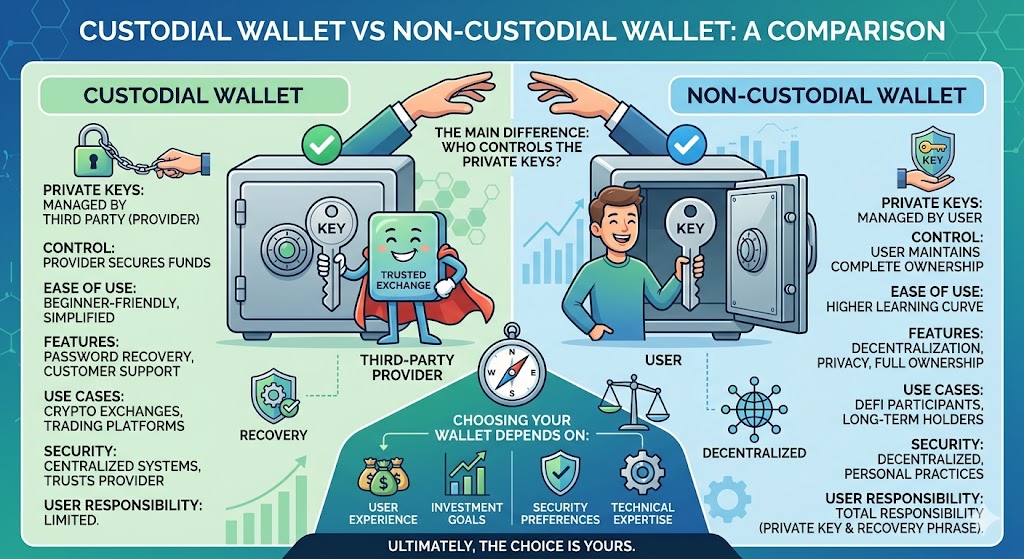
The main difference between custodial and non-custodial wallets lies in who controls the private keys. In custodial wallets, a third-party provider manages the private keys and secures the user’s funds. In non-custodial wallets, users maintain complete ownership and control over their private keys and cryptocurrency assets.
Custodial wallets are generally easier for beginners because they offer password recovery, customer support, and simplified user experiences. They are commonly used by crypto exchanges, trading platforms, and investors seeking convenience.
Non-custodial wallets, on the other hand, prioritize decentralization, privacy, and full asset ownership. Users have total control over their cryptocurrencies but are also fully responsible for securing their private keys and recovery phrases.
Security preferences also differ between the two wallet types. Custodial wallets rely on centralized security systems managed by the provider, while non-custodial wallets reduce dependency on third parties but require stronger personal security practices.
Businesses and enterprises often choose custodial wallets for operational simplicity, while experienced crypto users and DeFi participants may prefer non-custodial wallets for greater financial independence.
Choosing between custodial and non-custodial wallets ultimately depends on user experience, investment goals, security preferences, and technical expertise.
Cryptocurrency Wallet Industry Statistics
The global cryptocurrency wallet market is experiencing rapid growth as blockchain adoption increases across industries. Businesses, investors, and consumers are increasingly using digital wallets for cryptocurrency trading, payments, and decentralized finance applications.
Key Industry Insights
- Millions of users worldwide now rely on custodial wallets for cryptocurrency trading and asset management.
- Centralized crypto exchanges remain one of the largest providers of custodial wallet services.
- The cryptocurrency wallet market is expected to grow significantly as Web3 and blockchain technologies expand.
- Security, ease of use, and recovery support are among the top reasons beginners choose custodial wallets.
Businesses integrating crypto payments increasingly adopt custodial wallet infrastructure for compliance and scalability.
Why This Matters
As cryptocurrency adoption grows, custodial wallets continue to play a major role in simplifying blockchain accessibility for mainstream users. Companies investing in secure crypto wallet development and blockchain infrastructure are expected to benefit from the growing digital asset economy.
Expert Insight
“Custodial wallets are helping accelerate mainstream cryptocurrency adoption by simplifying digital asset management for businesses and everyday users. As blockchain technology evolves, security, compliance, and user experience will remain critical factors shaping the future of crypto wallet solutions.”
— PerfectionGeeks Blockchain Development Team
Frequently Asked Questions
Quick answers related to this article from PerfectionGeeks.
1. What is a custodial wallet?
2. Is a custodial wallet safe?
3. What is the difference between custodial and non-custodial wallets?
4. Why do beginners use custodial wallets?
5. Can businesses use custodial wallets?
Conclusion
Understanding the differences between custodial and non-custodial wallets is important for managing cryptocurrency safely. Custodial wallets provide convenience and easy account recovery, while non-custodial wallets offer full control and stronger security. Your choice depends on how much responsibility you want and how you plan to use your crypto. With the right wallet and the right guidance, digital asset management becomes safe, simple, and efficient.

Shrey Bhardwaj is the Director & Founder of PerfectionGeeks Technologies, bringing extensive experience in software development and digital innovation. His expertise spans mobile app development, custom software solutions, UI/UX design, and emerging technologies such as Artificial Intelligence and Blockchain. Known for delivering scalable, secure, and high-performance digital products, Shrey helps startups and enterprises achieve sustainable growth. His strategic leadership and client-centric approach empower businesses to streamline operations, enhance user experience, and maximize long-term ROI through technology-driven solutions.


