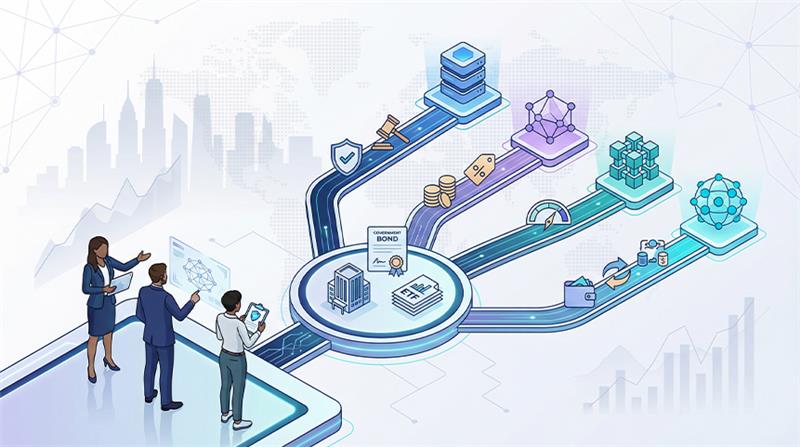
Published 29 December 2025 | Updated 15 January 2026
Blockchain
8 Asset Tokenization Blockchain Platforms Compared for 2026 (Pros, Costs, Compliance)
Real-world asset (RWA) tokenization isn’t a lab experiment anymore. By June 26, 2025, tokens tied to Treasuries, funds, property, and other regulated instruments on public chains were worth US $24 billion—a 380 percent jump in just three years (CoinDesk).That surge has banks, asset managers, and fintech teams racing to pick the right blockchain rail for 2026 launches, even though every provider touts “compliance,” “low fees,” and “institutional-grade” speed. This guide cuts through the marketing haze. We’ll compare Polymesh, Securitize, Tokeny, and Hedera against five weighted criteria so you can move from curiosity to a confident pilot.
Why choosing a tokenization platform is tougher than it looks
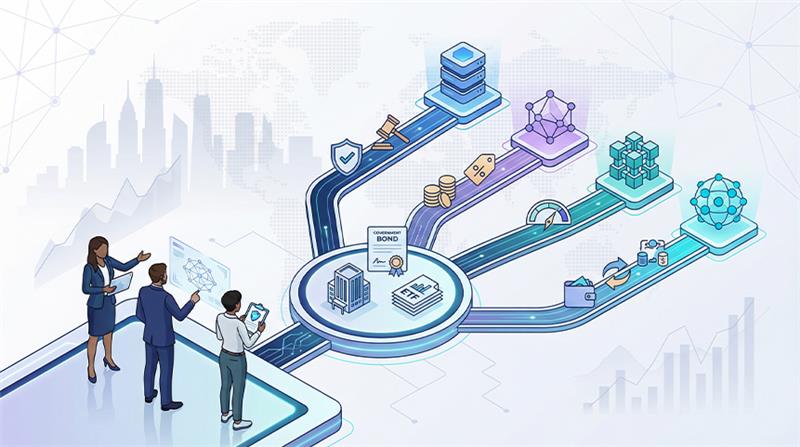
Choosing the right blockchain rail for real-world asset tokenization means balancing regulation, fees, speed and ecosystem reach.
Vendors love to promise three superpowers: airtight compliance, razor-thin fees, and unlimited throughput, yet the fine print tells a different story.
Regulation is fragmented. The U.S. Securities and Exchange Commission requires transfer-agent records and broker-dealer oversight under Rule 17Ad-7 of the Exchange Act (sec.gov), while the EU’s DLT Pilot Regime lets operators request targeted exemptions and mandates real-time reporting (eur-lex.europa.eu). A stack tuned for one jurisdiction can misfire the moment an issuer markets tokens abroad.
Costs hide in unexpected line items. A network that charges fractions of a cent in gas might still add a 0.5–2.5 percent annual assets-under-management fee or a six-figure licensing bill (us.fitgap.com). Another platform waives “percentage fees,” yet shifts legal opinions and KYC integrations onto the issuer. Unless you trace every expense—from token-creation paperwork to year-end cap-table updates—comparisons collapse.
Performance numbers lack context. Marketing decks flaunt “10 000 TPS,” but rarely clarify whether that figure covers simple transfers or complex smart-contract calls during peak load. Some ledgers sacrifice decentralization for raw speed; others lock in deterministic finality at single-digit TPS.
Ecosystem reach is uneven. A compliance-centric chain may enforce on-chain KYC by default yet struggle with popular wallets or DeFi pools. Public Layer-1s boast large developer networks, but you may have to bolt on your own identity modules to keep regulators happy.
Surface-level checklists blur these nuances. That’s why the next sections rate Polymesh, Securitize, Tokeny, and Hedera against five weighted factors: regulatory control, cost clarity, scalability, ecosystem reach, and developer security, so you can match each rail to your real-world constraints.
How we evaluated each platform
We scored each platform on five factors that shape real-world rollouts, then weighted the results so trade-offs stay clear.
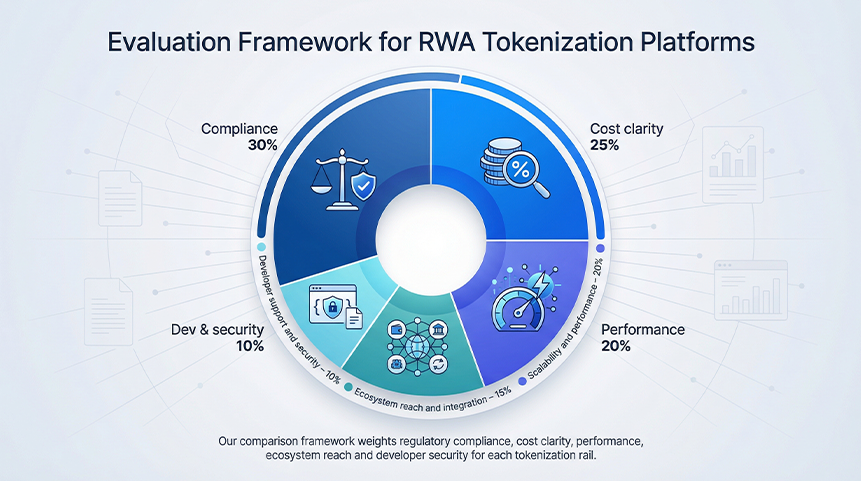
Regulatory compliance – 30 percent. If a chain can’t enforce KYC, transfer limits, or jurisdiction blocks on-chain, throughput claims don’t matter. This weight mirrors the Investment Management Compliance Testing Survey, which found 57 percent of firms rank compliance as their top digital-asset concern (businesswire.com).
- Cost and fee clarity – 25 percent. We look past sub-cent gas quotes to setup paperwork, cap-table servicing, and hidden commissions that chip away at yield.
- Scalability and performance – 20 percent. Institutional desks need predictable finality whether they clear 10 or 10 000 trades per second.
- Ecosystem reach and integration – 15 percent. A token is liquid only when wallets, custodians, and exchanges already support its rail.
- Developer support and security – 10 percent. Rich SDKs, audited code, and clear docs shorten projects and calm risk teams.
We apply these weights uniformly and double-check vendor claims against case studies and primary documents.
Polymesh’s published identity and compliance documentation, for example, shows how each asset can carry its own on-chain rule set tied to investor claims like jurisdiction, KYC status, accreditation, or lockups, and how transfers that violate those rules are rejected automatically at settlement.
Using that level of detail as a benchmark helps you tell the difference between rails that enforce regulation in code and those that lean on off-chain spreadsheets, even when the marketing language looks identical.
Your decision-path cheat sheet
Think of four signposts, each tied to the single constraint that often decides a boardroom vote. Match your situation to a sign, and the right rail comes into focus.
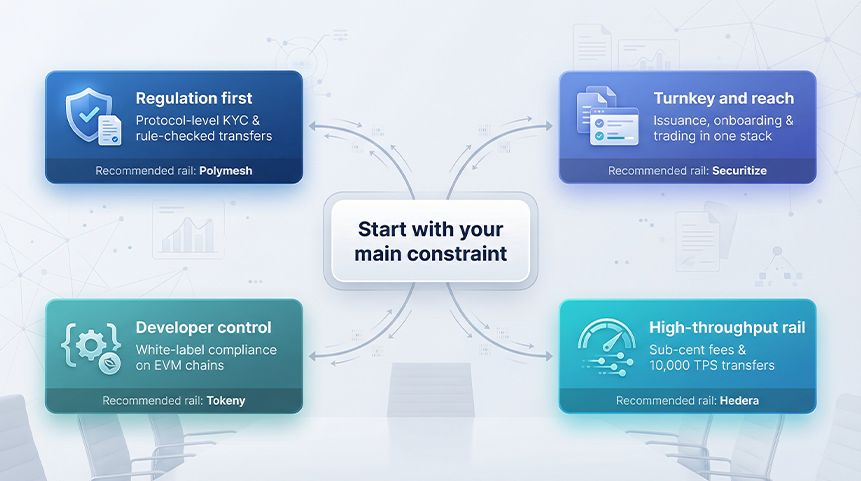
Regulation first. Need broker-dealer licensing, transfer-agent records, and zero tolerance for anonymous wallets? Choose Polymesh for protocol-level KYC and rule-checked transfers.
- Turnkey and reach. Want issuance, investor onboarding, and secondary trading in one dashboard? Securitize provides the full stack and a pre-verified investor base.
- Developer control. Prefer open APIs and full ownership of the tech stack? Tokeny lets your team drop ERC-3643 compliance into any EVM chain.
- High-throughput rail. Prioritize predictable sub-cent fees and 10 000-TPS token transfers? Hedera meets that need, with council-governed infrastructure and published transfer limits of 10 000 TPS for token moves.
In the next sections we break down each destination with hard numbers, live deployments, and real cost models so you can check the fit.
Polymesh: compliance baked into the base layer
Polymesh starts where most general-purpose chains stop: every wallet must pass Customer Due Diligence before it can hold a security token. The identity check lives in the protocol, so when an issuer adds a rule such as “only accredited French investors before June” the chain enforces it at settlement, according to Polymesh developer documentation.
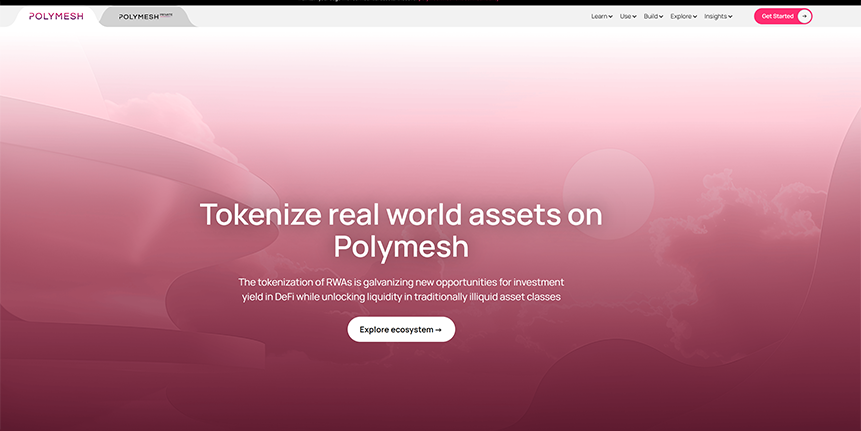
Polymesh provides a dedicated real-world assets platform for tokenizing regulated equity, debt and other instruments.
That design pleases regulators because unverified wallets simply cannot trade, and Polymesh applies the same rule-based guardrails to equity, debt, real estate, and other assets—as its overview of RWA's with Polymesh illustrates. The flip side is extra friction: investors finish KYC up front, and anonymous DeFi wallets stay outside the gate.
Speed and cost. Finalized blocks land roughly every six seconds, and recent Subscan data shows a basic transfer fee of 0.07 POLYX (about US $0.01 at a 15-cent POLYX price). No gas-price spikes. Smart-contract support arrived in 2023 via Substrate, letting developers write Rust logic without losing compliance guarantees.
Pricing. The network never taxes asset value; you only pay transaction fees. Commercial tools from Polymath, such as TokenStudio and corporate-action modules, follow project-based pricing, though issuers can build in-house instead.
Who picks Polymesh? Stock exchanges, broker-dealers, and real-estate funds that open each meeting with “are we 100 percent compliant?” If you need protocol-level identity, lock-ups, and audit trails, Polymesh removes a pile of legal overhead. If you prioritize DeFi liquidity or retail airdrops, the permissioned model may feel too tight.
Bottom line: Polymesh turns regulatory pressure into native features, which makes the trade-off worthwhile when compliance risk eclipses everything else.
Securitize: end-to-end issuance with regulatory licenses
Securitize bakes compliance into its corporate charter rather than its code. The firm is an SEC-registered transfer agent, a FINRA-member broker-dealer, and it operates the Securitize Markets alternative trading system (2025 CoinDesk report). Those licenses let you create, manage, and trade digital securities without lining up outside providers.
.png)
Securitize combines SEC and FINRA licenses with an end-to-end platform for issuing and trading tokenized securities.
How the flow works. Upload your offering documents, invite investors, and Securitize ID walks each buyer through KYC, AML, and accreditation. Once cleared, a smart contract (usually on Polygon) mints the tokens, and the cap table syncs automatically.
Cost model. Issuers pay an upfront package fee (typically mid-five figures for legal templates, token deployment, and onboarding), plus annual servicing and standard trading commissions. The premium replaces separate invoices from lawyers, transfer agents, and ATS partners.
Scale advantage. According to a 2023 press release from PR Newswire, Securitize reports more than 1.2 million verified investor accounts and 3 000 connected businesses. Major issuers such as BlackRock, Hamilton Lane, and KKR already have fund shares on chain, giving new deals instant distribution.
Trade-offs. You work inside Securitize’s closed platform, and custom features follow its product timeline. Experimental smart-contract logic or DeFi integrations may wait in line. For large raises that need ironclad compliance and ready liquidity, though, the single-login model saves months of coordination.
Tokeny: compliance middleware for issuers who want control
Tokeny is a white-label SaaS stack, complete with dashboards, APIs, and the open-source ERC-3643 smart-contract standard. It lets issuers mint permissioned tokens on any EVM chain. Most clients choose Polygon, where a basic transfer costs about US $0.002 in gas, according to the Polygon Gas Tracker..png)
Tokeny’s onchain finance platform lets institutions issue, manage and distribute compliant tokenized securities at scale.
Compliance inside the token. Every holder has an ONCHAINID smart contract that stores KYC attributes; each transfer checks those attributes before settling, so issuers skip external whitelists and manual spreadsheets. Rules such as jurisdictions, lock-ups, or investor tiers update in a web console and take effect on-chain within minutes.
Pricing. Tokeny sells annual licenses instead of asset-based commissions. A 2023 customer survey indicates that mid-size banks pay low-six-figure subscriptions for unlimited issuances, which keeps costs predictable compared with per-deal concierge fees.
Adoption. Europe’s regulatory sandboxes favor flexible middleware: Tokeny added 45 new financial-institution clients in 2023 and now counts Apex Group, Euronext’s 21X, and several private banks among its partners.
Choose Tokeny if you have developer resources, want your own branding and custody stack, and view tokenization as core infrastructure rather than a one-off fundraise.
Hedera Hashgraph: high-speed rails with built-in KYC flags
Hedera stands apart in this quartet. It runs a Hashgraph DAG rather than a blockchain and is governed by a rotating council of global blue-chip companies. That setup lets the network process up to 10 000 token-transfer TPS with deterministic finality in 3–5 seconds, while transfers cost about US $0.001 in HBAR, according to Hedera documentation.
Hedera’s Asset Tokenization Studio provides an open source toolkit to configure, issue and manage regulated tokenized assets on-chain.
Compliance in the token service. Issuers can flag accounts as KYC-approved, freeze non-compliant wallets, or hard-code Reg D lock-ups, all without writing Solidity. The open-source Asset Tokenization Studio wraps those controls in a no-code interface and ships templates for U.S. Reg D and Reg S offerings, cutting launch time from months to days.
When speed and cost matter. Sub-cent fees and high throughput suit money-market funds or short-duration bonds that trade in small increments all day. Hedera’s blog notes that RedSwan CRE is migrating a US $5 billion real-estate portfolio to Hedera, and the asset-manager abrdn is piloting tokenized money-market funds on the same rails.
Trade-offs. MetaMask and mainstream DeFi protocols don’t speak Hashgraph natively, so projects rely on Hedera-specific SDKs or bridges. Governance is curated, with council nodes validating transactions, which some crypto-native users view as less decentralized.
Pick Hedera when transaction speed, predictable fees, and a neutral, enterprise-run governance model outweigh the need for maximal openness.
Side-by-side snapshot
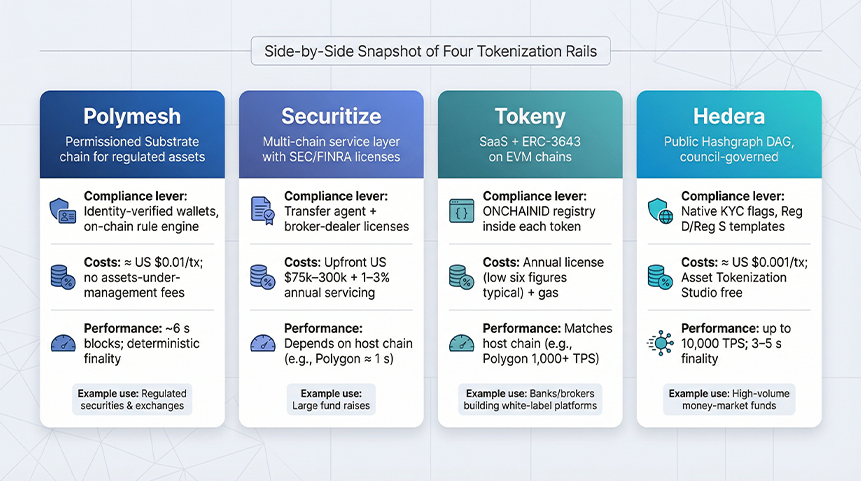
| Platform | Network type | Compliance lever | Typical issuer costs* | Performance** | Notable adoption |
| Polymesh | Permissioned Substrate chain | Identity-verified wallets, on-chain rule engine | Network fees ≈ US $0.01/tx; optional Polymath tools (project-based) | ~6 s blocks; deterministic finality | 200+ security tokens; CA $51.9 million CRE deal (Ocree) |
| Securitize | Multi-chain service layer (Polygon, Ethereum) | SEC-registered transfer agent & broker-dealer | Upfront US $75 k–300 k; 1–3 percent annual servicing | Depends on host chain (Polygon ≈ 1 s after Bhilai upgrade) | BlackRock & Hamilton Lane fund shares |
| Tokeny | SaaS + ERC-3643 on EVM chains | ONCHAINID registry in each token | Annual license (low six figures typical) + gas | Matches host chain (Polygon 1 000+ TPS post-upgrade) | Euronext-backed 21X; 45+ financial institutions |
| Hedera | Public Hashgraph DAG, council-governed | Native KYC flags, Reg D/Reg S templates | Fixed ≈ US $0.001/tx; Asset Studio free | ≤ 10 000 TPS transfers; 3–5 s finality | RedSwan CRE US $5 billion migration; abrdn money-market fund pilot |
*Costs exclude legal structuring and custody.
**Latest published main-net benchmarks as of December 2025.
Key trade-offs:
- Compliance location: baked into the chain (Polymesh, Hedera), corporate licenses (Securitize), or token standard (Tokeny).
- Cost visibility: predictable network fees vs. bundled concierge pricing.
- Ecosystem gravity: broad public-chain reach (Securitize, Tokeny, Hedera) vs. a focused but narrower ledger (Polymesh).
If a cell you care about is blank (secondary-trading fees, smart-contract audits, and so on), note it before you sign. Unexpected line items, not headline TPS, sink budgets.
How to pick the right rail for your deal
- Start with regulation. If your legal team needs “identity on every wallet,” choose Polymesh. Protocol-level KYC removes edge-case headaches and lets engineers focus on product.
- Need a turnkey launch. A fund that must go live next quarter benefits from Securitize. Its SEC/FINRA licenses and 1.2 million pre-verified investors shave months off capital-raising timelines.
- Want full control. Banks or exchanges that treat tokenization as core IP pick Tokeny. You keep your branding, custody, and fee model while ERC-3643 enforces rules inside each token.
- Chasing scale economics. Sub-cent fees and up to 10 000-TPS token transfers make Hedera ideal for high-volume assets such as money-market funds; every basis point saved flows to yield.
Due-diligence questions to close before you sign
Bring these questions to every vendor call; clear answers uncover hidden costs and technical limits while changes are still affordable.
- Performance under load. Request the latest stress-test report that shows real throughput, latency, and 99th-percentile settlement times, including complex smart-contract calls.
- Fee escalation paths. Ask what triggers higher rates, such as asset-value tiers, investor-count bands, or legal-opinion renewals, and model a five-year worst-case spend.
- Secondary-market access. List the exchanges or ATS venues that already trade the platform’s tokens, together with listing criteria and fees.
- Custody workflow. Confirm which qualified custodians connect natively; filling gaps after launch slows settlement and raises risk.
- Exit flexibility. Ask how to export cap-table records and identity proofs, and whether tokens can bridge to another network without rewriting compliance rules.
What’s next: 2026–2027 outlook
Regulation moves from sandbox to production. The EU’s DLT Pilot Regime runs for three years and requires the Commission to decide by March 24, 2026, whether to make the framework permanent (eur-lex.europa.eu). In the United States, SEC staff issued a December 17, 2025 statement on broker-dealer custody of crypto-asset securities and said it’s drafting a rule that would let broker-dealers hold tokenized securities directly (sec.gov). Together, these steps could open fully regulated secondary markets.
.png)
From new EU and SEC rules to DeFi–TradFi convergence and identity-preserving bridges, tokenization is moving from pilots to core market infrastructure by 2027.
DeFi meets TradFi. Tokenized U.S. Treasuries already exceed US $5 billion in market value (coindesk.com). The next wave is collateralized lending against fund tokens and revenue-share notes in KYC-gated liquidity pools, giving banks a compliant way to monetize idle assets.
Consolidation ahead. Service-heavy platforms face margin pressure as open-source compliance stacks mature. Expect at least one merger between a licensed platform and a high-throughput chain, pairing regulatory coverage with sub-cent fees.
Interoperability turns critical. Enterprises will need bridges that carry identity metadata so a KYC-approved wallet stays approved on the destination chain. Standards groups are already drafting ERC-3643 extensions and ISO-style schemas to make portable compliance proofs routine.
Bottom line: tokenization’s early adopter phase is ending. Over the next 18 months, permanent rules, permissioned DeFi, and cross-chain identity will separate pilot favorites from future market backbones. Pick partners that align with those trends now, and you’ll avoid a last-minute scramble to re-platform later.
Frequently Asked Questions
Quick answers related to this article from PerfectionGeeks.
1. What is asset tokenization and why is it important in 2026?
2. Which factors should be considered when comparing asset tokenization platforms?
3. Are asset tokenization platforms compliant with global regulations?
Conclusion
Tokenization has moved from proof-of-concept to core market infrastructure. The question is no longer whether to tokenize, but which rail delivers compliance, cost control, and scale for your use case.
- Polymesh: best when identity-first compliance is non-negotiable.
- Securitize: the fastest route for large raises that need licenses, investors, and liquidity in one dashboard.
- Tokeny: ideal for tech-savvy issuers that want a white-label engine with granular rule control.
- Hedera: fits high-volume instruments that benefit from sub-cent fees and 10 000-TPS capacity.
No single platform covers every need. Map your regulatory perimeter, cost tolerance, and performance ceiling, then run a sandbox pilot before committing assets. An hour spent clarifying fees, custody links, and exit options today can save months of remediation later. That planning puts you in position to ride the 2026 tokenization wave instead of chasing it.

Shrey Bhardwaj is the Director & Founder of PerfectionGeeks Technologies, bringing extensive experience in software development and digital innovation. His expertise spans mobile app development, custom software solutions, UI/UX design, and emerging technologies such as Artificial Intelligence and Blockchain. Known for delivering scalable, secure, and high-performance digital products, Shrey helps startups and enterprises achieve sustainable growth. His strategic leadership and client-centric approach empower businesses to streamline operations, enhance user experience, and maximize long-term ROI through technology-driven solutions.